Blog
Steel Casting vs. Ductile Iron for Trailer Suspension Casting Systems
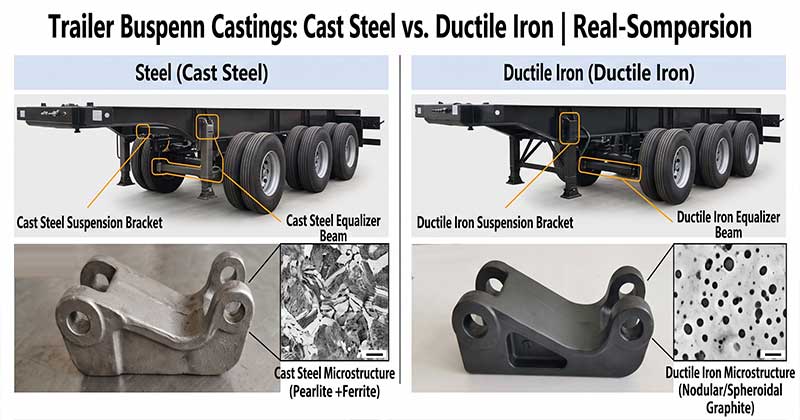
The material selection for a trailer suspension casting often comes down to a critical showdown: Steel Casting (Cast Steel) versus Ductile Iron (Nodular Iron).Both materials offer distinct advantages, but understanding their behavior in terms of tensile strength, yield strength, and shock absorption is vital.
This guide analyzes the metallurgical battle between the two, backed by authoritative industry data, to help your engineering team make the optimal choice for heavy-duty trailer applications.
1. The Crucial Role of a Trailer Suspension Casting
A trailer suspension casting serves as the anchor point that connects the axle to the trailer chassis. In off-road, construction, or heavily rutted highway environments, these components face severe multiaxial stress.
Tensile Stress: Stretching forces attempting to pull the component apart.
Yield Stress: The point at which the material permanently bends or deforms (plastic deformation) rather than returning to its original shape.
Vibration and Fatigue: Constant micro-impacts that can lead to microscopic cracks over time.
Selecting the right material requires balancing raw strength with the ability to dampen these destructive vibrations.
2. Understanding the Contenders
2.1. Steel Casting (Cast Steel)
Cast steel is renowned for its exceptional toughness and impact resistance. Because its carbon content is relatively low compared to cast iron, it does not contain the graphite flakes or nodules that break up the steel matrix. This gives it a high degree of ductility and ultimate tensile strength, making it ideal for components that might be subjected to sudden, violent impacts (like a heavy trailer hitting a deep pothole at high speeds).
2.2. Ductile Iron (Nodular Iron)
Ductile iron revolutionized the casting industry by introducing magnesium into the molten iron before casting. This process forces the graphite to form into spherical nodules rather than brittle flakes. The result is a material that retains the excellent machinability and vibration-damping characteristics of traditional cast iron, but with a yield strength and ductility that rivals or even exceeds certain grades of cast steel.
3. Authoritative Mechanical Data Comparison
To make an objective engineering decision, we must look at the standardized mechanical properties. Below is a comparison based on widely adopted standards from ASTM International (American Society for Testing and Materials), specifically comparing common grades used in heavy equipment manufacturing: ASTM A27 (Cast Steel) and ASTM A536 (Ductile Iron).
Table 1: Standardized Mechanical
| Material Grade | Cast Steel (Grade 65-35) | Ductile Iron (Grade 65-45-12) |
| ASTM Standard | ASTM A27 | ASTM A536 |
| Min. Tensile Strength (MPa / psi) | 450 MPa (65,000 psi) | 448 MPa (65,000 psi) |
| Min. Yield Strength (MPa / psi) | 240 MPa (35,000 psi) | 310 MPa (45,000 psi) |
| Elongation in 2" (%) | 0.24 | 0.12 |
| Brinell Hardness (HB) | 131 - 170 | 156 - 217 |
Data Insight: While both materials offer nearly identical ultimate Tensile Strength, Ductile Iron (65-45-12) boasts a nearly 30% higher Yield Strength than standard cast steel. This means ductile iron can endure significantly higher stress before permanently deforming, a critical factor in heavy payload suspension brackets.
4. Performance in Harsh Road Conditions
Raw numbers only tell part of the story. How do these materials perform when subjected to real-world, harsh road conditions?
4.1. Shock Absorption and Vibration Damping
According to materials science data published by the Society of Automotive Engineers (SAE), the spherical graphite nodules in ductile iron act as microscopic shock absorbers. Ductile iron has a damping capacity that is significantly higher than that of cast steel. In a heavy-duty trailer traversing corrugated dirt roads or uneven terrain, a ductile iron trailer suspension casting will absorb structural vibrations, preventing that kinetic energy from transferring directly into the chassis and causing premature metal fatigue in the welds.
4.2. Impact Toughness at Low Temperatures
If your trailers are operating in freezing environments (such as forestry logging in winter), Cast Steel holds the advantage. Steel casting maintains its high impact toughness at sub-zero temperatures, whereas ductile iron can transition to a more brittle state in extreme cold, making it susceptible to cracking upon sudden, severe impacts.
4.3. Weight-to-Strength Ratio
Modern fleet operators are constantly looking to reduce tare weight to increase payload capacity. Because of its higher yield strength and excellent castability (allowing for thinner walls and more complex geometries without defects), ductile iron allows engineers to design a lighter trailer suspension casting without sacrificing load-bearing capacity.
Table 2: Engineering Performance Evaluation Matrix
| Performance Metric | Cast Steel | Ductile Iron | Engineering Verdict for Suspensions |
| Vibration Damping | Low | Very High | Ductile Iron prevents fatigue transfer to chassis. |
| Yield Resistance | Moderate | Excellent | Ductile Iron resists permanent bending under heavy static loads. |
| Cold Weather Impact | Excellent | Moderate | Cast Steel is superior for extreme sub-zero off-road use. |
| Weldability | Excellent | Poor/Complex | Cast Steel is required if the casting must be welded to the frame. |
| Machinability & Cost | Moderate/Higher Cost | Excellent/Lower Cost | Ductile Iron reduces tooling wear and overall production costs. |
5. The Engineer's Verdict: Which Should You Choose?
Selecting the right material for your next trailer suspension casting project depends entirely on the operational environment and assembly methods of your final product.
5.1 Choose Ductile Iron (ASTM A536) if:
You are designing bolted suspension brackets for heavy payloads.
Your trailers will operate primarily on highways or rough roads where constant vibration and fatigue resistance are the primary modes of failure.
You want to optimize the strength-to-weight ratio and reduce overall manufacturing costs.
5.2 Choose Cast Steel (ASTM A27) if:
Your suspension bracket design requires it to be directly welded to the trailer chassis.
The trailer will be used in extreme off-road applications (mining, logging) where catastrophic, sudden impacts are a daily occurrence.
The equipment will regularly operate in extreme sub-zero temperatures where impact toughness is paramount.
By leveraging the high yield strength and superior damping capacity of ductile iron, or the rugged impact toughness of cast steel, our engineers can design suspension systems that keep heavy-duty trailers rolling safely, no matter how harsh the road ahead.
LihuaCasting is a premier provider of top-tier OEM casting services with over 30 years experience, which specializes in the manufacturing of high-quality precision cast components and machinery parts.Our comprehensive range of services encompasses earth moving Wear Parts, Trailer Parts, railway parts, Truck Parts, Farming Parts, excavator quick adapters, quick coupler castings, and Customized Castings.
RELATED NEWS
- How to choose the right lawn mower blades? 2026-09-23
- How to Choose Right Industrial Steel Self-Dumping Forklift Hopper? 2026-09-21
- Disc Plow vs Disc Harrow for Primary & Secondary Tillage 2026-09-18
- What Factors Affect Plough Share Service Life? 2026-09-15
- 2026 Bucket Teeth Selection Guide for Soil Rock and Mining 2026-09-11
CATEGORIES
LATEST NEWS
CONTACT US
Contact: Susanna Sun
Phone: +86 13706842897
E-mail: sue-sunwin@vip.163.com ; sophie091983@gmail.com
Whatsapp:+86 13706842897
Add: 1588 Jiangnan Road Ningbo High-tech Industry zone