Blog
Disc Harrow Guide: Adjustment, Maintenance, Troubleshooting & Working Width Selection
The disc harrow remains one of the most versatile tillage implements for seedbed preparation, residue management, and weed control on commercial farms and contracting operations. Whether you run offset, tandem, or folded hydraulic models, proper setup, regular service, and smart sizing directly cut downtime, reduce fuel use, and deliver uniform mixing across every pass.
This practical guide covers how to adjust a disc harrow for better field performance, maintain disc harrow bearings and blades, resolve frequent breakdowns, and select the right disc harrow working width to match your fleet and field conditions.
1. How to Adjust a Disc Harrow for Better Field Performance
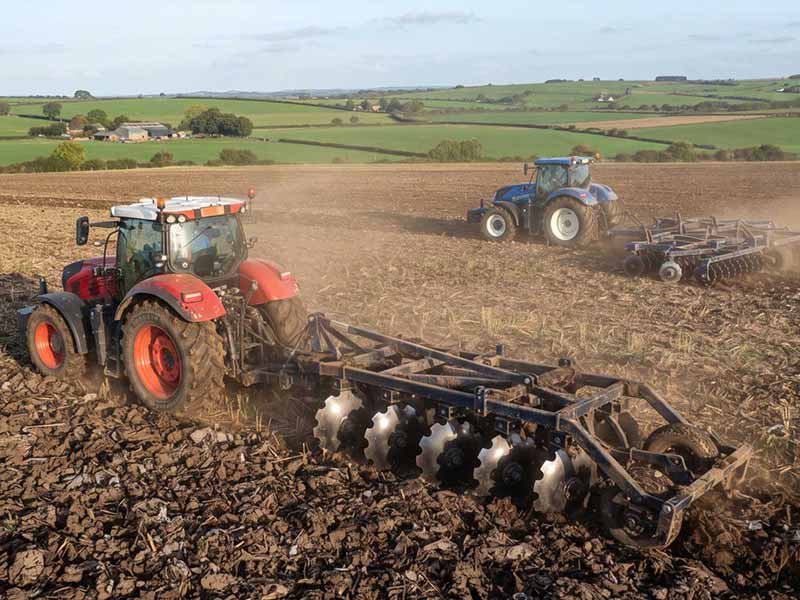
Correct adjustment starts with balancing gang angle, cutting depth, tractor hitch level, ground speed, and scraper clearance. Many operators only change depth and overlook gang angle, which is the main control for how aggressively discs slice, turn, and mix soil and straw residue.
Start on a flat test strip. Lower the disc harrow into working position and check front-to-rear gang leveling; uneven gangs create ridges, incomplete incorporation, and premature blade wear.
Increase gang angle for harder, compacted ground to boost penetration, and reduce the angle for light sandy soil to avoid over-working and clod formation.
Hitch height must keep the frame parallel to the ground, not nose-down or nose-up.
Operating speed is equally critical: too fast creates rough, inconsistent finish; too slow leaves uncut residue and wastes working time.
Scrapers stop wet soil from packing on disc faces. Set scraper tips 1/16” to 1/8” from the blade surface, without touching the steel, so they clean effectively without dragging and wearing edges prematurely. After adjustment, make one short test pass, then inspect the furrow profile before committing to full-field work.
| Soil Type | Suggested Gang Angle | Operating Speed | Primary Adjustment Goal |
|---|---|---|---|
| Heavy clay / compacted loam | 16–22° | 4–5 mph | Deep penetration, break hard clods |
| Medium loam / mixed residue | 12–16° | 5–6 mph | Uniform mixing for seedbeds |
| Sandy / light loose soil | 8–12° | 6–7 mph | Gentle tillage, prevent over-dispersal |
2. How to Maintain Disc Harrow Bearings and Blades
For disc harrow bearings, stick to a grease interval matched to operating hours and moisture exposure. Use lithium-based NLGI No.2 grease, and avoid over-greasing, which blows out seals and lets dirt and water enter the housing. Each pre-season inspection should check for side play, grinding noise, leaking seals, and loose hub bolts. Replace seals at the first sign of leakage rather than waiting for bearing seizure.
Disc blades require visual inspection for edge rounding, nicks, cracking, and uneven wear. Blades that are dull or bent cannot cut residue cleanly and pull harder on the tractor. Replace blades in matched sets on each gang to keep load balanced; mixing new and heavily worn discs creates uneven depth and side pull. Keep all arbor bolts torqued to specification, especially during the first 20 hours of new or rebuilt operation, as components settle and loosen.
| Service Item | Interval | Action Standard | Warning Sign |
|---|---|---|---|
| Bearing lubrication | 50–100 working hours | Low-pressure grease until fresh grease appears at seal | Constant rumble, wobble, hot hub |
| Blade & scraper inspection | Pre-season + every 20 hours | Check edge condition, clearance, bolt torque | Ragged cuts, residue wrapping on discs |
| Bearing seal / hub overhaul | 300 hours or annual storage | Clean housing, renew seals, test free rotation | Mud or water inside bearing housing |
3. Common Disc Harrow Problems and How to Fix Them
Even a well-maintained disc harrow develops predictable issues in variable field conditions. Most faults stem from one of four root categories: incorrect adjustment, worn parts, mismatched working width, or unsuitable operating speed. Below are the most frequent complaints and actionable fixes for farm operators and equipment managers.
Poor penetration in hard ground: Usually caused by too-small gang angle, shallow depth setting, dull blades, or insufficient tractor downforce. Increase gang angle slightly, verify blade sharpness, and confirm the hitch transfers weight correctly to the gangs.
Soil plugging between discs: Common in wet, high-clay soil or heavy straw residue. Reduce gang angle, adjust scrapers, slow forward speed, or add extra scrapers for sticky conditions.
Center ridge or uneven finish: Front and rear gangs are out of level, or gang spacing is mismatched. Re-level the frame and recheck offset alignment.
Excessive bearing noise and short service life: Over-greasing, damaged seals, dirty grease, or continuous operation in rocky soil. Replace seals, clean hubs, and follow the lubrication schedule.
Heavy side pull on tractor: Uneven blade wear, one gang set at a different angle, or improper offset setup. Match gang angles and replace worn discs as pairs.
If failures repeat after adjustment, cross-check whether your disc harrow working width exceeds your tractor’s drawbar horsepower rating. An over-sized implement will never run cleanly and accelerates wear across bearings, frame, and hitch.
4. Disc Harrow Working Width: How to Choose the Right Size
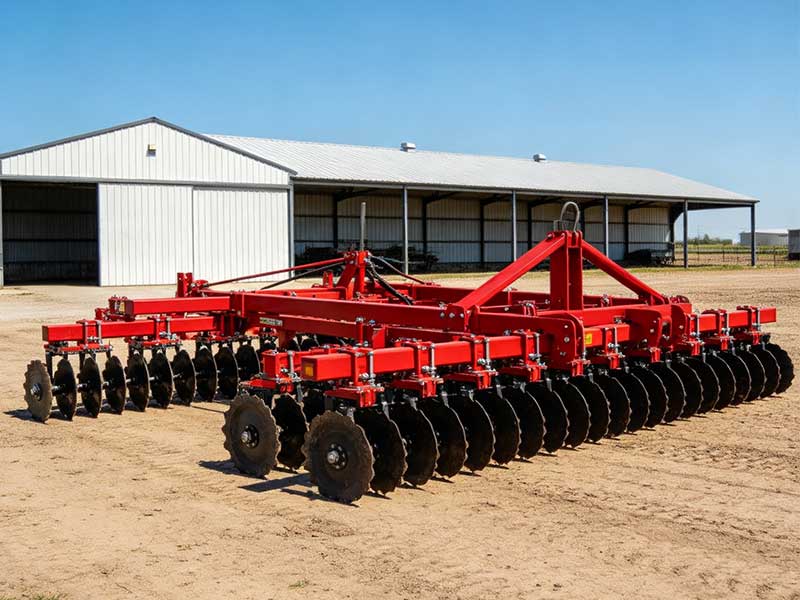
Selecting the correct disc harrow working width balances daily throughput, tractor capability, transport safety, and field geometry. Buying a wider unit than your tractor can pull is a frequent B-side mistake: it slows work, spikes fuel consumption, and shortens component life. Narrower than needed, and you lose coverage rate and profitability on large acreage.
Three core inputs drive sizing: available tractor drawbar horsepower, typical soil resistance, and road transport rules. Offset and tandem disc harrows have different power requirements; heavy-duty cast gang models demand more power than light-duty bolt-together gangs. Also consider field shape: long rectangular fields favour wider folded models, while small, irregular parcels work better with compact fixed-width units.
The table below provides a practical sizing reference for standard tillage conditions.
| Tractor Drawbar HP | Recommended Working Width | Harrow Style Fit | Typical Use Case |
|---|---|---|---|
| 40–70 HP | 6–10 ft | Light offset / single gang | Small farms, orchards, secondary tillage |
| 70–120 HP | 10–16 ft | Standard tandem disc harrow | Mixed row crops, primary seedbed prep |
| 120–180+ HP | 16–24 ft+ hydraulic fold | Heavy-duty folded tandem | Large commercial acreage, high throughput |
When comparing suppliers, confirm that stated working width is effective cutting width, not overall frame width. Also confirm transport width compliance for local road laws before ordering a large folded disc harrow.
Your disc harrow will deliver consistent returns when adjustment, maintenance, and sizing decisions work together. Always complete test runs on representative soil before full tillage, store the implement under cover to protect bearings and blade edges from corrosion, and keep torque and lubrication records for each unit in your fleet. For OEM replacement parts, custom gang assemblies, and matched disc harrow packages built for heavy farm duty, work with manufacturers that understand both field performance and long serviceability.
FAQ
Q1: How often should I grease disc harrow bearings?
A: Under normal dry field conditions, every 50–100 working hours. Wet, muddy ground requires more frequent checks and greasing.
Q2: Can I run a wider disc harrow by simply slowing the tractor down?
A: Slowing speed helps temporarily, but it does not fix an overmatched working width. Persistent overload will damage bearings, axles and frame welds over time.
Q3: What is the difference between gang angle and working width?
A: Gang angle controls cutting depth and soil turning action. Working width defines how much ground the disc harrow covers per pass, tied directly to tractor power requirements.
RELATED NEWS
- How to Overcome Tool Wear Challenges When Machining High-Hardness Iron Castings? 2026-10-23
- Low-Temperature Charpy Impact Testing for Off-Road Trailer Castings 2026-10-20
- Common Casting Defects in Trailer Towing Rings and How to Prevent Them 2026-10-15
- Ductile Iron vs. Carbon Steel Engineering Guide for Heavy-Duty Agricultural Trai 2026-10-13
- Heavy Duty Disc Harrow: How to Choose the Right Model? 2026-10-09
CATEGORIES
LATEST NEWS
CONTACT US
Contact: Susanna Sun
Phone: +86 13706842897
E-mail: sue-sunwin@vip.163.com ; sophie091983@gmail.com
Whatsapp:+86 13706842897
Add: 1588 Jiangnan Road Ningbo High-tech Industry zone