Blog
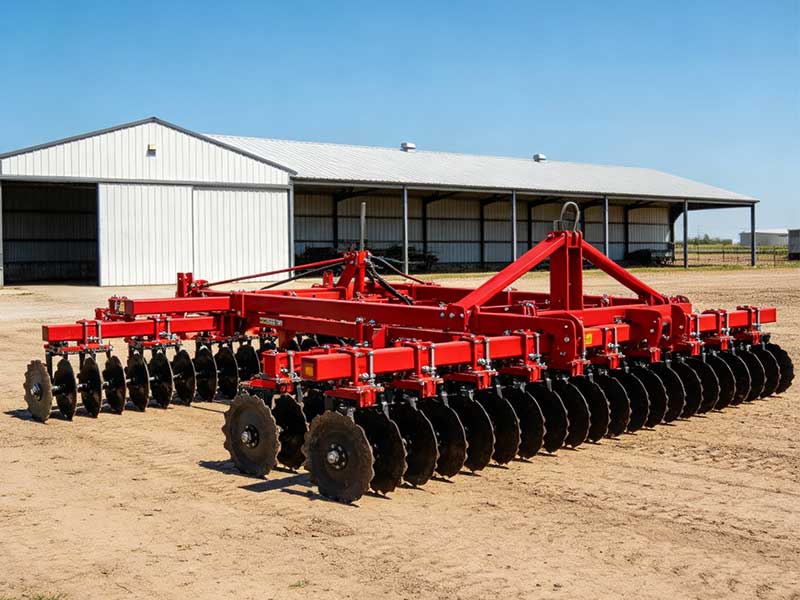
Heavy-Duty Disc Harrows vs. Light-Duty Disc Harrows
Among the most fundamental secondary tillage tools is the disc harrow. When international agricultural equipment dealers, farm owners, and landscaping professionals look to upgrade their tillage equipment, choosing the right implement can make or break a crop cycle. But navigating the options—ranging from light-duty plots to heavy-duty commercial fields, and distinguishing them from disc plows—requires a solid understanding of technical specifications and field applications.
1. Heavy-Duty vs. Light-Duty Disc Harrow: Key Differences
The primary differences between heavy-duty and light-duty disc harrows lie in their structural build, weight, disc dimensions, and the operational demands they can withstand.
| Feature | Light-Duty Disc Harrow | Heavy-Duty Disc Harrow |
| Frame & Build | Lighter-gauge steel tubing; designed for lower tractive resistance. | Reinforced structural steel frames, heavy box frames, and added ballast weight. |
| Disc Blade Size | Smaller diameters (typically 16 to 18 inches) with thinner profiles. | Larger diameters (22 to 24+ inches) with thicker gauge steel. |
| Primary Application | Secondary tillage, finishing seedbeds, mixing fertilizer, and light weed control in softer, previously tilled soils or small food plots. | Primary tillage in certain soils, breaking up virgin or packed ground, and managing heavy crop residues (e.g., dense corn stalks). |
| Tractor Compatibility | Compatible with low-to-mid horsepower compact and utility tractors. | Requires high horsepower, substantial drawbar pull, and heavy 3-point hitch capacity. |
Stocking both categories allows you to cater to different market segments—from hobby farmers and wildlife food plot managers requiring light-duty maneuverability, to commercial agricultural contractors needing high-durability, rugged performance.
2. Disc Harrow vs. Disc Plow: What’s the Difference?
A common point of confusion for equipment buyers is whether they need a disc plow or a disc harrow. While both use concave steel discs to slice through earth, they serve entirely different stages of land preparation.
Disc Plow (Primary Tillage):
Function: Built to break up uncultivated, hard, rocky, or virgin land, turning the soil completely upside down.
Design: Features fewer discs (typically 2 to 5) of significantly larger diameters, operating at deeper depths (up to 12 inches / 30 cm).
Result: Leaves rough, turned earth with buried weeds and residue.
Disc Harrow (Secondary Tillage):
Function: Designed to refine, smooth, level, and pulverize soil that has already been ploughed.
Design: Utilizes many smaller discs (ranging from 12 to 36+ arranged in gangs) working at shallower depths.
Result: Creates a fine, leveled seedbed primed for immediate planting.
Pro Tip for Dealers: These implements are complementary, not interchangeable. Commercial operations typically run a disc plow first to break hard ground, followed by a disc harrow to condition the seedbed.
3. How to Choose the Right Disc Harrow
When advising customers or selecting models for your inventory, guide them through these four core evaluation criteria:
1. Match Tractor Horsepower & Weight
An oversized or overly heavy harrow will cause excessive wheel slip, bog down the tractor, and spike fuel consumption. Always cross-reference the harrow's weight and required horsepower range with the client’s utility or compact tractor specifications.
2. Evaluate Soil Type and Conditions
Hard, dry, or heavy clay soils demand a heavier frame and notched discs, which offer an aggressive bite to shatter stubborn clods.
Lighter, sandy, or loamy soils are easily managed with lighter harrows utilizing smooth discs for a finer finish.
3. Determine Working Width
Match the width of the harrow to the field size and tractor power. Wider models maximize efficiency across expansive fields, while narrower models ensure better maneuverability around tight turns, orchards, and fencing.
4. Check Gang Adjustability
Look for models featuring adjustable gang angles. The ability to easily alter the angle of the disc gangs allows operators to control how aggressively the implement cuts into the soil depending on seasonal moisture and compaction levels.
RELATED NEWS
- How to Choose the Right Subsoiler Shank for Your Implement? 2026-10-29
- Disc Harrow Guide: Adjustment, Maintenance, Troubleshooting & Working Width Sele 2026-10-28
- How to Overcome Tool Wear Challenges When Machining High-Hardness Iron Castings? 2026-10-23
- Low-Temperature Charpy Impact Testing for Off-Road Trailer Castings 2026-10-20
- Common Casting Defects in Trailer Towing Rings and How to Prevent Them 2026-10-15
CATEGORIES
LATEST NEWS
CONTACT US
Contact: Susanna Sun
Phone: +86 13706842897
E-mail: sue-sunwin@vip.163.com ; sophie091983@gmail.com
Whatsapp:+86 13706842897
Add: 1588 Jiangnan Road Ningbo High-tech Industry zone