Blog
Anti-Wear Agriculture Precision Casting for Custom Tiller Plough Blades
Among all agricultural machinery components, soil-engaging tools endure the harshest conditions. Rocks, compacted clay, and abrasive sandy soils constantly grind against metal, causing rapid degradation.
As a leading manufacturer and supplier of precision agricultural casting parts, we have seen firsthand how standard steel components fail under pressure. The solution to this costly problem lies in the science of metallurgy: specifically, precision casting combined with custom alloy formulations and advanced heat treatment.
Here is the secret behind the longevity of our custom Tiller Plough Blade designs, and how our casting process is revolutionizing field efficiency.
1. The True Cost of Abrasive Wear in Agriculture
Abrasive wear is the primary culprit behind the failure of rotary tillers and plows. According to research published in the Journal of Agricultural Engineering, abrasive wear on soil-engaging tools accounts for up to 50% of total machinery maintenance costs, with global agricultural losses due to wear exceeding hundreds of millions of dollars annually.
When a standard blade loses its edge, the tractor must work harder, burning up to 15% more fuel to achieve the same soil penetration. By upgrading to a high-performance agricultural casting part, farmers not only save on replacement costs but also significantly reduce fuel consumption and operational downtime.
2. The Magic of the Mix: Custom Alloying Elements
The foundation of an anti-wear revolution begins in the foundry. Unlike basic carbon steel, which relies solely on carbon for hardness, our custom cast blades utilize a precise matrix of alloying elements. During the precision casting process, we introduce specific metals that fundamentally alter the microscopic structure of the blade, creating a material that is tough enough to absorb impacts from rocks, yet hard enough to resist severe abrasion.
Table 1: Key Alloying Elements in High-Performance Cast Tiller Blades
| Alloying Element | Typical Content (%) | Primary Function in the Casting Process |
| Carbon (C) | 0.25 - 0.45% | Provides the baseline hardness and strength of the steel matrix. |
| Chromium (Cr) | 0.80 - 1.20% | Drastically improves wear resistance and helps form hard carbides. Prevents corrosion in damp soils. |
| Manganese (Mn) | 1.00 - 1.50% | Increases the depth of hardening and improves the overall tensile strength of the blade. |
| Boron (B) | 0.001 - 0.005% | Even in microscopic amounts, Boron significantly increases hardenability without sacrificing impact toughness. |
| Molybdenum (Mo) | 0.15 - 0.30% | Prevents brittleness during heat treatment and maintains strength at higher operational temperatures. |
3. Heat Treatment: Forging Resilience
Adding the right elements is only half the battle. The true secret to longevity is the proprietary heat treatment process applied after the part is cast.
Austenitizing (Quenching): The cast blades are heated to extreme temperatures (typically between 850°C and 900°C) to alter their crystal structure, then rapidly cooled in a specialized oil or polymer bath. This process, known as quenching, locks the steel into a state of maximum hardness (Martensite).
Tempering: Because a fully quenched blade is too brittle and could shatter upon hitting a rock in the field, we immediately temper the blades. They are reheated to a lower temperature (around 300°C to 400°C) and allowed to cool slowly. This relieves internal stresses, sacrificing a tiny fraction of hardness to gain a massive increase in impact toughness.
The result is a custom Tiller Plough Blade with a hardened exterior to cut through abrasive soil, and a ductile core that absorbs heavy shock loads without snapping.
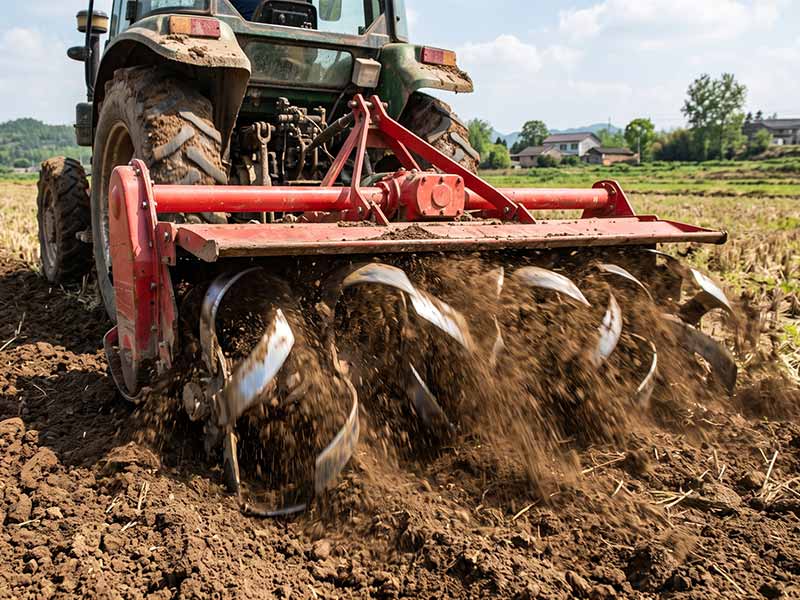
4. Performance Comparison: Standard vs. Precision Cast
How does a precision-cast, heat-treated alloy blade compare to traditional off-the-shelf components? Industry field tests reveal a stark contrast in performance metrics.
Table 2: Field Performance Comparison (Sandy Loam Soil Conditions)
| Metric | Standard 65Mn Spring Steel (Forged) | Custom Boron/Chrome Alloy (Precision Cast) | Improvement |
| Core Hardness | 38 - 42 HRC | 48 - 52 HRC | +23% |
| Impact Toughness | Moderate (Prone to chipping) | High (Absorbs shock) | Significant |
| Field Lifespan | ~150 - 200 Hectares | ~450 - 550 Hectares | Up to 2.5x longer |
| Cost per Hectare | Baseline | Reduced by ~40% | Highly Cost-Efficient |
Data reflects average operational benchmarks from comparative field testing in abrasive agricultural environments.
5. Partner with an Expert Manufacturer
As a dedicated manufacturer and supplier of agricultural casting parts, Lihuacasting understands that no two farms are exactly alike. Soil compositions vary, and so do equipment requirements. By leveraging precision casting, we can create custom geometries—adjusting the cutting angle, blade thickness, and alloy composition—to perfectly match the specific wear patterns of your local environment.
Contact our engineering team today to discuss how our custom anti-wear casting part alloy solutions can revolutionize your equipment's performance and keep your farming machines in the field where they belong.
RELATED NEWS
- How to Overcome Tool Wear Challenges When Machining High-Hardness Iron Castings? 2026-10-23
- Low-Temperature Charpy Impact Testing for Off-Road Trailer Castings 2026-10-20
- Common Casting Defects in Trailer Towing Rings and How to Prevent Them 2026-10-15
- Ductile Iron vs. Carbon Steel Engineering Guide for Heavy-Duty Agricultural Trai 2026-10-13
- Heavy Duty Disc Harrow: How to Choose the Right Model? 2026-10-09
CATEGORIES
LATEST NEWS
CONTACT US
Contact: Susanna Sun
Phone: +86 13706842897
E-mail: sue-sunwin@vip.163.com ; sophie091983@gmail.com
Whatsapp:+86 13706842897
Add: 1588 Jiangnan Road Ningbo High-tech Industry zone