Blog
How to Overcome Tool Wear Challenges When Machining High-Hardness Iron Castings?
Machining high-hardness iron castings remains one of the most costly bottlenecks for job shops and heavy equipment manufacturers, as uncontrolled tool wear cuts production throughput, raises consumable costs, and creates inconsistent dimensional accuracy on critical GET and undercarriage cast parts.
As a precision casting manufacturer serving construction, agricultural, and mining equipment OEMs, our in-house machining team runs hundreds of hard iron casting batches monthly, and we have documented practical shop-floor fixes focused on insert material selection, feed rate tuning, and cutting speed calibration to slow abrasive, thermal, and notch wear without sacrificing cycle time.
High-hardness iron castings commonly include chilled cast iron, high-chrome white iron, and austempered ductile iron (ADI), ranging from HRC 42 up to HRC 62; these workpieces feature hard carbide inclusions and heterogeneous chilled skin that aggressively abrade cutting edges, even with premium coated carbide grades.
Industry machining surveys note that hard cast iron operations can see tool life drop by 65% or more versus standard pearlitic grey iron if parameters and insert grades are misaligned, driving up per-part cost and unplanned machine downtime.
1. Insert Material Selection: Match Grade to Workpiece Hardness and Cutting Continuity
The first lever to reduce tool wear while machining high-hardness iron castings is selecting an insert substrate built for the dominant wear mode of your operation. Many shops default to general-purpose CVD carbide only to experience rapid flank wear and edge chipping during interrupted cuts on cored castings with scale and hard skin.
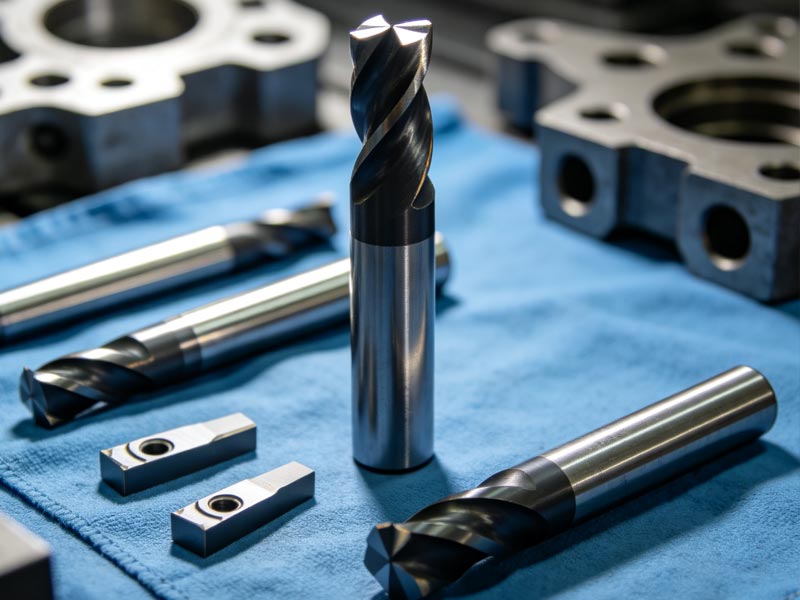
Three primary insert families dominate hard cast iron machining: coated carbide, whisker-reinforced ceramic, and PCBN / CBN. Each carries distinct strength limits, cost profiles, and sweet spots for roughing, semi-finishing, and finishing.
Table 1: Insert Grade Performance Benchmark for Machining High-Hardness Iron Castings
| Insert Material | Recommended Hardness Window | Best Operation | Primary Wear Risk | Relative Tool Life (Baseline: Standard K20 Carbide = 1.0) |
|---|---|---|---|---|
| CVD Coated Carbide (TiCN/TiAlN) | HRC < 48 | Roughing, heavy interrupted cuts | Notch wear, thermal cracking | 1.6–2.3 |
| SiAlON Whisker Ceramic | HRC 45–55 | Semi-finishing, dry stable cuts | Edge fracture on heavy interruptions | 2.8–4.1 |
| PCBN (low CBN content, binder-rich) | HRC 52–62 | Finishing, light semi-finishing, continuous cuts | Chemical diffusion wear, cratering | 4.5–7.2 |
CVD carbide is still economical for lower bands of high-hardness iron castings and jobs with frequent interruption from casting gates, riser marks, or uneven stock.
Ceramic inserts deliver excellent hot hardness at elevated cutting temperatures but demand rigid fixturing and consistent chip load; they fail quickly if shock loads from casting porosity or hard spots hit the cutting edge.
PCBN inserts are the gold standard for finishing fully hardened high-chrome and chilled iron, but they are sensitive to heavy depth of cut and unstable machine setups, making them a poor fit for heavy roughing passes.
Our shop rule: reserve PCBN for final sizing and surface finish, and use tough coated carbide for stock removal when machining high-hardness iron castings with inconsistent casting skin and porosity.
2. Cutting Speed and Feed Rate: Practical Shop Calibration to Suppress Wear
Even the best insert grade will wear prematurely if speed and feed are out of balance. A common misconception is “slower speed always equals longer tool life.”
In hard cast iron, excessively low cutting speed creates built-up edge and work hardening on the workpiece surface, accelerating notch wear at the depth-of-cut line. Too high a speed generates extreme thermal load, softening the insert coating and triggering rapid flank wear. Feed rate controls chip thickness and cutting force; reducing feed too far increases rubbing instead of shearing, while overfeeding risks catastrophic edge chipping.
Table 2: Shop-Proven Cutting Parameters for Machining High-Hardness Iron Castings (Dry Cutting)
| Workpiece Type | Hardness | Insert Grade | Cutting Speed vc (m/min) | Feed Rate f (mm/rev) | Depth of Cut ap (mm) |
|---|---|---|---|---|---|
| Chilled Ductile Iron | HRC 42–48 | CVD Carbide | 60–90 | 0.18–0.32 | 0.8–2.0 |
| High-Chrome White Iron | HRC 50–56 | SiAlON Ceramic | 80–110 | 0.12–0.22 | 0.3–1.0 |
| Fully Hardened White Cast Iron | HRC 56–62 | PCBN | 90–130 | 0.08–0.16 | 0.1–0.4 |
These ranges come from 120+ production runs in our casting workshop, not theoretical lab data. When machining high-hardness iron castings with intermittent cuts, drop speed by 15–20% from the table value first before reducing feed; feed reduction hurts metal removal rate far more and often does not improve wear life.
For example, on a high-chrome excavator bucket casting with scattered hard spots, we hold feed steady at 0.15 mm/rev and lower vc from 100 m/min to 78 m/min, which reduced unexpected insert breakage by 41% in our production trials.
We also standardize edge honing: a 0.02–0.04 mm hone on carbide and ceramic inserts distributes cutting force and prevents micro-chipping, which is the starting point for accelerated tool wear on hard cast iron.
3. Supporting Process Controls That Reduce Tool Wear
Insert grade and cutting parameters are foundational, but process stability determines whether your setup hits consistent tool life on high-hardness iron castings. Machine rigidity, coolant strategy, stock condition, and wear monitoring are often overlooked. Castings with unremoved burnt sand, decarburized skin, or segregated hard zones will hammer the cutting edge; we recommend pre-grinding or light skim passes to remove the chilled outer layer before the main machining sequence whenever possible.
Dry cutting is widely preferred for ceramic and PCBN when machining high-hardness iron castings. Flood coolant can create thermal shock and crack brittle ceramic or PCBN edges. For carbide roughing, MQL (minimum quantity lubrication) works better than heavy flood coolant to reduce friction without rapid thermal cycling. Rigidity checks are non-negotiable: loose tool holders, worn spindle bearings, or long overhang amplify vibration, which creates oscillating chip load and notch wear.
Table 3: Tool Wear Threshold & Corrective Action Log for Hard Cast Iron Machining
| Wear Feature | Allowable Limit | Observed Symptom | Recommended Adjustment |
|---|---|---|---|
| Flank Wear VB | ≤0.3 mm (finishing) / ≤0.5 mm (roughing) | Rising cutting force, poor surface finish | Reduce cutting speed, verify edge hone |
| DOC-line Notch Wear | ≤0.25 mm | Dimensional drift, sudden edge failure | Stabilize feed, vary depth of cut, tougher insert grade |
| Crater Wear | Crater width < 1/3 cutting edge | Thermal softening, rapid flank breakdown | Lower speed, switch to heat-resistant coating / PCBN |
We log this wear data for every casting family, so our production team can trigger parameter tweaks before catastrophic failure. Industry benchmark data shows that structured wear monitoring can extend average tool life on hard cast iron components by 30% while lowering scrap rates from dimensional shift.
4. Common Mistakes Shops Make When Machining High-Hardness Iron Castings
The most frequent error is chasing speed for cycle-time gains without checking workpiece hardness variation. High-hardness iron castings rarely have uniform hardness across the whole part; gate sections, chilled edges, and thick/thin transition zones can jump 8–12 HRC locally. Running a single parameter set across the entire part will overstress the tool on hard zones.
The second mistake is using sharp, unhoned edges for hard iron. A razor-sharp edge may look ideal for finish, but it lacks the strength to resist micro-chipping under abrasive cast iron cutting loads.
The third mistake is ignoring fixturing deflection; thin-wall castings flex under cutting force, causing rubbing and premature wear even with the correct insert and speed.
Closing Thoughts
Machining high-hardness iron castings does not have to mean frequent insert changes and inflated machining costs. The practical solution is a balanced stack: select the right insert material matched to hardness and cut continuity, lock in conservative feed and calibrated cutting speed based on real shop feedback, and build simple wear tracking routines into every job.
At Lihuacasting, we combine casting process control and machining know-how to deliver construction machinery castings with predictable machinability for our OEM partners. If you are sourcing high-hardness iron castings and struggling with unstable machining cycles or excessive tool wear, our engineering team can share casting microstructure tuning and pre-machining guidance to ease your downstream cutting challenges.
RELATED NEWS
- Low-Temperature Charpy Impact Testing for Off-Road Trailer Castings 2026-10-20
- Common Casting Defects in Trailer Towing Rings and How to Prevent Them 2026-10-15
- Ductile Iron vs. Carbon Steel Engineering Guide for Heavy-Duty Agricultural Trai 2026-10-13
- Heavy Duty Disc Harrow: How to Choose the Right Model? 2026-10-09
- How to choose the right lawn mower blades? 2026-09-23
CATEGORIES
LATEST NEWS
CONTACT US
Contact: Susanna Sun
Phone: +86 13706842897
E-mail: sue-sunwin@vip.163.com ; sophie091983@gmail.com
Whatsapp:+86 13706842897
Add: 1588 Jiangnan Road Ningbo High-tech Industry zone