Blog
APAC Metal Casting Market and Precision Analysis
The APAC metal casting market is the largest and most dynamic globally, accounting for roughly 47% to 56% of the total worldwide revenue. Driven by rapid industrialization and massive automotive sectors, the region is projected to experience steady growth over the next decade.(Data source: Dataintelo )
While market size estimates vary by research firm, valuations for 2025 generally range from $55 billion to over $160 billion, with expected Compound Annual Growth Rates (CAGR) hovering between 4.8% and 5.7% through the mid-2030s.(Data source: Market Research Future )
1. Key Market Drivers
Automotive Electrification & Lightweighting: The transition to electric vehicles (EVs) is a massive catalyst. Manufacturers are heavily investing in mega-casting and integrated die-casting technologies to produce lightweight structural components and battery housings.
Urbanization & Infrastructure: A continuing construction boom across developing nations requires immense volumes of structural beams, decorative elements, and heavy machinery parts.
Renewable Energy Projects: The push for sustainable energy is driving demand for precision cast components used in wind turbines, hydroelectric plants, and solar infrastructure.
Aerospace Expansion: Countries like China and India are investing heavily in domestic aerospace capabilities, increasing the need for high-performance, precision-engineered metal parts.
2. Material Breakdown
| Material | Market Status | Key Characteristics & Applications |
| Cast Iron | Dominant Share (~38-41%) | Offers excellent strength, wear resistance, and castability. Heavily used in traditional automotive engine blocks, heavy industrial machinery, and construction hardware. |
| Aluminum | Fastest Growing | Crucial for the automotive industry's push toward lightweighting. Demand is surging for EV battery casings and high-tech structural components. |
| Steel & Others | Steady Demand | Used for specialized applications requiring extreme durability, such as mining equipment and aerospace components. |
3. Regional Highlights
The APAC metal casting market is driven by several distinct manufacturing hubs:
China: The undisputed global leader, housing over 4,600 foundries. Growth is underpinned by a massive domestic automotive market (producing over 30 million vehicles annually) and government initiatives like "Made in China 2025".
India: The second-largest producer in the region. The sector benefits from rising domestic vehicle production, a growing export market for precision castings, and a national infrastructure pipeline worth over $1.4 trillion.
Japan: Remains a critical hub for high-precision die casting. Japanese manufacturers are heavily investing in advanced pressure die-casting lines to serve the expanding EV and electronics markets.
South Korea & Southeast Asia: South Korea focuses on high-tech applications, while countries like Vietnam, Thailand, and Malaysia are emerging as significant hubs due to foreign direct investment from automotive Tier-1 suppliers.
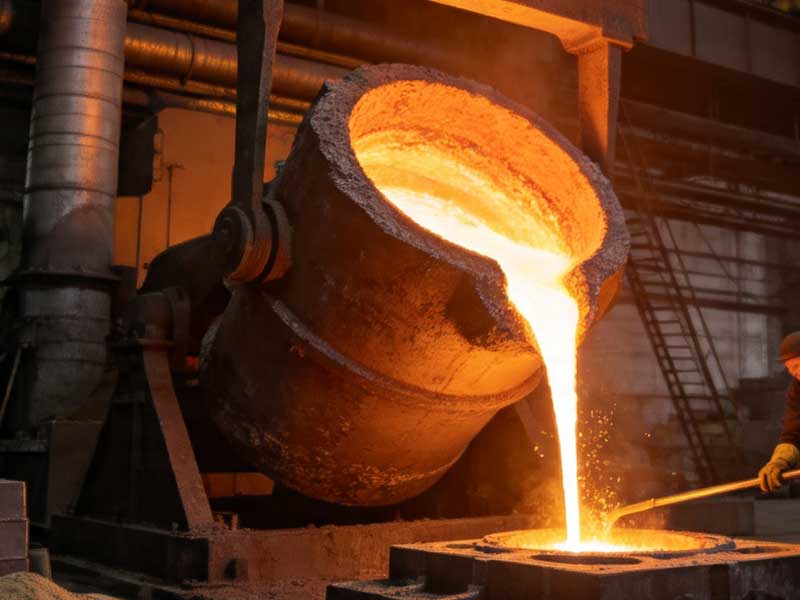
4. How Accuracy is Measured (ISO 8062)
In heavy-duty applications, dimensional accuracy is critical. A part that is cast slightly too large or too small can lead to excessive vibration, uneven stress distribution, and premature wear during operation.The global standard for defining casting precision is ISO 8062, which uses Casting Tolerance (CT) grades ranging from CT1 to CT16.
Low Numbers (CT1 - CT4): Extreme precision. Achieved mainly through specialized processes like pressure die casting or highly controlled investment casting for small, intricate parts.
Mid-Range (CT5 - CT9): Excellent to good precision. Typical for investment casting and shell molding. This is often the target range for high-quality engineering Wear Parts where a precise fit is required without secondary machining.
High Numbers (CT10 - CT16): Rough tolerances. Common in standard green sand casting for massive components where exact dimensions are less critical or will be heavily machined later.
5. Key Factors Affecting Dimensional Accuracy
Achieving the correct final dimensions is a complex balance of thermodynamics and tooling precision.
Shrinkage Allowance: All casting alloys shrink as they cool and transition from liquid to solid. To compensate, the original pattern or mold must be made slightly larger than the final part. Different metals have different shrinkage rates (e.g., steel shrinks more than aluminum), and getting this calculation wrong is the leading cause of dimensional failure.
Tooling and Pattern Wear: Over thousands of production cycles, the patterns used to make the sand molds or the wax dies for investment casting will slowly wear down. Worn tooling directly translates to inaccurate castings.
Mold Rigidity: The material holding the molten metal must withstand intense heat and pressure. If a sand mold is packed too loosely, the pressure of the liquid metal can cause the mold walls to bulge, resulting in a heavier, oversized part.
Thermal Dynamics (Pouring Temperature): If the molten metal is poured too hot, it can break down the mold surface or cause excessive, unpredictable shrinkage during solidification.
6. Exploring Casting Methods
The process chosen dictates the maximum achievable accuracy. For example, investment casting uses a ceramic shell that is baked hard, allowing it to hold much tighter tolerances than a sand mold that might shift slightly under pressure.
You can explore how different common casting methods stack up regarding typical tolerances:
| Method | Typical CT Grade | Surface Finish | Typical Apps |
| Green Sand | CT10-CT13 | 12.5-25.0 µm Ra | Engine blocks, heavy machinery |
| Resin Sand | CT8-CT11 | 6.3-12.5 µm Ra | Valves, machine bases |
| Shell Molding | CT7-CT9 | 3.2-6.3 µm Ra | Camshafts, small crankshafts |
| Investment Casting | CT5-CT7 | 1.6-3.2 µm Ra | Turbine blades, implants |
| Die Casting | CT4-CT6 | 0.8-1.6 µm Ra | Electronics, engine housings |
7. Exceptional Dimensional Accuracy, Rooted in Expert Manufacturing
In the demanding field of heavy machinery, where absolute dimensional accuracy and reliable performance are paramount, Lihuacasting remains your trusted partner. As a professional supplier of construction machinery wear parts (such as excavator bucket teeth and adapters), we have amassed a wealth of experience in metal casting. We possess a deep understanding of the shrinkage characteristics of various alloys and the intricacies of mold tolerance control.
To meet the highest assembly standards, Lihuacasting provides not only premium rough castings but also advanced, high-precision CNC machining services. We are dedicated to offering global clients a comprehensive, one-stop customized casting solution—from mold development and precision casting to extensive CNC machining. No matter how rigorous your project's dimensional requirements may be, we ensure that every delivered component achieves a seamless fit, empowering your equipment to maintain peak performance even under extreme operating conditions.
RELATED NEWS
- Disc Plow vs Disc Harrow for Primary & Secondary Tillage 2026-09-18
- What Factors Affect Plough Share Service Life? 2026-09-15
- 2026 Bucket Teeth Selection Guide for Soil Rock and Mining 2026-09-11
- OEM vs Aftermarket Bucket Teeth: Which Delivers Better Value for Your Fleet? 2026-09-10
- Agricultural Ground‑Engaging Tools: Aftermarket & Sourcing 2026-09-08
CATEGORIES
LATEST NEWS
CONTACT US
Contact: Susanna Sun
Phone: +86 13706842897
E-mail: sue-sunwin@vip.163.com ; sophie091983@gmail.com
Whatsapp:+86 13706842897
Add: 1588 Jiangnan Road Ningbo High-tech Industry zone