Blog
Shell Molding vs Sodium Silicate Casting Comparison Guide
When sourcing heavy machinery components, infrastructure parts, or precision valves, choosing the right manufacturing process is one of the most critical decisions affecting your bottom line. Two of the most widely used methods in modern foundries are Shell Molding (Pre-coated Sand Casting) and Sodium Silicate Casting (Water Glass Casting).
While both fall under the sand casting family, they rely on entirely different binder systems, hardware setups, and cost structures.
In this comprehensive guide, we will break down their processes, core characteristics, direct differences, and provide a manufacturing recommendation specifically for heavy-duty construction parts like excavator components.
1. What is Shell Molding (Pre-coated Sand Casting)?
Shell molding is a thermohardening (heat-cured) process that utilizes resin-coated sand to create a thin, highly precise mold shell.
The Production Process:
>1. Pattern Heating: A precision metal pattern (usually iron or steel) is preheated to 200°C to 300°C.
>2. Sand Investment (Dumping/Shooting): Pre-coated sand (sand particles coated with a solid phenolic resin and a curing agent) is blown or dumped onto the hot metal pattern.
>3. Shell Formation: The heat causes the resin to melt, bonding the sand grains together into a hard, dense crust (shell) about 5–10 mm thick next to the pattern.
>4. Curing & Ejection: Excess loose sand is removed, and the shell is baked further to achieve maximum strength before being ejected from the pattern.
>5. Assembly & Pouring: Two halves of the shell are clamped together, placed in a flask, and molten metal is poured.
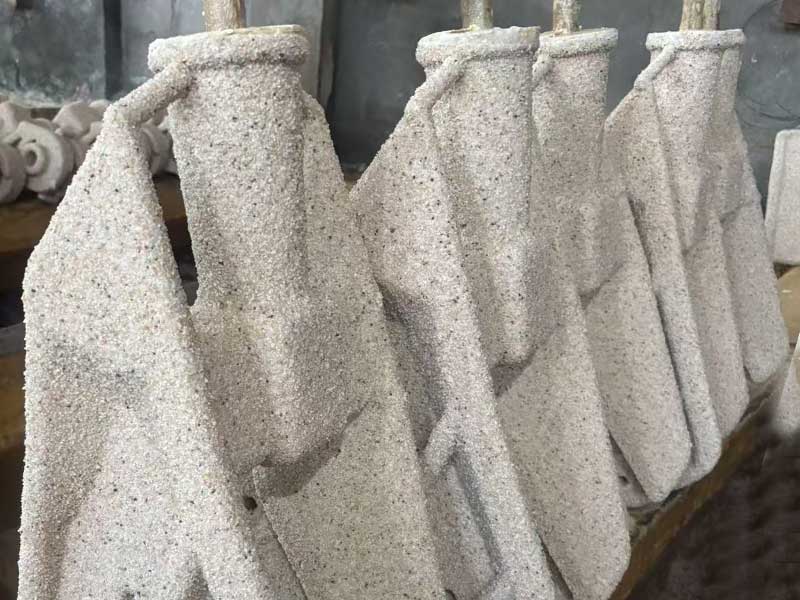
2. What is Sodium Silicate Casting (Water Glass Casting)?
Sodium silicate casting uses a liquid water glass solution as a binder mixed with silica sand. It is a chemical-hardening process that cures at room temperature.
The Production Process:
>1. Sand Mixing: Silica sand is mixed with 4% to 6% liquid sodium silicate and specific chemical additives.
>2. Molding: The mixture is packed and rammed into a pattern mold (which can be made of wood, aluminum, or plastic).
>3. Gas Gassing (Curing): Carbon dioxide (CO2) gas is injected into the mold. The gas reacts with the sodium silicate to form a hard, rigid silica gel structure instantly.
>4. Demolding & Coating: The pattern is removed, and a refractory coating is applied to the mold surface to improve surface finish and heat resistance.
>5. Assembly & Pouring: The mold halves are closed, locked, and prepared for metal pouring.
3. Core Characteristics & Side-by-Side Comparison
To help your procurement team make an informed decision, here is a direct comparison across key technical and economic metrics:
| Technical Metrics | Shell Molding (Pre-coated Sand) | Sodium Silicate Casting (Water Glass) |
| Binder Agent | Organic Phenolic Resin (Thermo-curing) | Inorganic Sodium Silicate (Chemical-curing) |
| Dimensional Accuracy | Excellent (CT6 - CT8 Grade) | Moderate (CT8 - CT10 Grade) |
| Surface Roughness (Ra) | 6.3um - 12.5um (Very smooth, crisp details) | 12.5um - 25um (Rougher, matte finish) |
| Machining Allowance | Minimal (Near-net shape) | Moderate to high (Requires more post-machining) |
| Collapsibility (Shakeout) | Excellent (Resin burns away at high temps) | Poor (Glass forms hard residue, harder to clean) |
| Part Weight Range | Grams up to 50–100 kg max | 5 kg up to several tons |
| Initial Tooling Cost | High (Requires high-grade metal molds) | Very low (Compatible with low-cost wooden/plastic patterns) |
| Eco-Friendliness | Moderate (Emits pungent smoke during pouring) | Excellent (Inorganic, low odor, non-toxic smoke) |
4. Sourcing Guide: How to Choose the Right Process?
Choosing between these two technologies typically boils down to three variables: Production Volume, Surface Finish Requirement, and Part Size.
>1. Choose Shell Molding If: You are placing a high-volume order (thousands of pieces) for small-to-medium parts that require complex internal geometries, thin walls, excellent surface aesthetics, and tight dimensional tolerances to eliminate downstream machining costs.
>2. Choose Sodium Silicate If: You need low-to-medium volume production for large, heavy components where upfront tooling investment needs to be kept to a minimum, and slight surface roughness is completely acceptable.
5. Manufacturing Focus: Excavator Attachments & Wear Parts
In the earthmoving and construction equipment industry, parts like excavator bucket teeth, adapters, track shoes, and corner guards face extreme impact and abrasive wear.
What is the best process to manufacture them?
High Impact & Abrasive Environments ➔ Requires Optimized Metallurgical Integrity
Process Recommendation for Heavy Machinery Parts:
A. For Premium, High-Value Wear Parts (Bucket Teeth & Adapters)
We strongly recommend Shell Molding. Why?
Zero Gas Defects: Shell molding offers excellent gas permeability. This dramatically minimizes internal gas porosity and shrinkage cavities, which are fatal flaws that cause bucket teeth to snap under heavy impact.
Uniform Grain Structure: The cooling rate inside a shell mold yields a highly dense, uniform metallurgical structure, improving the material's impact toughness after heat treatment.
Tight Tolerances for Perfect Fit: Bucket teeth must fit flawlessly onto their adapters. The high precision of shell molding ensures a secure lock without loose wobbles, extending the service life of the entire assembly.
B. For Large structural Components (Bucket Hinges, Brackets, Large Chassis Parts)
For oversized castings, Sodium Silicate Casting remains the industry favorite. Its ability to cast multi-ton components affordably makes it highly cost-effective for parts where tight geometric tolerances are less critical.
RELATED NEWS
- How to choose the right lawn mower blades? 2026-09-23
- How to Choose Right Industrial Steel Self-Dumping Forklift Hopper? 2026-09-21
- Disc Plow vs Disc Harrow for Primary & Secondary Tillage 2026-09-18
- What Factors Affect Plough Share Service Life? 2026-09-15
- 2026 Bucket Teeth Selection Guide for Soil Rock and Mining 2026-09-11
CATEGORIES
LATEST NEWS
CONTACT US
Contact: Susanna Sun
Phone: +86 13706842897
E-mail: sue-sunwin@vip.163.com ; sophie091983@gmail.com
Whatsapp:+86 13706842897
Add: 1588 Jiangnan Road Ningbo High-tech Industry zone