Blog
How to Identify Your Bucket Teeth & B2B Procurement Guidelines
Bucket teeth are core wear-resistant parts for excavators, loaders, and engineering buckets, directly affecting construction efficiency, bucket service life, and operating safety. For engineering machinery operators, maintenance teams, and B2B procurement enterprises, accurate identification of bucket tooth models, specifications, and types is the premise of precise replacement, cost control, and standardized equipment maintenance. Misjudgment of bucket tooth parameters often leads to poor assembly compatibility, accelerated wear, frequent replacement, and increased construction costs.
This article systematically introduces practical bucket tooth identification methods, sorts out mainstream product differences, and provides targeted professional procurement suggestions for B-end buyers.
1. Core Methods to Identify Bucket Teeth
Bucket tooth identification focuses on five key dimensions: equipment matching model, structural design parameters, locking system, manufacturer characteristics, and wear type. Different dimensions can quickly narrow down the product range and confirm accurate specifications, avoiding matching errors caused by similar appearances.
1.1 Confirm Supporting Equipment Model
The first step in identifying bucket teeth is to confirm the complete model of the engineering machine and bucket type. Different tonnages of excavators and different functional buckets correspond to exclusive bucket tooth specifications. Standard earthwork buckets, heavy-duty rock buckets, and mining-specific buckets are equipped with bucket teeth of different strength, size, and structural designs. For example, JCB 3DX/3CX loaders support special lightweight bucket teeth, while 20-ton and 30-ton excavators of Caterpillar adopt completely different tooth base sizes and tooth tip lengths.
1.2 Identify Structural & Locking System Features
The internal tooth socket structure and pin locking mode are the most intuitive identification features of bucket teeth, and they are also the core criteria for distinguishing different brands and series. Mainstream manufacturers have fixed exclusive structural designs, which can be quickly identified through visual observation and simple measurement.
1.3 Check Part Number & Manufacturer Markings
Genuine and high-quality standardized bucket teeth are engraved with unique manufacturer logos, part numbers, and batch codes on the tooth base. The part number corresponds to the tooth type, size, and applicable equipment one by one, which is the most accurate identification basis. For worn bucket teeth with blurred markings, the parameters can be reversed through the matching adapter size and pin model.
1.4 Distinguish Manufacturing Process & Quality
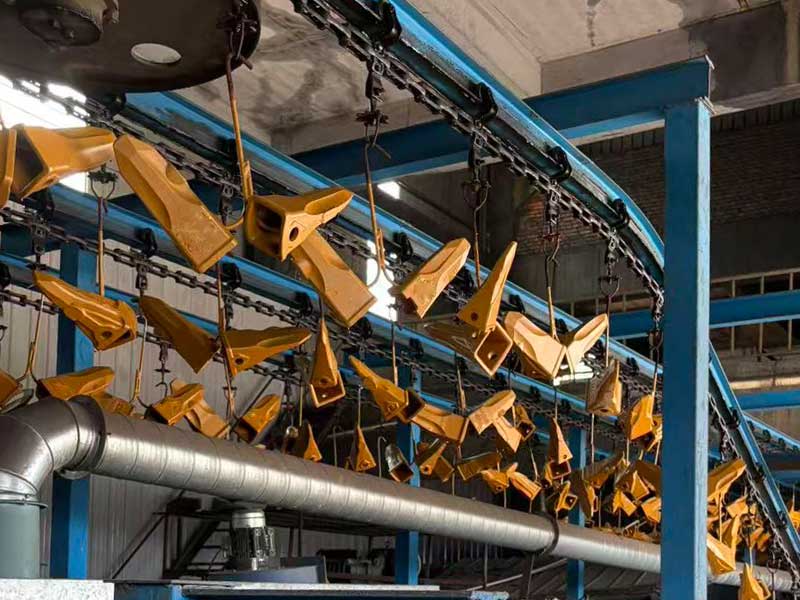
Bucket teeth are mainly divided into forged and cast types in terms of production process, with obvious differences in appearance and performance. Forged bucket teeth have dense texture, smooth surface, no pores and sand holes, uniform wall thickness, and strong impact resistance; cast bucket teeth have rough surfaces, occasional tiny pores, and relatively poor wear resistance, which are suitable for conventional light-load earthwork scenarios.
2. Bucket Tooth Type & Brand Identification Comparison Table
The following table sorts out the identification characteristics of mainstream bucket tooth brands and common types, covering core structural differences, locking modes, and applicable scenarios, which is convenient for rapid manual identification and screening.
| Bucket Tooth Brand/Series | Core Structural Identification Features | Locking Pin Design | Applicable Scenarios & Equipment |
| Caterpillar (CAT) | Flat tooth base, regular conical tooth socket, uniform wall thickness, standard dimensional tolerance | Horizontal pin hole design, side penetration locking | Medium and large excavators, rock excavation, heavy-load construction |
| Hensley | Thickened tooth tip, reinforced tooth root structure, anti-breakage optimization design | Vertical pin hole design, top-down locking | Mining projects, high-strength impact working conditions |
| Esco | Unique concave conical tooth socket, streamlined tooth body, good soil cutting performance | Special snap ring locking, no exposed pin | Earthwork excavation, sand and gravel handling, light and medium load |
| JCB Standard Series | Lightweight tooth body, narrow tooth base, compact overall structure | Horizontal short pin locking, simple disassembly and assembly | Small loaders, mini excavators, municipal light construction |
3. Dimensional Parameter Identification Standard Table
Accurate size measurement is the key to confirm non-standard and worn bucket teeth. Measuring core parameters can completely eliminate matching errors and is suitable for the identification of unmarked old bucket teeth and customized products.
| Core Measurement Parameter | Identification Standard & Method | Matching Judgment Standard |
| Tooth Base Width & Height | Measure the maximum width and vertical height of the bucket tooth fitting tooth base with a vernier caliper; exclude wear and deformation parts | The error of matching adapter size shall not exceed ±0.5mm to ensure tight assembly |
| Tooth Tip Length | Measure the vertical distance from the tooth base fitting surface to the tooth tip; distinguish standard, extended, and rock-enhanced types | Extended teeth for deep excavation, short thick teeth for rock impact resistance |
| Pin Hole Diameter & Position | Measure pin hole inner diameter and center height, distinguish horizontal/vertical hole types | Pin hole parameters must be fully matched, otherwise locking failure and tooth falling will occur |
| Tooth Socket Inner Diameter | Measure the inner cavity size of the tooth base socket, which is the core matching size with the adapter | The gap is controlled within 0.3-0.8mm to avoid shaking and accelerated wear |
4. B2B Enterprise Procurement Suggestions for Bucket Teeth
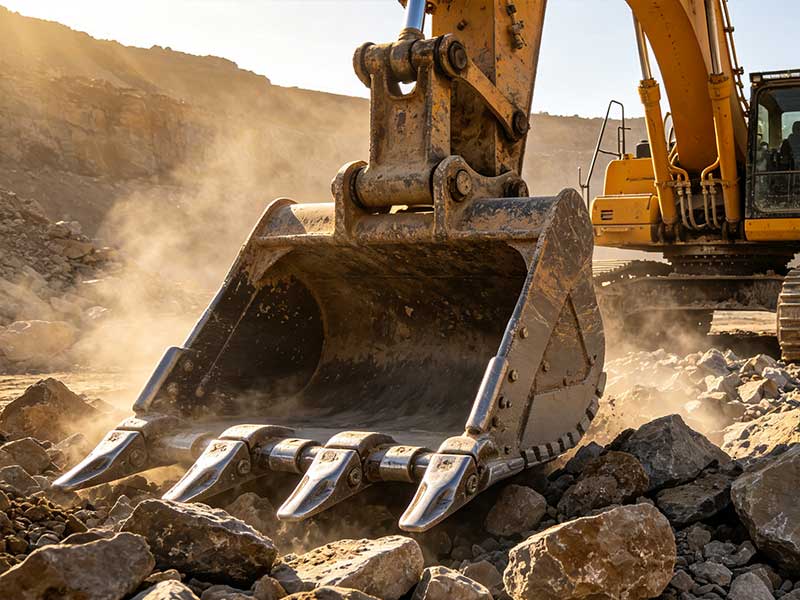
For engineering machinery leasing companies, construction engineering enterprises, and parts distributors (B-end buyers), bucket tooth procurement needs to balance quality, applicability, cost, and after-sales stability. Different from individual purchases, B-end procurement focuses on batch consistency, long-term cost performance, and on-site adaptability. The following are professional targeted suggestions.
4.1 Standardize Pre-Purchase Identification & Confirmation Process
Establish a unified parts confirmation process for batch procurement.
Before purchasing, comprehensively verify parameters through equipment model, on-site measurement data, and original part numbers.
For old equipment with incomplete data, take photos of the tooth body, pin hole, and tooth socket, and provide complete size measurement reports to suppliers to avoid batch mismatching.
It is recommended to archive parameter data of all equipment bucket teeth to form a proprietary parts database and improve subsequent procurement efficiency.
4.2 Select Materials & Processes Based on Working Conditions
Classify purchases according to on-site construction working conditions to avoid over-quality or insufficient quality procurement.
For conventional earthwork, sand and gravel handling and other light-load working conditions, high-precision cast bucket teeth can be selected to control procurement costs;
For mining, rock breaking, and frequent impact heavy-load working conditions, forged high-manganese steel bucket teeth must be prioritized, which have better toughness and wear resistance and reduce the frequency of batch replacement.
Avoid uniform procurement of the same type of bucket teeth for all equipment to optimize overall cost performance.
4.3 Prioritize Batch Consistency & Supplier Qualification
B-end batch procurement focuses on product consistency. It is necessary to select regular manufacturers and qualified suppliers with complete production certifications, stable process standards, and traceable product batches.
Avoid low-cost miscellaneous products with uneven quality, which will lead to inconsistent wear speed of on-site bucket teeth, affect construction progress, and increase maintenance labor costs.
For long-term cooperative suppliers, sample inspection and quality sampling tests can be carried out regularly to ensure stable product quality.
4.4 Optimize Inventory & Replacement Cycle Management
Combine equipment operation hours and working condition intensity to formulate scientific inventory reserves and replacement cycles.
Normally, bucket teeth need to be inspected every 50-100 working hours. When the tooth tip wear exceeds 50% of the original thickness or cracks and missing blocks appear, they need to be replaced in time.
For B-end enterprises, establish classified inventory management: reserve standard conventional models in stock for emergency replacement, and customize special models in small batches on demand to reduce inventory backlog and capital occupation.
4.5 Focus on Cost-Performance & After-Sales Service
In batch procurement, comprehensively evaluate the unit price, service life, and after-sales guarantee of products, not just the lowest price.
High-quality bucket teeth have a longer service life and lower replacement frequency, which can effectively reduce comprehensive operating costs. Prioritize suppliers who provide size matching guidance, batch after-sales warranty, and quick replacement services, which can greatly reduce the maintenance time cost of engineering equipment and ensure the stable progress of construction projects.
5. Conclusion
Accurate identification of bucket teeth is the basis of equipment maintenance and standardized procurement. Combined with scientific working condition classification, supplier screening, and inventory management, enterprises can effectively reduce parts replacement costs, improve equipment operation stability, and maximize the economic benefits of engineering construction. Standardized identification and refined procurement management will become an important part of the cost control and efficient operation of engineering machinery enterprises.
For reliable bucket tooth procurement and customized solutions,Lihuacasting stands out as a professional and trustworthy manufacturer with decades of rich experience in the casting industry. Specializing in the R&D and production of engineering machinery Wear Parts, we offer a full range of high-quality bucket teeth, tooth adapters, and related casting components compatible with mainstream excavator and loader models.
We support flexible OEM and ODM services, covering personalized product design, exclusive mold development, and customized production according to customers’ drawings, samples, or actual working condition demands. Catering to diverse B-end procurement needs, we also support small-batch customization with flexible MOQs, enabling enterprises to meet personalized equipment matching requirements while controlling inventory costs. Adhering to strict quality control standards and mature casting craftsmanship, Lihuacasting delivers cost-effective, durable wear parts and one-stop customized solutions for global engineering machinery enterprises, distributors, and engineering contractors.
RELATED NEWS
- 2026 Bucket Teeth Selection Guide for Soil Rock and Mining 2026-09-11
- OEM vs Aftermarket Bucket Teeth: Which Delivers Better Value for Your Fleet? 2026-09-10
- Agricultural Ground‑Engaging Tools: Aftermarket & Sourcing 2026-09-08
- Mining Truck Dump Body:Trends, Material Technology & Procurement Guide for 2026‑ 2026-09-03
- How to Reduce Loader Blade Fleet Operating Costs? 2026-09-01
CATEGORIES
LATEST NEWS
CONTACT US
Contact: Susanna Sun
Phone: +86 13706842897
E-mail: sue-sunwin@vip.163.com ; sophie091983@gmail.com
Whatsapp:+86 13706842897
Add: 1588 Jiangnan Road Ningbo High-tech Industry zone