Blog
Excavator Bucket Teeth and Tooth Adapters for Harsh and Extreme Cold Working Conditions
Ordinary carbon steel fails to meet the rigorous performance requirements of excavator bucket teeth and tooth adapters under harsh mining, earthmoving, and frozen soil working conditions. The rational addition of alloying elements (manganese, chromium, molybdenum, and nickel) fundamentally optimizes the microscopic crystal structure and carbide distribution of cast steel, balancing wear resistance and impact toughness. Meanwhile, precise quenching and tempering heat treatment processes are essential to fully activate the potential of alloy components.
For exported products serving ultra-low temperature regions such as Russia and Canada, targeted optimization of heat treatment procedures is required to eliminate low-temperature brittle fracture risks.
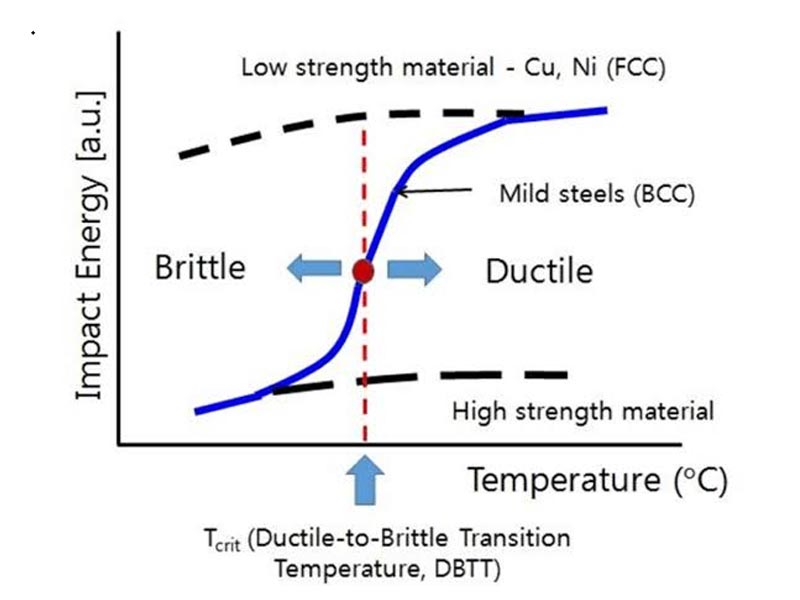
(Ductile-to-brittle transition temperature curve for steel. Source: YENA Engineering.)
This article systematically elaborates on the coupling mechanism of alloy ratio, heat treatment process and product performance, as well as customized technical schemes for extreme cold working conditions.
1. Influence Mechanism of Core Alloying Elements on Wear Resistance and Impact Toughness
Manganese (Mn), chromium (Cr), and molybdenum (Mo) are the three core alloying elements that determine the service performance of cast bucket teeth and tooth adapters. Each element has unique functional characteristics, and their synergistic effect enables castings to adapt to different working condition scenarios. The detailed functional mechanisms and applicable conditions are summarized in the table below.
| Alloy Element | Content Range | Core Microscopic Action | Performance Contribution | Applicable Working Conditions |
| Manganese (Mn) | Low/medium alloy: <2%High manganese steel: 11%-14% | Improves hardenability of steel, realizes deep heat treatment effect; deoxidizes and desulfurizes to purify molten steel and reduce casting defects; high manganese steel undergoes phase transformation under strong impact to form dense surface strengthening layer | Low/medium Mn: Basic toughness improvement and casting quality optimization;High Mn: Excellent work hardening performance, low initial hardness but ultra-high impact toughness, effectively prevents fracture | Low/medium Mn: Conventional earthwork working conditions;High Mn: Heavy rock mining with strong impact load |
| Chromium (Cr) | Conventional casting: 1.5%-2.5%High wear-resistant model: 2.5%-3.5% (carbon matched) | Combines with carbon atoms to form high-hardness chromium carbide particles, uniformly dispersed in the steel matrix; synergizes with Mn to boost hardenability; forms dense oxide film for corrosion resistance | Significantly enhances cutting wear resistance of bucket teeth; improves thermal stability and surface oxidation resistance; excessive Cr causes carbide aggregation and material embrittlement | Rock cutting, gravel excavation and high-friction working conditions; not suitable for ultra-low temperature extreme working conditions with excessive addition |
| Molybdenum (Mo) | High-performance casting: 0.2%-0.4% (trace addition) | Refines steel grain structure to homogenize internal organization; inhibits grain boundary impurity segregation; suppresses temper brittleness; improves high-temperature structural stability | Balances high hardness and high toughness of castings; eliminates internal stress defects after heat treatment; prevents softening and wear failure of tooth tips under high-temperature friction | High-strength mining working conditions, high-load continuous operation scenarios, and ultra-low temperature export products |
2. Customized Alloy Ratio Strategies for OEM/ODM Mass Production
Based on differentiated market demands and working conditions, targeted alloy ratio schemes are adopted in bucket tooth and tooth adapter casting production to balance cost performance and service life:
Standard Earthwork Bucket Teeth: Adopt medium carbon steel as the base material, with 1.0%-1.5% manganese and a small amount of chromium added. Rely on standard conventional heat treatment to meet basic wear resistance requirements, focusing on cost performance for ordinary soil and loose gravel excavation.
Mining Rock Bucket Teeth (23TL, V19 TYL and other mainstream models): Increase the content of chromium and molybdenum significantly. Adopt high-strength low-alloy steel (such as 30CrMnMo) or high manganese steel formula, focusing on extreme impact resistance and cutting wear resistance to adapt to heavy rock mining scenarios.
Extreme Cold Working Condition Bucket Teeth: Strictly control carbon and impurity (phosphorus, sulfur) content, and add nickel element in cooperation with manganese and molybdenum. Optimize the low-temperature impact toughness of the material to avoid brittle failure in frozen soil excavation at sub-zero temperatures.
3. Heat Treatment Mechanism: Activate Alloy Material Potential
Alloy ratio determines the inherent performance of castings, while quenching and tempering heat treatment is the core process to release alloy potential. Untreated alloy steel castings have disordered and loose internal crystal structures, resulting in wasted alloy components and poor comprehensive mechanical properties. The dual processes of quenching and tempering reconstruct the microscopic structure of steel, realizing the perfect combination of wear resistance and toughness.
3.1 Quenching: Forced Solid Solution to Achieve Ultra-High Hardness
First, the cast bucket teeth are heated to 900°C-1050°C above the critical temperature to complete austenitization. At high temperature, manganese, chromium, molybdenum and carbon atoms are fully dissolved into the iron lattice to form a uniform solid solution. Subsequently, the red-hot castings are rapidly cooled through quenching oil or water medium. The rapid temperature drop locks the alloy and carbon atoms in the lattice, forming a distorted needle-like martensite structure. Quenched bucket teeth obtain ultra-high surface hardness and wear resistance, but accompanied by high internal residual stress and obvious brittleness, which cannot be directly put into use.
3.2 Tempering: Stress Relief and Toughness Improvement
Tempering is the key process to solve quenching brittleness and balance mechanical properties. The quenched workpieces are reheated to 200°C-500°C and kept warm for a certain period. During the tempering process, chromium elements combine with precipitated fine carbon atoms to form dispersed alloy carbides, realizing secondary hardening and stabilizing wear resistance. More importantly, molybdenum elements effectively inhibit temper brittleness caused by grain boundary impurity segregation, release internal residual stress, and transform brittle martensite into tough tempered martensite, which greatly improves the impact resistance of bucket teeth.
4. Special Heat Treatment Optimization for Ultra-Low Temperature Export Working Conditions
For products exported to high-latitude ultra-cold regions (Siberia, Northern Canada, ambient temperature as low as -40°C to -60°C), ordinary heat treatment processes cannot avoid the ductile-brittle transition of steel. Materials will lose impact energy absorption capacity at low temperature, resulting in brittle fracture of bucket teeth during frozen soil and rock impact. Combined with low-temperature working condition characteristics, the optimized heat treatment process parameters are shown in the table below.
| Heat Treatment Process | Conventional Working Condition Parameters | Ultra-Low Temperature Working Condition Optimized Parameters | Optimization Purpose & Performance Advantage |
| Tempering Temperature | 200°C-300°C (low-temperature tempering, priority to hardness) | 400°C-500°C (high-temperature tempering, inclined to toughness) | Sacrifices partial HRC hardness, transforms martensite into tempered sorbite/troostite, and significantly improves low-temperature impact toughness |
| Tempering Holding Time | Standard holding time (complete basic stress relief) | Properly extended holding time | Completely eliminate residual quenching stress, avoid crack propagation induced by tiny stress concentration in ultra-cold environment |
| Cooling Mode after Tempering | Furnace slow cooling or natural cooling | Forced water/oil rapid cooling | Cross the brittle temperature range rapidly, prevent secondary temper brittleness of Mn-Cr alloy steel, and lock low-temperature toughness |
| Advanced Process Scheme | Conventional quenching + tempering (martensite structure) | Austempering (250°C-400°C constant temperature salt bath treatment) | Form lower bainite structure, ultra-high impact toughness at -40°C~-60°C, completely solve low-temperature brittle fracture failure |
| Performance Verification Standard | Room temperature impact test, focus on hardness index | -40°C/-50°C Charpy V-notch impact test (AK≥25J) | Quantitatively verify low-temperature impact resistance, meet ultra-cold region export inspection standards |
5. Conclusion
The excellent performance of excavator bucket teeth and tooth adapters under harsh and extreme cold working conditions depends on the precise matching of alloy ratio and heat treatment process. Manganese provides work hardening toughness, chromium guarantees wear resistance via hard carbides, and molybdenum optimizes grain structure and eliminates temper brittleness. The conventional quenching and tempering process realizes the basic balance of hardness and toughness, while the optimized high-temperature tempering and austempering processes for ultra-cold working conditions fundamentally solve the low-temperature ductile-brittle transition problem.
In OEM/ODM custom manufacturing, Lihuacasting tailors alloy formulations and heat treatment processes to the specific operating conditions of the client's region, thereby delivering castings that combine high wear resistance, high impact resistance, and fracture resistance at low temperatures.
RELATED NEWS
- 2026 Bucket Teeth Selection Guide for Soil Rock and Mining 2026-09-11
- OEM vs Aftermarket Bucket Teeth: Which Delivers Better Value for Your Fleet? 2026-09-10
- Agricultural Ground‑Engaging Tools: Aftermarket & Sourcing 2026-09-08
- Mining Truck Dump Body:Trends, Material Technology & Procurement Guide for 2026‑ 2026-09-03
- How to Reduce Loader Blade Fleet Operating Costs? 2026-09-01
CATEGORIES
LATEST NEWS
CONTACT US
Contact: Susanna Sun
Phone: +86 13706842897
E-mail: sue-sunwin@vip.163.com ; sophie091983@gmail.com
Whatsapp:+86 13706842897
Add: 1588 Jiangnan Road Ningbo High-tech Industry zone