Blog
Agricultural Equipment Castings Guide: Wear Parts & Manufacturing
1. Current Status of Agricultural Equipment Castings
High‑quality agricultural equipment casting delivers superior wear resistance, structural integrity, and impact toughness that directly reduce unplanned machine stops and lower total‑cost‑of‑ownership (TCO) for fleets and original equipment manufacturers.
Industry data shows wear‑related component failures account for over 50% of agricultural machinery breakdowns, and unplanned downtime during planting or harvest creates severe financial losses for farm operators and equipment OEMs alike. During peak growing seasons, downtime costs can reach $1,500 per operating hour, with average seasonal losses per farm hitting $3,348 from emergency repairs, rush‑part shipping and lost yield potential.
2. Common Agricultural Equipment Castings
Agricultural equipment castings cover ground‑engaging wear components, transmission sprockets, structural housings, and hitch assemblies. Many wear‑part failure modes mirror those seen in construction GET (Ground‑Engaging Tools) such as excavator bucket teeth, where abrasive erosion and repeated impact drive component degradation.
Tillage & Plowing Wear Parts
These components make direct contact with soil and rock, suffering the highest abrasive wear: plow points, cultivator sweeps, ripper teeth, sub‑soiler tips.
Harvesting Components
High‑cycle, high‑load parts for combine harvesters and forage equipment: combine harvester guards, rasp bars, heavy‑duty sprockets, feeder‑house cast brackets.
Tractor Undercarriage & Linkage
Structural castings handling static and dynamic shock loads: axle housings, wheel hubs, three‑point hitch components, transmission housings.
Industry note: Properly selected cast wear‑parts can extend service life by 30‑50 % compared to generic stamped alternatives, reducing total field‑maintenance events per season.
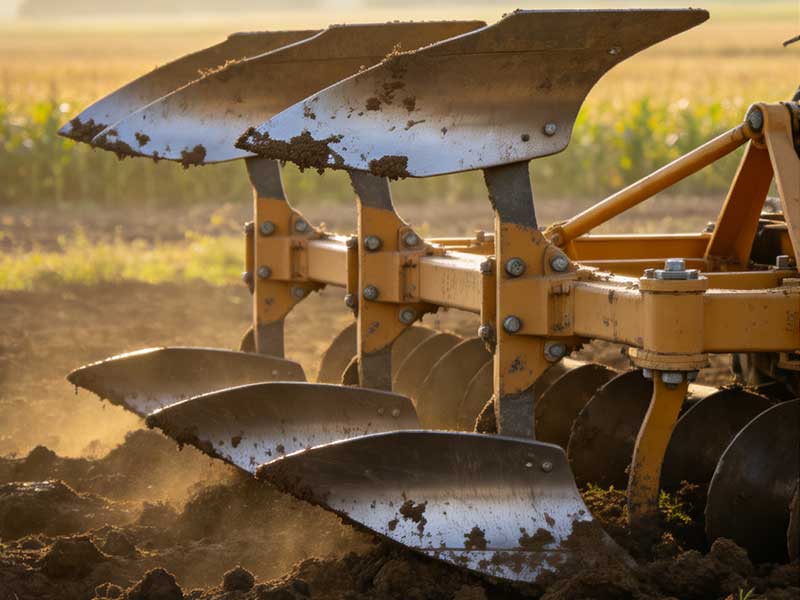
3. Choosing the Right Materials for the Soil: Material Science for Agricultural Equipment Castings
Material selection defines how long your agricultural equipment castings survive in abrasive soil. Hardness, tensile strength, impact toughness, and heat‑treatment quality must match local soil conditions (sandy soil = high abrasion; rocky soil = heavy impact loading).
Table 1: Material Comparison for Agricultural Equipment Castings
| Material Grade | Typical Hardness Range | Key Strengths | Typical Agricultural Use‑Case |
| Gray Cast Iron | HB 180‑240 | Good castability, low cost, vibration damping | Low‑load housings, non‑wear structural brackets |
| Ductile (Nodular) Iron QT600‑3 / QT700‑2 | HB 220‑320 | High tensile strength, shock‑resistance, fatigue performance | Axle housings, hitch components, moderate‑load sprockets |
| Wear‑Resistant Alloy Steel (Mn‑Cr‑Mo) | HRC 42‑52 after quenching & tempering | Excellent abrasion + impact resistance | Plow points, ripper teeth, ground‑engaging wear parts |
| ADI (Austempered Ductile Iron) | HB 340‑440 | Balanced toughness‑hardness, cost advantage over alloy steel | Tillage components, high‑stress structural castings |
Gray iron offers low‑cost casting capability but limited impact strength, making it unsuitable for ground‑engaging wear‑parts exposed to rock impacts. Ductile iron outperforms gray iron significantly on tensile strength and crack‑resistance, and it is widely preferred for tractor structural castings.
For direct‑contact ground‑engaging tools, high‑carbon and alloy steels with manganese‑chromium‑molybdenum alloying deliver the best balance of abrasion resistance and anti‑brittleness.
Heat‑treatment (quenching and tempering) is non‑negotiable for wear‑part performance. Without precise thermal processing, even premium alloy steel will either wear rapidly (too soft) or crack under rock shock (over‑hard and brittle). Target working hardness for most tillage wear‑parts sits between HRC 42‑50, balancing field durability and impact toughness.
4. The Manufacturing Process: OEM & ODM Capabilities for Agricultural Equipment Castings
Two primary precision casting workflows dominate agricultural equipment casting production: sand casting and investment (lost‑wax) casting. Each fits different part sizes, complexity, tolerance requirements, and batch‑volume scenarios.
Table 2: Sand Casting vs Investment Casting for Agricultural Castings
| Parameter | Sand Casting | Investment (Lost‑Wax) Casting |
| ISO Tolerance Grade | CT 7‑9 | CT 4‑6 |
| Typical Surface Roughness Ra | 6.3‑12.5 μm | 1.6‑3.2 μm |
| Best‑fit Part Size | Medium‑to‑large castings (>5 kg) | Small‑to‑medium complex‑geometry parts |
| Unit Cost (High Volume) | Very cost‑effective | Moderate‑higher |
| Post‑Casting Machining Requirement | Higher | Reduced machining allowance |
| Primary Agricultural Applications | Ripper teeth, housings, hitch castings, large sprockets | Precision sprockets, small complex harvester components |
Sand casting remains the workhorse for most heavy agricultural equipment castings thanks to flexible tooling, suitability for large‑weight components, and competitive high‑volume pricing. Investment casting delivers tighter dimensional tolerances and smoother surfaces for intricate‑geometry wear‑parts, though with higher production cost.
5. OEM vs ODM for Agricultural Cast Wear‑Parts
OEM Casting: The manufacturer produces parts strictly following customer‑supplied blueprints, 3D models, or original‑part samples. The foundry reproduces exact dimensions, material grades, and heat‑treatment specifications. Ideal for direct‑replacement spare‑part orders.
ODM Casting: The supplier provides engineering input: analyzing field‑failure modes, optimizing material selection, redesigning casting geometry, and delivering improved‑performance custom parts for unique machinery challenges. ODM projects suit customers seeking to upgrade weak‑point components rather than simply copy existing designs.
Dimensional accuracy and rigorous quality control separate reliable agricultural‑casting manufacturers from low‑cost competitors. Professional foundries implement full‑process testing: optical‑spectrometry material‑composition verification, hardness testing, dimensional inspection, and non‑destructive defect checks before shipment. Batch‑to‑batch consistency eliminates unexpected early‑field failures.
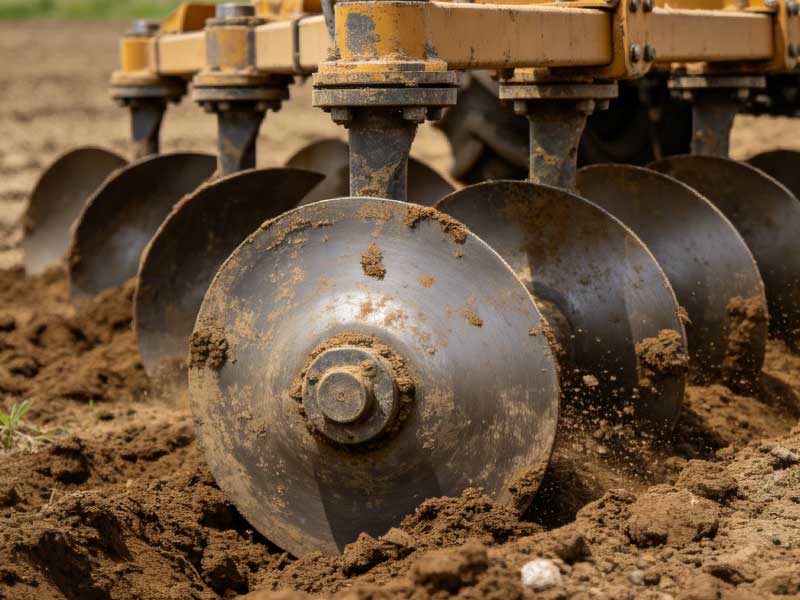
6. How to Evaluate a Casting Supplier:
When sourcing agricultural equipment castings, procurement teams should assess these core criteria beyond raw unit price:
6.1. Production Capacity & Seasonal Scalability
Agricultural‑part orders frequently spike ahead of planting and harvest cycles. Confirm whether your supplier can scale high‑volume runs without sacrificing quality or extending lead‑times.
6.2. In‑House Tooling & Mold Expertise
Suppliers with internal pattern‑making and tool‑building capability deliver shorter lead‑times for new‑project OEM/ODM orders. Outsourced tooling creates delays and version‑control risks.
6.3. Domain Experience with Wear‑Parts & Ground‑Engaging Components
General‑purpose foundries may lack practical understanding of agricultural‑field wear dynamics. Your partner should demonstrate past project experience with tillage teeth, harvester sprockets, and tractor structural castings.
6.4. Complete In‑House Processing Scope
Prefer vendors offering casting, heat‑treatment, CNC machining, and quality testing under one roof. Multiple‑vendor‑outsourced workflows increase quality inconsistency and delivery risks.
6.5. Quality‑Assurance Protocols
Confirm availability of material‑test reports, hardness certificates, dimensional inspection records, and compliance documentation for every batch.
7. Conclusion
Investing in premium‑grade agricultural equipment castings delivers tangible long‑term returns: extended component service life, fewer field breakdowns, and dramatic reduction of costly peak‑season downtime. Material selection, proper heat‑treatment, and selecting a competent OEM/ODM casting partner outweigh short‑term savings from low‑spec replacement parts.
If you are searching for reliable wear‑parts and structural castings for agricultural or construction machinery, partner with Lihuacasting. We bring extensive hands‑on expertise in casting and precision CNC machining. Lihuacasting delivers comprehensive custom‑solution support for both agricultural equipment castings and heavy‑duty construction GET parts, covering OEM blueprint replication and ODM performance‑optimized custom development. Our in‑house workflow includes pattern development, casting production, professional heat‑treatment, full‑range CNC finishing, and strict multi‑stage quality inspection.
RELATED NEWS
- Disc Plow vs Disc Harrow for Primary & Secondary Tillage 2026-09-18
- What Factors Affect Plough Share Service Life? 2026-09-15
- 2026 Bucket Teeth Selection Guide for Soil Rock and Mining 2026-09-11
- OEM vs Aftermarket Bucket Teeth: Which Delivers Better Value for Your Fleet? 2026-09-10
- Agricultural Ground‑Engaging Tools: Aftermarket & Sourcing 2026-09-08
CATEGORIES
LATEST NEWS
CONTACT US
Contact: Susanna Sun
Phone: +86 13706842897
E-mail: sue-sunwin@vip.163.com ; sophie091983@gmail.com
Whatsapp:+86 13706842897
Add: 1588 Jiangnan Road Ningbo High-tech Industry zone