Blog
How to Choose Right Industrial Steel Self-Dumping Forklift Hopper?
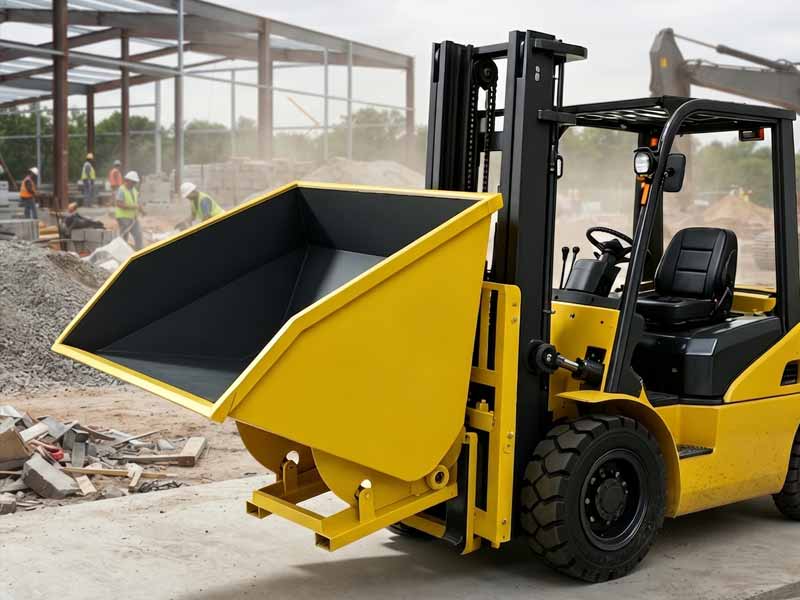
The Industrial Steel Self-Dumping Forklift Hopper is a foundational material-handling attachment for manufacturing plants, metal fabrication shops, recycling yards, and distribution warehouses.
Designed to slide onto standard forklift forks, this steel container tilts automatically to discharge scrap metal, CNC chips, construction debris, plastic waste, and bulk recyclables without manual lifting. A well-selected Industrial Steel Self-Dumping Forklift Hopper cuts material handling labor costs, reduces workplace injury risks, and streamlines waste removal workflows.
According to material handling industry surveys, facilities using properly sized self-dumping hoppers reduce waste handling cycle time by up to 32% and lower manual lifting incidents by more than 40% compared with static bins and manual wheeled containers.
1. Material Options & Construction of Industrial Steel Self-Dumping Forklift Hopper
Steel grade and plate thickness directly determine service life, impact resistance, and abrasion performance. Most standard models use carbon steel, while heavy-duty or corrosive environments require upgraded alloys. Powder coating is the standard surface finish to resist rust, scratches, and chemical splashes.
Steel Material Selection Guide for Industrial Steel Self-Dumping Forklift Hopper
| Material Grade | Plate Thickness (Side / Bottom) | Best Application | Core Advantages | Limitations |
|---|---|---|---|---|
| Mild Carbon Steel | 10 ga / 3/16 in | General warehouse waste, light packaging scraps | Low upfront cost, easy welding & repair | Poor corrosion resistance with wet/acidic materials |
| A36 Structural Steel | 7 ga / 1/4 in | Machine shops, metal chips, medium scrap | High tensile strength, impact-resistant | Surface must be coated for outdoor use |
| 304 Stainless Steel | 10 ga / 3/16 in | Food processing, chemical sludge, wet corrosive waste | Rust-proof, chemical resistant | Higher purchase price, lower impact resistance than A36 |
For heavy scrap metal, always prioritize reinforced bottom plates. The base frame and fork pockets are high-stress zones; continuous full welds are required to avoid cracking under repeated dumping cycles. Low-cost hoppers often use spot welds that fail quickly in high-volume operations.
2. Core Features & Working Principle
An Industrial Steel Self-Dumping Forklift Hopper uses gravity-balanced tipping design with a mechanical safety latch. When the forklift lifts the loaded hopper, the latch stays locked during transport. Operators pull a release cable at the dumping point; the hopper tilts forward to empty all contents, then automatically returns to upright position and re-locks when lowered back to ground.
Key features to evaluate:
- Integrated fork pockets, fully welded to the base frame
- Positive safety latch to prevent accidental dumping mid-transport
- Balanced tipping geometry for full material discharge
- Reinforced top lip to resist impact during loading
- Optional casters for floor mobility when not mounted on forklifts
Duty Class Comparison of Industrial Steel Self-Dumping Forklift Hopper
| Duty Class | Typical Volume | Safe Working Load | Estimated Daily Dump Cycles | Recommended Industry |
|---|---|---|---|---|
| Light Duty | 0.25 – 0.5 cu yd | 1,500 lbs | ≤10 | Maintenance rooms, small assembly workshops |
| Standard Duty | 0.75 – 1 cu yd | 2,000 lbs | 10–25 | CNC shops, general manufacturing, warehouse waste |
| Heavy Duty | 1 – 2 cu yd | 4,000 lbs | 25–50 | Metal recycling, fabrication, construction sites |
Market data shows the 1 cubic yard standard-duty Industrial Steel Self-Dumping Forklift Hopper remains the top-selling size across North America and Europe, accounting for nearly 46% of all self-dumping hopper orders, as it balances footprint, load capacity, and forklift compatibility for most mid-sized factories.
3. Typical Applications
The versatility of the Industrial Steel Self-Dumping Forklift Hopper makes it suitable across multiple sectors:
- Metal fabrication & CNC machining: collect steel chips, aluminum scraps, cutting waste
- Manufacturing & assembly plants: packaging waste, rejected parts, general plant trash
- Construction & demolition: rubble, concrete fragments, wood debris
- Recycling facilities: segregated metal, plastic, cardboard bulk collection
- Agriculture & food processing: organic byproducts (stainless steel variant)
Before selection, confirm your material bulk density. A hopper rated by cubic yard volume may reach its weight limit long before it is physically full with dense materials like steel chips. Overloading is the cause of hopper deformation, latch failure, and forklift stability hazards.
4. Step-by-Step Selection Checklist
Step 1: Calculate both volume and weight requirements
Do not only choose by cubic yard capacity. Calculate your average load weight per dump. Always match the hopper’s safe working load (SWL) to your heaviest expected batch, not average load.
Step 2: Verify forklift fork pocket compatibility
Measure your forklift fork width, thickness, and maximum fork insertion length. Standard fork pocket openings are 160 × 60 mm, but custom sizes are available for large heavy-duty forklifts. Mismatched fork pockets cause slipping, unstable lifting, and safety risks.
Step 3: Check site clearance & working space
Measure aisle width, overhead clearance, and dump zone space. Low-profile Industrial Steel Self-Dumping Forklift Hopper works better for narrow-aisle warehouses.
Step 4: Confirm safety compliance
Select units engineered to align with OSHA and ANSI material handling guidelines. Critical safety items include fail-safe latch mechanism, reinforced base, and clearly marked load rating labels.
Step 5: Evaluate supplier support & spare parts availability
Prioritize manufacturers offering replaceable latches, pivot pins, and hinge components. A low-cost hopper becomes a liability if Wear Parts cannot be sourced quickly.
Common Selection Mistakes & Risk Mitigation
| Common Mistake | Potential Risk | Mitigation Action |
|---|---|---|
| Choosing by volume only, ignoring material density | Overloading, structural bending | Calculate weight first; use heavy-duty model for dense scrap |
| Purchasing thin-gauge steel for high-impact scrap | Weld cracking, premature failure | Select A36 steel with reinforced bottom plate |
| Skipping safety latch inspection | Unintended dumping during transport | Confirm positive auto-reset latch before purchase |
| Ignoring fork pocket dimension check | Fork slippage during lifting | Measure fork specs and share with manufacturer |
5. Maintenance & Lifespan Best Practices
Even robust Industrial Steel Self-Dumping Forklift Hopper requires routine preventive maintenance to maximize service life and maintain safe operation. Properly maintained standard-duty hoppers can deliver 7–10 years of service, while neglected units may fail within 2–3 years.
Daily Pre-Shift Check
- Inspect latch, cable, pivot pins for wear or deformation
- Check weld seams for cracks, especially at fork pockets and base frame
- Remove trapped debris that can jam the tipping mechanism
Weekly Maintenance
- Lubricate hinge and pivot points with industrial grease
- Clean internal residue to avoid corrosion and material buildup
- Inspect powder coating; touch up scratched areas to prevent rust spread
Monthly Full Inspection
- Verify load labels are legible
- Tighten all bolts and fasteners
- Test dumping cycle to confirm smooth auto-reset and secure locking
Maintenance warnings: Never weld or modify the hopper frame, fork pockets or safety latch without manufacturer approval. Any structural modification voids safety certification and creates severe operational hazards. Avoid shock loading and dropping the hopper on hard surfaces.
6. Final Summary
Choosing the right Industrial Steel Self-Dumping Forklift Hopper balances material construction, load rating, forklift compatibility, safety design, and long-term maintenance cost. Start by analyzing your material type, density, daily dump cycles, and site space constraints. Match steel thickness and duty class to your toughest operating scenario, not your average workload.
RELATED NEWS
- Disc Plow vs Disc Harrow for Primary & Secondary Tillage 2026-09-18
- What Factors Affect Plough Share Service Life? 2026-09-15
- 2026 Bucket Teeth Selection Guide for Soil Rock and Mining 2026-09-11
- OEM vs Aftermarket Bucket Teeth: Which Delivers Better Value for Your Fleet? 2026-09-10
- Agricultural Ground‑Engaging Tools: Aftermarket & Sourcing 2026-09-08
CATEGORIES
LATEST NEWS
CONTACT US
Contact: Susanna Sun
Phone: +86 13706842897
E-mail: sue-sunwin@vip.163.com ; sophie091983@gmail.com
Whatsapp:+86 13706842897
Add: 1588 Jiangnan Road Ningbo High-tech Industry zone