Blog
Disc Plow vs Disc Harrow for Primary & Secondary Tillage
Disc plow and disc harrow are two widely adopted tillage implements fitted with rotating steel discs, yet they serve distinct farming workflows. Many farm contractors and farm equipment buyers confuse disc plow and disc harrow when sourcing agricultural G.E.T parts or specifying new tillage machinery. Although both use round steel discs to cut soil, their working depth, structural design, soil disturbance function and target applications differ greatly.
Global agricultural tillage equipment market data shows the disc harrow market reached USD 2.8 billion in 2025, with a projected CAGR of 5.2% through 2033, driven by rising demand for residue management and seedbed preparation. Meanwhile, the disc plow market hit USD 2.01 billion in 2025, growing at 5.2% CAGR, mainly from land reclamation and heavy-soil primary tillage projects across commercial farms worldwide. This market split reflects a clear functional separation: disc plow for primary deep tillage, disc harrow for secondary finishing tillage.
1. Core Function & Tillage Classification
Disc Plow (Primary Tillage)
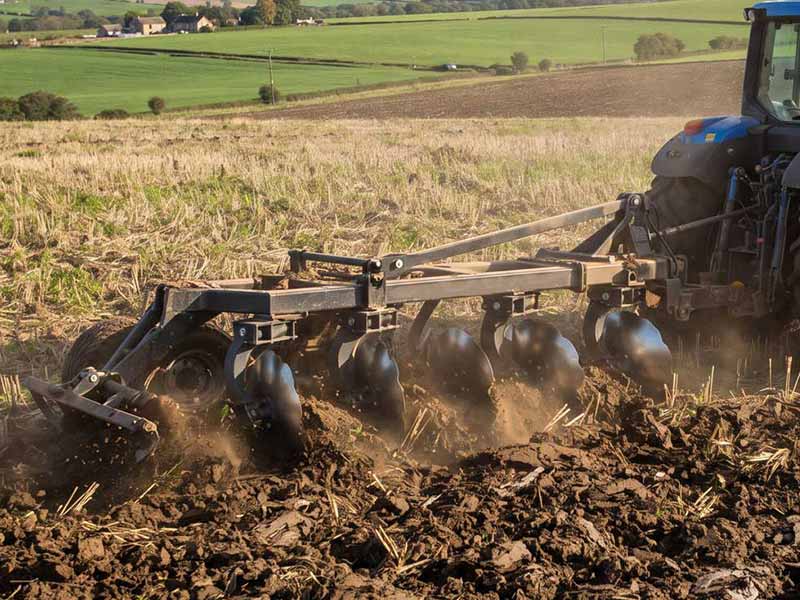
Disc plow belongs to primary tillage equipment. Its core task is breaking uncultivated hard ground, virgin land or heavy clay soil, cutting and fully inverting soil layers to bury weeds, crop stubble and debris deep underground. Each disc is mounted on an independent arm and bearing assembly, with large disc diameter and aggressive tilt angle. The concave disc slices and flips soil, leaving obvious furrows after pass. It is ideal for land reclamation, compacted heavy soil and fields requiring full burial of surface biomass.
Disc Harrow (Secondary Tillage)
Disc harrow is secondary or finishing tillage equipment, used after primary plowing. It is designed to crush clods, chop stubble residue, mix organic matter evenly into topsoil and level the field surface before seeding. Discs are grouped into gangs on shared axles, commonly fitted with notched discs. Instead of full soil inversion, disc harrow cuts and mixes topsoil to create a fine, uniform seedbed with minimal deep disturbance.
Table 1: Key Working Parameter Comparison
| Item | Disc Plow | Disc Harrow |
|---|---|---|
| Tillage Category | Primary Tillage | Secondary / Finishing Tillage |
| Typical Working Depth | 20–35 cm | 8–15 cm |
| Disc Diameter Range | 600–800 mm+ | 400–600 mm |
| Disc Arrangement | Independent single disc on separate arm | Disc gangs mounted on shared axle |
| Soil Action | Full soil inversion, bury residue | Chop, mix and level, limited inversion |
| Recommended Soil Type | Heavy clay, hard compacted soil, virgin land | Loose tilled soil, post-plow fields, stubble fields |
2. Structural & G.E.T Wear Component Differences
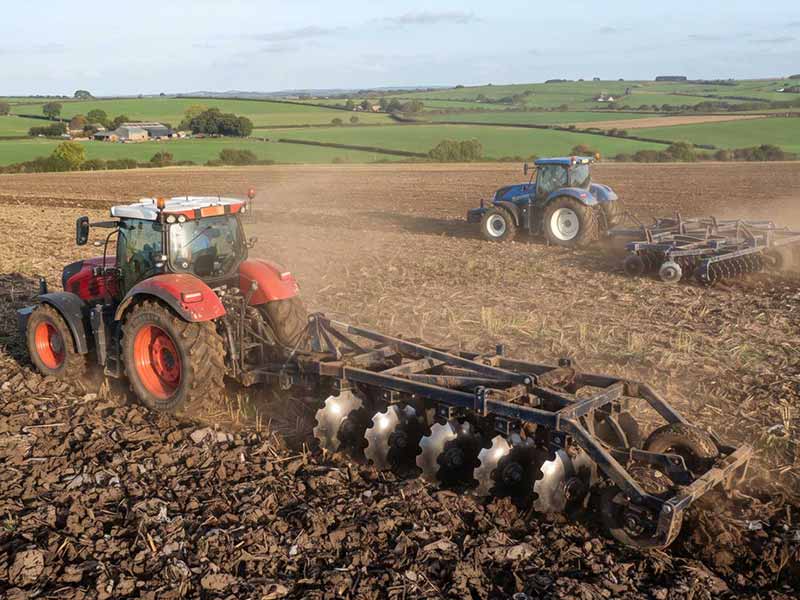
The structural difference directly impacts your agricultural G.E.T parts procurement and maintenance cycle. Disc plow discs bear heavy shock load during deep cutting, so they require high tensile alloy steel, thicker plate and reinforced bearing housings. Independent arm design lets each disc follow uneven ground, but puts concentrated stress on disc edges and bearing seals. Wear Parts for disc plow focus on impact resistance and deep abrasion under heavy loads.
Disc harrow gangs run at shallow depth with continuous sliding and cutting against stubble and small stones. Notched discs are the preferred G.E.T component for disc harrow, delivering superior cutting performance on corn, wheat and soybean residue. Seal quality on gang bearings becomes critical, as frequent surface debris can damage bearing assemblies if seals fail.
Table 2: G.E.T Wear Parts & Maintenance Reference
| Attribute | Disc Plow G.E.T Parts | Disc Harrow G.E.T Parts |
|---|---|---|
| Main Wear Component | Plain heavy-duty disc plow blades, arm bushings | Notched disc harrow blades, gang bearings, scraper parts |
| Primary Failure Mode | Edge chipping, heavy abrasion, impact crack | Blade dulling, seal contamination, bushing wear |
| Material Recommendation | High carbon boron steel, hardened to HRC 48–54 | 65Mn alloy steel, induction hardened cutting edge |
| Service Focus | Shock resistance for deep rocky soil | Continuous cutting performance & dust sealing |
3. Field Application & Farm Operation Selection
Choosing between disc plow and disc harrow depends on your soil type, crop rotation and tillage objectives. Industry agronomy data indicates primary tillage with disc plow reduces surface weed population by 70–85% by burying weed seeds deep below germination zone, which is valuable for organic farming and fallow land renovation. However, disc plow consumes higher tractor horsepower and disturbs deeper soil structure, so it is not recommended for annual repeated use in conservation tillage systems.
Disc harrow is the workhorse for seedbed preparation. It can process large acreage quickly after harvest, mixing residue into topsoil to accelerate decomposition. For no-till or reduced-till operations, offset disc harrow versions handle residue management without full soil inversion, preserving soil moisture and organic carbon.
Table 3: Operation & Power Matching Guide
| Operation Factor | Disc Plow | Disc Harrow |
|---|---|---|
| Tractor HP Requirement | High, 80–220 HP for standard models | Medium, 40–180 HP depends on working width |
| Field Condition | Hard, uncultivated, heavy clay, rocky land | Post-plowed land, stubble field, loam & sandy soil |
| Typical Working Speed | 4–6 km/h | 6–10 km/h |
| Best Use Case | Land reclamation, breaking hardpan, burying heavy weed growth | Seedbed preparation, stubble chopping, clod crushing |
4. Buying & OEM Sourcing Advice for B2B Buyers
As a manufacturer of agricultural G.E.T and casting wear parts, Lihuacasting frequently supports farm equipment dealers, contractors and global importers selecting and replacing discs and related components.
When sourcing for disc plow: Prioritize heavy-duty cast support arms, thick plain discs and robust bearing housings. For clients working in dry, rocky heavy clay, we recommend hardened alloy discs with high impact resistance. OEM casting service is available for custom disc plow components.
When sourcing for disc harrow: Focus on notched disc quality and bearing seal rating. Many large commercial farms order high volumes of replacement disc harrow blades each season, as these agricultural G.E.T parts wear faster under continuous residue cutting. We supply OEM disc harrow discs with controlled heat treatment to extend service life and reduce downtime.
5. FAQ
Q1: Can I replace disc plow with disc harrow for deep land breaking?
A: No. Disc harrow lacks the structural rigidity and disc angle to invert deep soil. It will only scratch topsoil and cannot break hardpan or virgin land.
Q2: Are disc plow and disc harrow discs interchangeable?
A: Generally not. Disc plow discs are thicker, larger and designed for impact inversion. Disc harrow discs, especially notched types, are optimized for shallow cutting. Mixing them will cause rapid failure and poor tillage results.
Q3: What is the best G.E.T upgrade for high residue fields?
A: Select notched disc harrow blades for post-harvest residue management. For heavy virgin land clearing, use reinforced disc plow discs with boron steel hardfacing.
6. Final Summary
Disc plow handles primary deep tillage to invert soil and prepare new ground, while disc harrow performs secondary shallow tillage to crush clods, chop stubble and create fine seedbeds. Understanding this difference helps you select the right implement and corresponding agricultural G.E.T wear parts, lowering operating cost and maximizing field efficiency. Lihuacasting provides OEM casting, heat-treated disc blades and custom G.E.T components for both disc plow and disc harrow, supporting distributors and farm contractors worldwide.
RELATED NEWS
- What Factors Affect Plough Share Service Life? 2026-09-15
- 2026 Bucket Teeth Selection Guide for Soil Rock and Mining 2026-09-11
- OEM vs Aftermarket Bucket Teeth: Which Delivers Better Value for Your Fleet? 2026-09-10
- Agricultural Ground‑Engaging Tools: Aftermarket & Sourcing 2026-09-08
- Mining Truck Dump Body:Trends, Material Technology & Procurement Guide for 2026‑ 2026-09-03
CATEGORIES
LATEST NEWS
CONTACT US
Contact: Susanna Sun
Phone: +86 13706842897
E-mail: sue-sunwin@vip.163.com ; sophie091983@gmail.com
Whatsapp:+86 13706842897
Add: 1588 Jiangnan Road Ningbo High-tech Industry zone