Blog
What Factors Affect Plough Share Service Life?
The service life of Plough Shares directly affects agricultural machinery downtime, replacement costs, and overall tillage efficiency. Multiple interconnected factors determine how quickly a plough share wears, bends or fractures, ranging from soil abrasive properties and material selection to manufacturing quality and operating parameters.
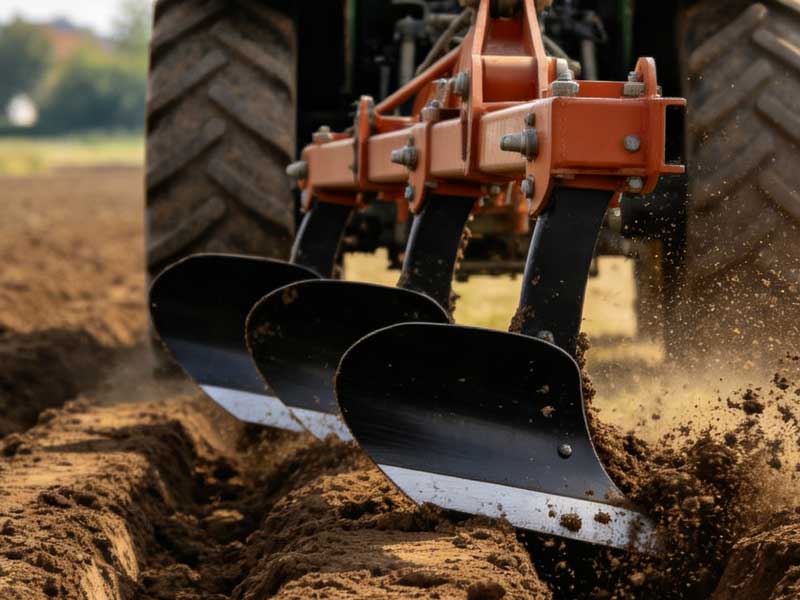
1. Soil Conditions (The Most Dominant Factor)
Soil composition, specific resistance and embedded debris are the largest drivers of plough share abrasion and impact damage.
- Soil specific resistance: Higher soil specific resistance creates continuous friction and bending load on the plough share. Heavy clay and virgin land with resistance up to 0.9–1.5 kg/cm² generate far greater stress than loose sandy loam.
- Abrasive particles: Sand, quartz and gravel cause abrasive wear. Sandy and stony soil will wear away the cutting edge rapidly, even for high-grade plough share.
- Embedded stones & rock fragments: Random rock impacts create shock loads. Brittle materials such as chilled cast iron tend to chip or crack under rock collision.
| Soil Type | Abrasion Level | Typical Plough Share Wear Pattern |
|---|---|---|
| Sandy loam | Medium | Gradual, uniform edge rounding |
| Clay / heavy clay | Medium–High | Bending stress plus moderate abrasion |
| Stony, sandy soil | Very High | Fast edge thinning, risk of impact chipping |
2. Material Grade & Heat Treatment
Material selection and heat treatment define the balance between hardness (wear resistance) and toughness (impact resistance).
- 65Mn forged steel: Proper quenching and tempering delivers HRC 50+ hardness for general farmland. Improper heat treatment leads to soft matrix (fast wear) or excessive brittleness (easy cracking).
- CADI and bimetallic cast plough share: Higher alloy content delivers superior wear performance, especially for abrasive soil.
- Chilled cast iron: Hard white iron surface layer provides wear resistance, but the substrate is brittle; once the white layer wears off, the share degrades quickly.
| Plough Share Material | Hardness | Wear Resistance | Impact Toughness |
|---|---|---|---|
| 65Mn forged steel | HRC 50+ | Good | High |
| Chilled cast iron | White layer HRC 48–52 | Medium | Low |
| CADI | HRC 52–58 | Excellent | Medium–High |
| Bimetallic (high-Cr edge) | Edge HRC 60+ | Outstanding | Medium |
3. Manufacturing & Structural Design
The forming process and geometry design affect stress distribution and local wear rate.
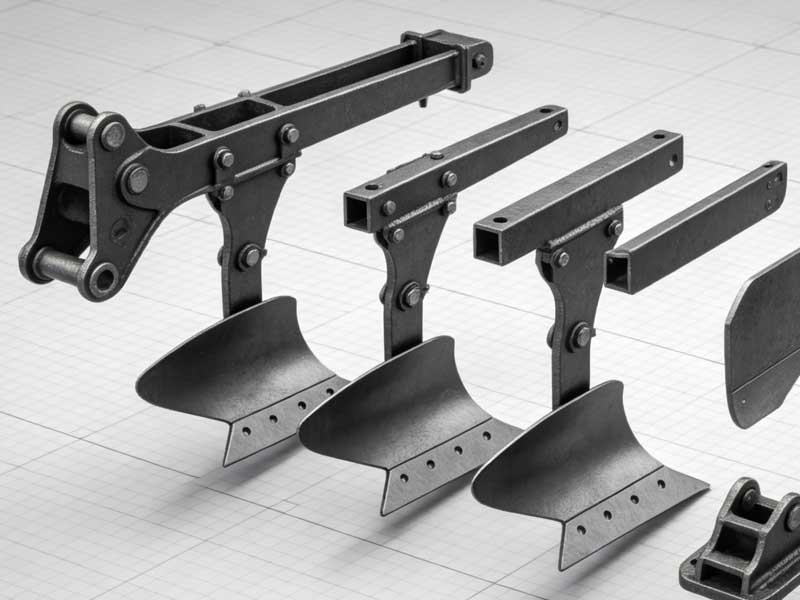
- Forming process: Forged plough shares have compact grain structure; casting quality controls porosity and internal defects. Defects like shrinkage cavities will trigger early fracture.
- Share geometry: Chisel plough share with extended offset tip reduces wear on the main body; modular plough share concentrates wear on replaceable tips.
- Surface reinforcement: Tungsten carbide hardfacing on the cutting edge can double service life by adding a local wear-resistant layer.
4. Operational Parameters
Field operation settings greatly influence the actual working load of the plough share.
- Tillage depth: Greater depth increases soil contact area and reaction force, accelerating wear and bending.
- Forward speed: Higher travel speed raises impact frequency against soil aggregates and stones.
- Plough alignment: Incorrect installation angle creates uneven load. One-sided overload causes asymmetric edge wear.
- Maintenance schedule: Delayed sharpening increases cutting resistance and accelerates further damage.
| Operating Parameter | Effect on Plough Share Service Life |
|---|---|
| Greater tillage depth | Higher friction, faster wear |
| Higher working speed | More impacts, higher chipping risk |
| Misaligned mounting | Uneven wear, premature bending |
| Dull cutting edge | Rising draft force, extra fuel cost |
5. Maintenance & Storage
Routine maintenance also changes usable life.
- Regular sharpening keeps low cutting resistance.
- Repair by hardfacing worn edges can extend service life without full replacement.
- Long-term outdoor storage leads to surface rust, which accelerates abrasion during the next tillage pass.
Summary
Soil condition is the primary factor affecting plough share service life, followed by material grade, heat treatment, manufacturing quality, operating settings and maintenance. For buyers of agricultural GET parts, matching the plough share material and design to local soil conditions is the most cost-effective way to reduce replacement frequency and operational downtime.
Lihuacasting offers various types of ploughshares and customizes agricultural machinery parts to meet specific requirements. Contact us for more information.
RELATED NEWS
- 2026 Bucket Teeth Selection Guide for Soil Rock and Mining 2026-09-11
- OEM vs Aftermarket Bucket Teeth: Which Delivers Better Value for Your Fleet? 2026-09-10
- Agricultural Ground‑Engaging Tools: Aftermarket & Sourcing 2026-09-08
- Mining Truck Dump Body:Trends, Material Technology & Procurement Guide for 2026‑ 2026-09-03
- How to Reduce Loader Blade Fleet Operating Costs? 2026-09-01
CATEGORIES
LATEST NEWS
CONTACT US
Contact: Susanna Sun
Phone: +86 13706842897
E-mail: sue-sunwin@vip.163.com ; sophie091983@gmail.com
Whatsapp:+86 13706842897
Add: 1588 Jiangnan Road Ningbo High-tech Industry zone