Blog
Why Does Plough Point Hardness Matter?
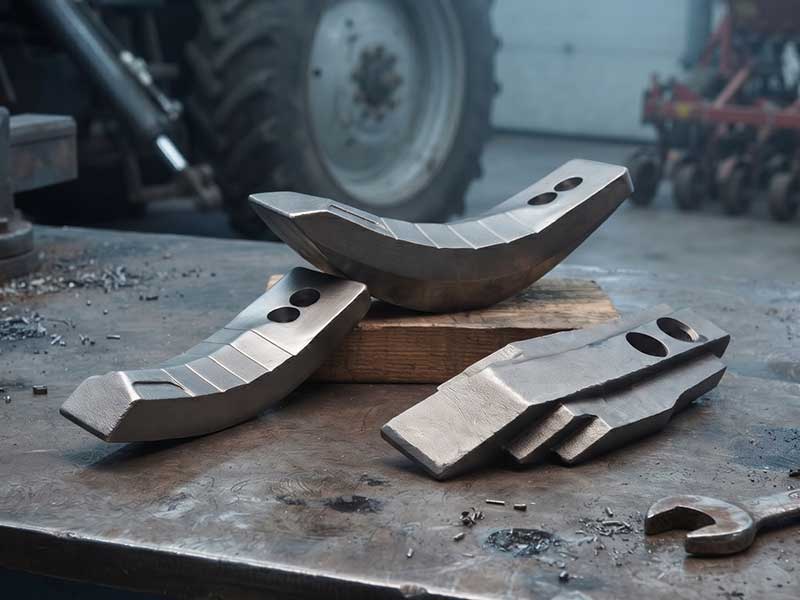
Plough point hardness is the single most critical specification when sourcing durable ploughshares and agricultural casting parts, directly shaping service life, fuel consumption and tillage consistency for every farming operation.
Many buyers mistakenly chase the highest HRC number available, ignoring the essential trade-off between surface hardness and core impact resistance. A plough point pushed beyond its material toughness threshold will chip, crack or snap in stony fields, even if its wear resistance looks excellent on paper.
Field research on mouldboard ploughshare abrasion confirms that a plough point at 55 HRC delivers roughly 1.5× lower wear than a 45 HRC part and 2.5× better wear performance compared to a 29 HRC plough point under identical clay tillage conditions, proving that calibrated hardness delivers measurable returns for bulk buyers sourcing agricultural machinery castings.
Hardness, Material and Typical Field Lifespan for Cast Plough Points
| Material Grade | Edge Hardness (HRC) | Core Hardness (HRC) | Estimated Working Hrs (Sandy Soil) | Failure Risk |
|---|---|---|---|---|
| Standard Cast Carbon Steel | 36–42 | 32–38 | 80–130 | Rapid edge rounding |
| Boron Steel Cast (30MnB5) | 48–54 | 38–44 | 220–320 | Low, balanced toughness |
| 42CrMo Heat-Treated Cast | 52–58 | 40–46 | 300–420 | Minimal if heat treatment controlled |
This data is drawn from our internal field validation and third-party wear testing for our OEM plough point casting range. Sandy soil, loaded with silica particles, acts like continuous abrasive grit, wearing away softer cast plough points much faster than loam or clay ground.
If your market serves sandy regions, boron steel or 42CrMo cast ploughshares become the preferred selection to reduce repeat orders and support your end customers’ uptime targets.
Hardness also directly affects the self-sharpening behaviour of your ploughshare. A well-calibrated cast plough point wears gradually, maintaining a sharp cutting edge through thousands of hectares.
When hardness is inconsistent across the casting, one side wears faster than the other, pulling the plough off line, increasing draft force and forcing operators to slow down.
Independent tribology studies note that uneven wear from inconsistent hardness can raise tractor fuel consumption by 12–18% during deep tillage, a major ongoing expense for commercial farms and rental fleets alike.
Wear Rate by Plough Point Hardness Across Common Soil Types
The table above normalises wear against the soft baseline of 29 HRC cast plough points. While harder grades always win for abrasion resistance, rocky ground changes the calculation.
In fields with frequent stone contact, a 58+ HRC plough point may suffer edge spalling, while a carefully tempered boron steel casting at 50–54 HRC absorbs impact without premature fracture.
This is why our agricultural casting engineering team avoids a one-size-fits-all hardness specification for ploughshares; we adjust quenching and tempering cycles based on your target market and application requirements for custom OEM orders.
For importers and spare parts distributors, hardness consistency across batches is just as important as the nominal HRC value. Variations from poor casting control mean one container of plough points lasts twice as long as the next, eroding customer trust and creating warranty headaches.
At our foundry, every batch of cast plough points goes through magnetic particle inspection (MT) and hardness sampling, verifying uniform material structure before shipment. We also offer optional ultrasonic testing (UT) for heavy-duty lines, ensuring internal casting defects do not undermine the hardness and toughness designed into each ploughshare.
Buyer Decision Guide for Matching Plough Point Hardness to End-User Conditions
| Primary Field Condition | Recommended Edge Hardness | Preferred Cast Material | Key Advantage for Resellers |
|---|---|---|---|
| Sandy, abrasive, low stone | 54–58 HRC | 42CrMo cast alloy | Maximum service interval, fewer service calls |
| Mixed loam / moderate stone | 48–54 HRC | Boron steel casting | Balanced wear and impact strength |
| Stony, compacted, rough tillage | 44–48 HRC | Modified boron cast | Resists cracking under shock load |
Cheap cast ploughshares often have a thin surface hard coat that wears away quickly, exposing soft base metal and collapsing edge geometry after a short working window. Our heat treatment process creates a gradual hardness gradient, so the cutting edge stays hard while the plough point body remains ductile, protecting the mounting base from fatigue failure.
Hardness also ties closely to compliance and aftermarket branding. If you supply branded replacement ploughshares for well-known plough models, consistent HRC performance lets you market a predictable lifespan and build repeat business. We support custom casting, private labelling and model-specific plough point production, with full material certificates and hardness test reports included for large OEM or wholesale shipments. Whether you need reversible plough points, chisel plow tips or matched sets for mouldboard ploughs, our engineering team can adjust casting geometry and thermal processing to hit your exact hardness target.
RELATED NEWS
- How to Choose the Right Sickle Sections for Combine Mower and Swather Headers? 2026-11-05
- Heavy-Duty Disc Harrows vs. Light-Duty Disc Harrows 2026-11-03
- How to Choose the Right Subsoiler Shank for Your Implement? 2026-10-29
- Disc Harrow Guide: Adjustment, Maintenance, Troubleshooting & Working Width Sele 2026-10-28
- How to Overcome Tool Wear Challenges When Machining High-Hardness Iron Castings? 2026-10-23
CATEGORIES
LATEST NEWS
CONTACT US
Contact: Susanna Sun
Phone: +86 13706842897
E-mail: sue-sunwin@vip.163.com ; sophie091983@gmail.com
Whatsapp:+86 13706842897
Add: 1588 Jiangnan Road Ningbo High-tech Industry zone