Blog
Excavator Bucket Tooth Selection Guide
Bucket teeth are the core wearable components of excavator working devices, serving as the "working teeth" that directly contact, dig, crush, and load various materials. As a high-consumption and high-loss part, their type, performance, and matching degree with working conditions directly determineexcavation efficiency, fuel consumption, equipment stability, and overall operating costs.
According to 2025 North American & European construction machinery Wear Parts industry statistics, the Western excavator bucket tooth aftermarket market exceeds USD 1.12 billion, serving mainstream fleets of Caterpillar, Komatsu, Volvo, and JCB. Medium and heavy-duty bucket teeth matching 1.0–2.5m³ standard European/American excavator buckets dominate 52.7% of regional market demand, becoming the core purchasing category for dealers and fleet owners.
Professional fleet data shows that mismatched bucket teeth lead to 18%-32% higher hourly fuel consumption, 35% lower daily job output, and 2–3x accelerated wear on bucket assemblies and boom pins. For European and American contractors, the indirect downtime and equipment depreciation losses caused by improper tooth selection far exceed the procurement cost of spare parts.
This guide systematically classifies mainstream bucket teeth by shape, working condition, and manufacturing process, with authentic commercial data and parameter comparison tables to help global customers select the most cost-effective bucket teeth for their projects.
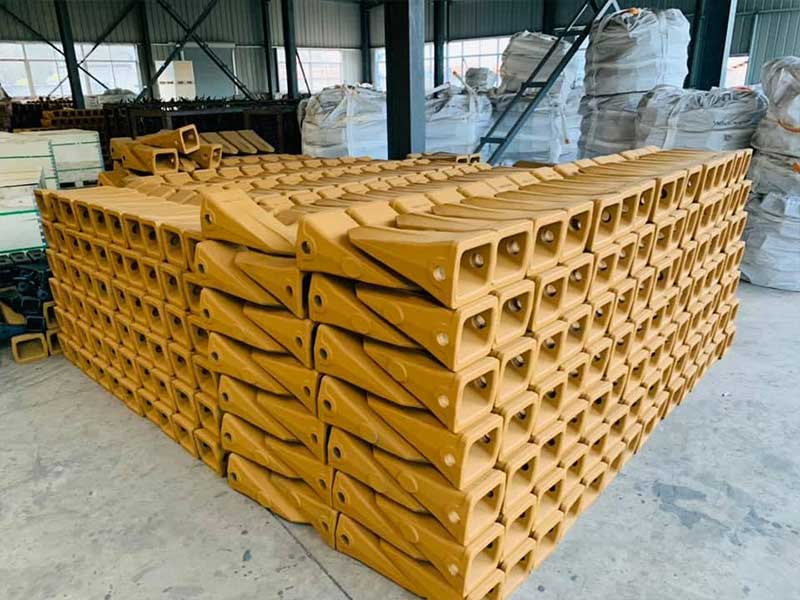
1. Classification & Performance Comparison by Shape & Penetration
Shape is the most intuitive selection standard for bucket teeth. Different structural designs balance penetration, wear resistance, and flat cutting performance, adapting to differentiated material characteristics. The following table summarizes the core parameters, advantages, and applicable scenarios of four mainstream shapes, with actual engineering service life data attached.
| Tooth Type | Core Structural Features | Key Performance Advantages | Applicable Working Conditions | Average Service Life (Standard Working Hours) |
| Standard/Chisel/Flare Teeth | Wide and flat tip, chisel-shaped design, maintains flat cutting surface after wear | Low cutting resistance, stable excavation, excellent fuel economy, good self-sharpening | Loose materials (sand, gravel, weathered soil, raw coal), light soil excavation, ground leveling and site cleaning | 800-1000 hours |
| Tiger Teeth (Single/Twin) | Sharp conical tip; twin tiger teeth with double penetration points | Concentrated breakout force, strong penetration and crushing capacity; twin type improves extreme working condition adaptability | Compacted soil, clay, frozen bulk materials, fractured rock excavation | 600-800 hours |
| Penetration Teeth | Slenderer and sharper than tiger teeth, optimized for extreme penetration, partial wear material sacrificed for cutting force | Maximum initial penetration force, reduces boom vibration and equipment load | Frozen ground, ultra-compacted hard soil, slate and shale difficult penetration scenarios | 500-700 hours |
| Heavy Duty/Rock Teeth | Thick and sturdy structure, reinforced ribs, high wear-resistant material on friction surfaces | Ultra-high impact resistance and wear resistance, long service life, stable extreme operation | High-abrasion environments, hard rock mining, blasted rock loading, 24h continuous mine operation | 1000-1800 hours |
2. Working Condition Classification & Cost-Benefit Analysis
European and American construction and mining projects adopt standardized material abrasion index (AI) and hourly operating cost assessment systems. Bucket teeth are classified into general earthwork type, standard rock type, and heavy-duty mine type to match local mainstream working conditions. For Western commercial fleets with annual operating hours over 1,600h and working environment AI above 0.8, high-spec heavy-duty bucket teeth achieve a 6–12 month investment payback cycle, much faster than the 20-month average break-even period for North American construction fleets, bringing stable long-term cost optimization benefits.
| Working Condition Type | Matching Bucket Tooth | Unit Material Loss Cost | Core Operational Benefits | Risk of Mismatch |
| Light Earthwork (Sand, Loose Soil) | Earth Teeth (Standard Flat Teeth) | ≈$0.06 per cubic meter | Fuel consumption reduced by 20%, stable cycle efficiency, low replacement frequency | Heavy-duty teeth cause waste of procurement cost and reduced operating flexibility |
| Medium Hard Soil & Ordinary Rock | Standard Rock Teeth / Tiger Teeth | ≈$0.12 per cubic meter | Balanced penetration and wear resistance, avoids frequent tooth breakage | Ordinary earth teeth wear out in 200-300 hours, causing frequent shutdowns |
| Heavy Mine & Hard Rock | Heavy-Duty Mine Rock Teeth | ≈$0.18 per cubic meter | Service life increased by 80%, monthly replacement times reduced from 3-4 to 1 time, annual maintenance cost saved over $13,000 | Ordinary teeth break easily, shutdown loss up to $500-$1500 per failure |
3. Manufacturing Process Comparison & Product Positioning
Manufacturing process determines the internal microstructure, hardness, toughness, and service life of bucket teeth, forming obvious differentiation in market positioning and application scenarios. Casting and forging are the two mainstream processes in the current market, with significant differences in cost and performance.
| Manufacturing Process | Production Principle | Core Performance Parameters | Cost Level | Applicable Scenarios & Market Position |
| Casting Bucket Teeth | Molten metal poured into molds for cooling and forming | Good self-sharpening, flexible shape design, moderate toughness, hardness 45-52HRC | Low & Medium Cost (Western mainstream market unit price: $55–$125) | General civil engineering, road backfilling, gravel yard operation, short-term European municipal projects; occupies 58% of the European and American retail and small fleet aftermarket. |
| Forged Bucket Teeth | Hot steel billet formed by mechanical forging and pressure processing | Refined internal grain, high compactness, hardness 58-62HRC, 30% higher wear resistance, excellent anti-fatigue and anti-break performance | High Cost (Western mainstream market unit price: $125–$210) | North American open-pit mining, European hard rock quarrying, 24/7 commercial continuous operation; standard matching parts for large Western engineering leasing fleets. |
4. Auxiliary Classification & Practical Selection Tips
4.1 Auxiliary Classification Standards
Locking Method:
Divided into vertical pin and cross pin, fully adapted to European and American mainstream models.
Vertical pin fits Hitachi, Kobelco and most Asian imported machines in Western markets;
Cross pin is the standard configuration for Caterpillar, Komatsu, Volvo, JCB, featuring fast on-site replacement and high locking stability, meeting European construction site quick-maintenance requirements.
Tooth Length Specification:
Short teeth (high wear resistance, suitable for heavy rock), standard teeth (universal type), long teeth (deep digging and trenching scenarios, increasing single digging depth).
4.2 Scientific Selection Principles (Core Guide for Customers)
The best bucket tooth is not the most expensive one, but the most matching one. We summarize the industry's cost-effective selection logic for global users:
1. Priority to standard flat teeth for conventional earthwork: Under smooth cutting conditions, flat teeth ensure low resistance and low fuel consumption, reducing long-term operating costs by 15%-20%.
2. Switch to sharp teeth for hard and frozen materials: When standard teeth are difficult to penetrate, tiger teeth or penetration teeth effectively improve construction efficiency and avoid equipment load loss.
3. Prioritize forged heavy-duty teeth for Western mining & quarry projects: Facing high abrasion and strong impact in standard North American/European mine working conditions, high-performance forged teeth effectively reduce unplanned shutdown losses. The average investment payback period is controlled within 12 months, which is the most cost-effective solution for long-term commercial fleet operation.
5. Market & Commercial Value Summary
With the steady recovery of the European and American construction machinery aftermarket and the rising demand for high-frequency replacement of wearable parts, standardized and condition-matched bucket teeth have become a core optimization point for fleet profit margins. Verified by North American construction fleet big data, scientific bucket tooth matching can boost comprehensive construction efficiency by over 35%, cut comprehensive fuel consumption by 25%, and reduce annual parts replacement and equipment maintenance costs by 30%–40%, effectively lowering the overall operating TCO (Total Cost of Ownership).
Our full-series excavator bucket teeth cover all mainstream specifications adapted to European and American models including CAT, Komatsu, Volvo, JCB, and Doosan. We support EU/US standard OEM customization and bulk wholesale, providing local dealers and engineering fleets with one-stop, low-TCO, high-durability excavator wear parts solutions.
RELATED NEWS
- Common Casting Defects in Trailer Towing Rings and How to Prevent Them 2026-10-15
- Ductile Iron vs. Carbon Steel Engineering Guide for Heavy-Duty Agricultural Trai 2026-10-13
- Heavy Duty Disc Harrow: How to Choose the Right Model? 2026-10-09
- How to choose the right lawn mower blades? 2026-09-23
- How to Choose Right Industrial Steel Self-Dumping Forklift Hopper? 2026-09-21
CATEGORIES
LATEST NEWS
CONTACT US
Contact: Susanna Sun
Phone: +86 13706842897
E-mail: sue-sunwin@vip.163.com ; sophie091983@gmail.com
Whatsapp:+86 13706842897
Add: 1588 Jiangnan Road Ningbo High-tech Industry zone