Blog
Excavator Bucket Teeth Replacement Standards and Heat Treatment Technology
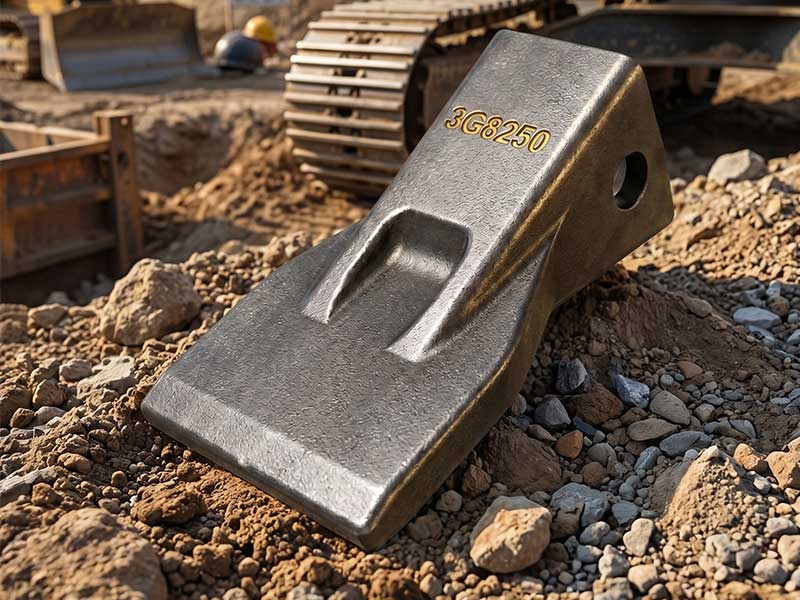
Bucket teeth are core wearable components of excavators, directly determining excavation efficiency, equipment fuel consumption and construction safety. Unlike conventional mechanical parts with fixed service cycles, the service life and replacement frequency of excavator bucket teeth depend entirely on construction working conditions and the inherent wear resistance of the teeth themselves. As a key part of Ground Engaging Tools (G.E.T.), their maintenance standards, manufacturing techniques and heat treatment processes are critical to overall equipment operating costs and construction stability.
1. Bucket Tooth Replacement Judgment Standards and Cycles
There is no unified fixed-time replacement standard for excavator bucket teeth. The service cycle varies drastically across different working conditions.
In general soft soil and earthwork projects, a set of bucket teeth can serve for several months.
In contrast, under high-intensity mine and rock operation scenarios, bucket teeth may wear out and require replacement within dozens of hours or a few days.
The actual replacement judgment relies on three core indicators: excavation penetration performance, tooth seat matching clearance and daily safety status.
1.1 Declined Penetration and Increased Operating Loss
When the tooth tip is severely blunted, the cutting resistance of the excavator rises sharply, leading to a significant drop in penetration capacity. Continuous operation with worn bucket teeth will not only reduce construction efficiency and increase fuel consumption, but also cause excessive mechanical wear on the excavator’s boom and hydraulic system, accelerating the aging of core equipment components.
1.2 Excessive Matching Clearance Between Tooth and Adapter
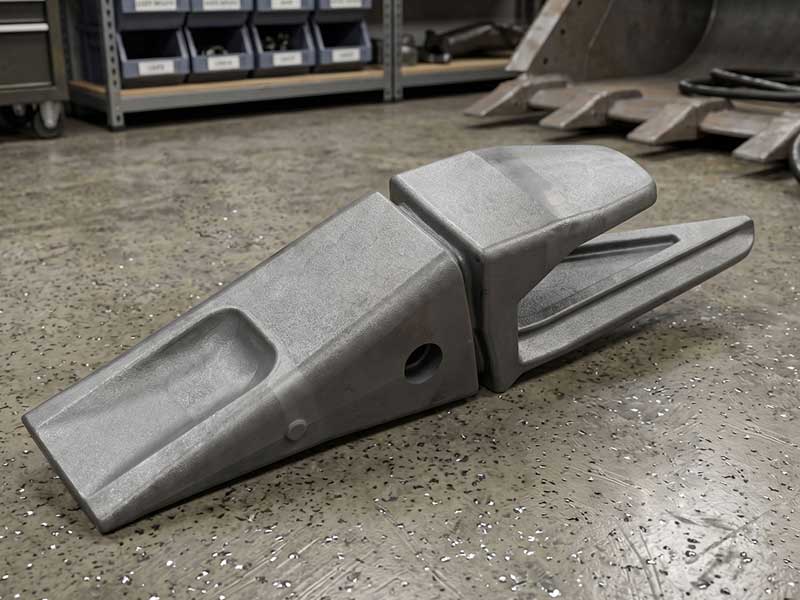
This is a key blind spot in G.E.T. after-sales maintenance. Industry practice shows that if the wear degree of the tooth adapter exceeds 10%–15%, the adapter is strongly recommended to be replaced together with the bucket tooth. Excessive wear of the adapter will create redundant gaps between the adapter and the new tooth, resulting in offset stress points. This problem is the main cause of sudden fracture of brand-new bucket teeth during operation, which is easily overlooked in daily maintenance.
1.3 Daily Safety Hazards and Emergency Replacement Rules
Operators must inspect pin tightness before daily startup. Once penetrating cracks or severe structural defects are found on the bucket tooth surface, immediate replacement is mandatory. Abnormal breakage of bucket teeth during high-load operation will not only damage excavator accessories but also trigger serious on-site safety accidents.
2. Mainstream Manufacturing Processes of Bucket Teeth
In the G.E.T. aftermarket, the service life and overall performance of bucket teeth are fundamentally determined by manufacturing processes and quality control systems. Three mainstream production technologies dominate the current market, with obvious differences in process accuracy, mechanical properties and applicable working conditions. The detailed comparison is shown in the table below.
| Manufacturing Process | Process Principle | Core Advantages | Limitations | Applicable Scenarios |
| Precision Casting (Sol-gel Lost Wax Casting) | Adopt sol-gel lost wax casting technology, use customized alloy steel formula, and complete pouring under strict temperature control | Ultra-high dimensional accuracy and smooth surface; supports complex reinforced tooth structure molding; achieves optimal balance between surface wear resistance and core toughness after professional heat treatment, with high cost performance | Higher process requirements than sand casting, moderate production cost | Most general earthwork, medium-load gravel operation, mainstream high-quality aftermarket bucket teeth |
| Forging Process | Heat alloy steel billet to about 1100℃, and form under ten-thousand-ton pressure through large-scale presses and air hammers | Eliminates internal shrinkage cavities and pores completely, refines metal crystal structure; features high material density, ultra-high strength and excellent impact resistance | Complex production process and high manufacturing cost | Heavy-duty working conditions such as mine exploitation, hard rock cutting, high-impact operation |
| Sand Casting | Traditional low-end process: pour molten steel directly into sand molds for natural cooling and forming | Extremely low production cost and simple process | Prone to internal defects such as sand inclusion and pores, unstable mechanical properties, easy fracture under slight heavy load | Low-demand temporary construction, phased out by formal high-quality supplier systems |
3. Heat Treatment: The Core Guarantee of Bucket Tooth Performance
Manufacturing forming only determines the basic structure of bucket teeth, while heat treatment (quenching + tempering) and factory non-destructive testing are the core lines of defense for final product performance.
It is universally acknowledged in the industry that even perfect casting and forging processes cannot produce high-quality bucket teeth without precise heat treatment. Unprocessed steel parts are either too brittle and easy to crack or too soft and severely worn.
The essence of bucket tooth heat treatment is to solve the physical contradiction between steel hardness (wear resistance) and toughness (impact resistance), realizing complementary and balanced mechanical properties through two standardized steps.
3.1 Quenching: Acquire Extreme Wear Resistance
The core purpose of quenching is to maximize the surface hardness and wear resistance of bucket teeth, adapting to high-friction cutting of rock and gravel.
Austenitization Heating:
Heat the formed bucket teeth to 850℃–950℃ (adjusted according to the content of carbon, chromium, molybdenum and other alloy components) in a heat treatment furnace. At high temperature, the internal crystal structure of steel transforms into austenite, with carbon atoms uniformly distributed in the lattice.
Ultra-fast Cooling:
After full heating, the bucket teeth are quickly immersed in special water-based quenching liquid or quenching oil for rapid cooling.
Microscopic and Macroscopic Changes:
The rapid cooling locks the austenite structure into hard needle-shaped martensite. At this stage, the bucket tooth has peak hardness and wear resistance, but accompanied by huge internal stress and extreme brittleness. Direct use without tempering will cause instantaneous fracture when impacting hard objects, leading to early tooth failure.
3.2 Tempering: Restore Structural Toughness and Eliminate Internal Stress
Tempering is the key process to eliminate quenching brittleness and balance hardness and toughness, determining the service stability of bucket teeth in complex working conditions.
Secondary Low-temperature Heating:
Reheat the quenched bucket teeth to 200℃–500℃ and keep warm for several hours.
Stress Release and Structural Optimization:
Moderate heating promotes the fine migration of internal carbon atoms, releases huge quenching internal stress, and transforms brittle martensite into tempered martensite or tempered sorbite.
Final Performance Presentation:
Tempering slightly reduces the peak hardness, but stabilizes the hardness of high-quality bucket teeth within the standard range of HRC 48–52. Meanwhile, the internal toughness and impact resistance are greatly improved, enabling the bucket teeth to absorb instantaneous impact force during rock impact and avoid brittle fracture.
4. Precision Quality Control for Scenario Adaptation
Top-tier bucket tooth manufacturers will optimize alloy formulas and tempering temperatures according to specific tooth types and working conditions to achieve targeted performance matching.
For mine-used rock teeth, appropriately increasing the tempering temperature prioritizes toughness improvement to prevent fracture under frequent strong impact.
For standard teeth applied to soft soil engineering, lower tempering temperature is maintained to maximize surface wear resistance and extend service life.
In addition, factory non-destructive testing is a necessary procedure to eliminate defective products with internal micro-cracks, ensuring that each batch of bucket teeth meets industry G.E.T. quality standards and avoiding hidden dangers of early failure in construction.
Conclusion
The service performance of excavator bucket teeth is a comprehensive result of working condition adaptation, manufacturing process and precise heat treatment. Scientific replacement judgment standards can reduce equipment loss and operating costs; selecting matching manufacturing processes according to scenarios is the basis of performance guarantee; standardized quenching and tempering heat treatment technologies fundamentally balance the wear resistance and impact resistance of bucket teeth. For engineering operations, standardized maintenance and high-quality process selection are the key to improving construction efficiency and reducing long-term operating costs.
RELATED NEWS
- How to choose the right lawn mower blades? 2026-09-23
- How to Choose Right Industrial Steel Self-Dumping Forklift Hopper? 2026-09-21
- Disc Plow vs Disc Harrow for Primary & Secondary Tillage 2026-09-18
- What Factors Affect Plough Share Service Life? 2026-09-15
- 2026 Bucket Teeth Selection Guide for Soil Rock and Mining 2026-09-11
CATEGORIES
LATEST NEWS
CONTACT US
Contact: Susanna Sun
Phone: +86 13706842897
E-mail: sue-sunwin@vip.163.com ; sophie091983@gmail.com
Whatsapp:+86 13706842897
Add: 1588 Jiangnan Road Ningbo High-tech Industry zone