Blog
Development Trends in Bucket Teeth Technology
1. The Future of Bucket Teeth Technology: Trends, Performance and Industrial Value
As the global mining and construction industries undergo comprehensive transformation toward automation, operational safety, and carbon neutrality, Ground Engaging Tools (GET), especially excavator bucket teeth, are experiencing a fundamental technological upgrade.
Long regarded as disposable wear-resistant steel components, bucket teeth have evolved into high-precision engineered system modules that determine construction efficiency, equipment safety, and overall operational costs.
Driven by stringent environmental regulations, intelligent mining demands, and advanced metallurgical innovations, the bucket teeth sector is embracing unprecedented technological iteration and market expansion.
Supported by industrial data and engineering practice, this article systematically analyzes the core technological trends, performance advantages, and industrial benefits of next-generation bucket teeth technology.
2. The global bucket teeth market maintains steady and robust growth.
Industry statistics show that the market size reached USD 974.20 million in 2024, with a compound annual growth rate (CAGR) of 7.13%, and is projected to exceed USD 1.75 billion by 2032.
Bucket teeth dominate the GET market, accounting for 34.2% of the total market revenue in 2025.
Mining and construction are the core application scenarios, contributing 28% and 44% of the total usage respectively. While traditional standard bucket teeth products face market saturation and homogeneous price competition, high-end intelligent and alloy-modified bucket teeth are growing far faster than the industry average, becoming the core growth driver of the market.
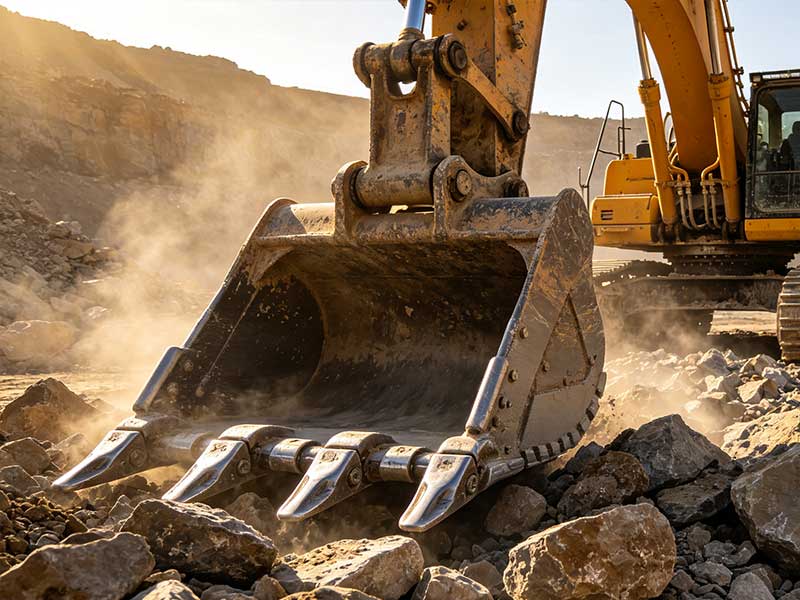
3. Core Technological Trends and Quantitative Performance Advantages
4 major technological innovations are reshaping the bucket teeth industry, solving the pain points of poor wear resistance, low safety, high energy consumption, and difficult maintenance of traditional products. Each technological upgrade brings measurable performance improvements and economic benefits.
The following table intuitively compares the differences between traditional and next-generation bucket teeth technologies in core performance, operation efficiency and industrial value.
| Technological Dimension | Traditional Bucket Teeth | Next-Generation Advanced Bucket Teeth | Quantitative Performance Improvement |
| Gradient Materials & Micro-Alloying | Single high-manganese steel structure, inherent compromise between hardness and toughness; prone to brittle fracture under strong impact; average service life of 1,600 working hours | Micro-alloying formula with vanadium and niobium elements, gradient heat treatment process; hard wear-resistant outer shell + tough shock-absorbing inner core structure | Service life extended to 1,800 working hours; completely eliminates brittle fracture risk in blasting operations; overall wear resistance increased by 12.5% |
| Locking System & Tooth Profile Design | Traditional pin-and-retainer structure, requiring sledgehammer manual replacement; flat and fixed tooth profile with passive wear | Hammerless quick-locking system + FEA-optimized self-sharpening profile | Tooth replacement time shortened by 60%; zero safety accidents caused by installation operation; stable optimal penetration angle maintained throughout the service cycle |
| Digital Monitoring Capability | No sensing function; tooth loss or breakage can only be found through manual inspection; easy to cause crusher damage and long downtime | Embedded RFID heavy-duty wireless sensors, real-time wear monitoring and tooth loss automatic alarm system | Maintenance costs reduced by 15%; equipment failure downtime caused by tooth damage reduced by 90%; intelligent product penetration rate expected to exceed 30% in 2026 |
| Energy-Saving & Carbon Reduction Performance | High digging resistance, large hydraulic load, high fuel consumption per unit operation | Low-resistance high-penetration structural design, matching green mining standards | Excavation resistance reduced by 10%-15%; unit fuel consumption and carbon emissions decreased synchronously, fully complying with global green mining certification requirements |
4. Industrial Application Value and Economic Benefit Analysis
The technological iteration of bucket teeth is not only a breakthrough in material and structural design, but also a key measure to reduce the comprehensive operating cost of mining and construction enterprises. The upgrade from low-cost ordinary products to high-performance intelligent bucket teeth has brought significant changes in equipment maintenance, production efficiency and cost control.
The following table summarizes the comprehensive industrial benefits brought by the new technology system based on industry operation data.
| Benefit Dimension | Specific Industrial Performance | Core Economic & Operational Value |
| Equipment Safety Protection | Tooth loss detection system instantly triggers equipment shutdown to prevent broken teeth from entering primary crushers; avoids major equipment damage risks | Eliminates millions of dollars in one-time equipment maintenance losses and weeks of production downtime caused by tooth failure |
| Full-Life-Cost Optimization | Laser cladding remanufacturing technology popularization rate reaches 31%, old parts utilization rate exceeds 85%; extended product service cycle reduces replacement frequency | Comprehensive GET procurement and maintenance costs per ton of ore reduced by 8%-12% |
| Operational Efficiency Improvement | Hammerless quick replacement structure reduces on-site operation time; self-sharpening design maintains efficient digging state continuously | Effective working time of excavator increased by 5%-8%, and overall project construction efficiency improved significantly |
| Green Low-Carbon Development | Low-resistance design reduces hydraulic system load, cuts fuel consumption and carbon emissions; environmentally friendly casting processes reduce production waste | Helps mining enterprises meet ISO 14001 environmental certification and global carbon emission reduction assessment standards |
5. Conclusion
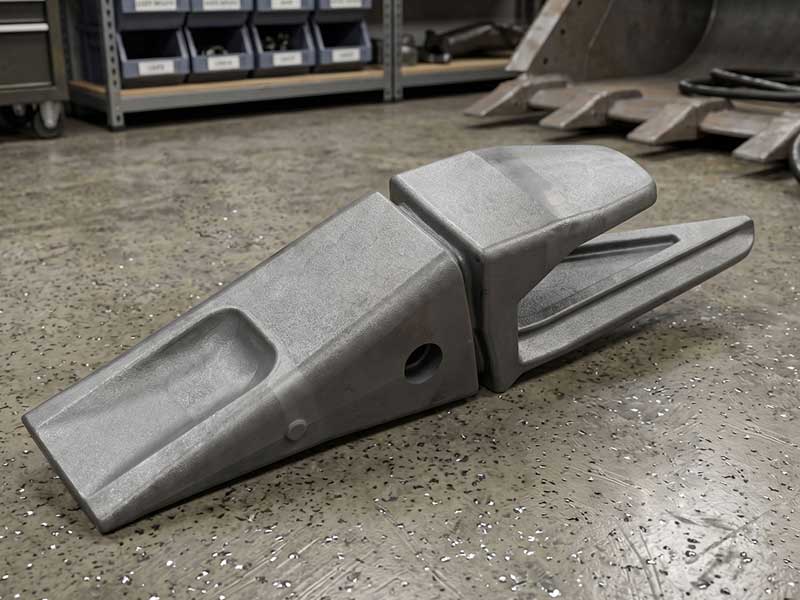
The bucket teeth industry has bid farewell to the era of simple steel processing and price-oriented competition, and entered a new stage driven by advanced metallurgy, digital intelligence and green design. Gradient micro-alloy materials, hammerless self-sharpening structures, intelligent real-time monitoring, and low-carbon energy-saving designs have become the four core pillars of future bucket teeth technology.
Supported by industrial data, advanced bucket teeth technologies can effectively improve equipment safety, reduce enterprise operating costs, boost construction efficiency, and help the mining industry achieve sustainable green development.
For mining and construction operators, abandoning single price-based purchasing strategies and selecting high-performance engineered bucket teeth products according to scientific scene matching and metallurgical performance indicators is the key to reducing overall operational costs, minimizing equipment downtime, and enhancing core market competitiveness in the long run.
With the continuous advancement of mining automation and carbon neutrality strategies, intelligent, high-efficiency and low-carbon bucket teeth technologies will further popularize and become the standard configuration of modern intelligent mining equipment.
RELATED NEWS
- Heavy Duty Disc Harrow: How to Choose the Right Model? 2026-10-09
- How to choose the right lawn mower blades? 2026-09-23
- How to Choose Right Industrial Steel Self-Dumping Forklift Hopper? 2026-09-21
- Disc Plow vs Disc Harrow for Primary & Secondary Tillage 2026-09-18
- What Factors Affect Plough Share Service Life? 2026-09-15
CATEGORIES
LATEST NEWS
CONTACT US
Contact: Susanna Sun
Phone: +86 13706842897
E-mail: sue-sunwin@vip.163.com ; sophie091983@gmail.com
Whatsapp:+86 13706842897
Add: 1588 Jiangnan Road Ningbo High-tech Industry zone