Blog
Forged Steel Outrigger Manufacturing Process
A forged steel outrigger is a high-strength load-bearing component for construction machinery, lifting equipment and mobile support systems. Manufactured by professional steel forging technology, it features compact internal structure, high toughness and strong fatigue resistance, which is far more reliable than cast or welded outriggers. This article focuses on its main product types and core forging & manufacturing processes.
1. Main Types of Forged Steel Outriggers
According to structure, load capacity and functional design, industrial forged steel outriggers are divided into four mainstream categories, covering light, medium and heavy-duty working scenarios.
| Outrigger Type | Structural Features | Load Capacity | Typical Application |
| Fixed Forged Steel Outrigger | One-piece integral forging, fixed structure, no telescopic function, high rigidity | 2–8 tons | Light trailers, fixed support equipment |
| Telescopic Forged Steel Outrigger | Multi-section forged sleeve structure, adjustable stroke, manual/hydraulic control | 5–20 tons | Truck cranes, aerial work platforms |
| Swing Forged Steel Outrigger | Rotatable forging structure with locking device, flexible angle adjustment | 3–12 tons | Mobile construction machinery |
| Heavy-Duty Forged Steel Outrigger | Thickened integral forging, reinforced structure, high pressure resistance | 20–50 tons | Large cranes, port & marine equipment |
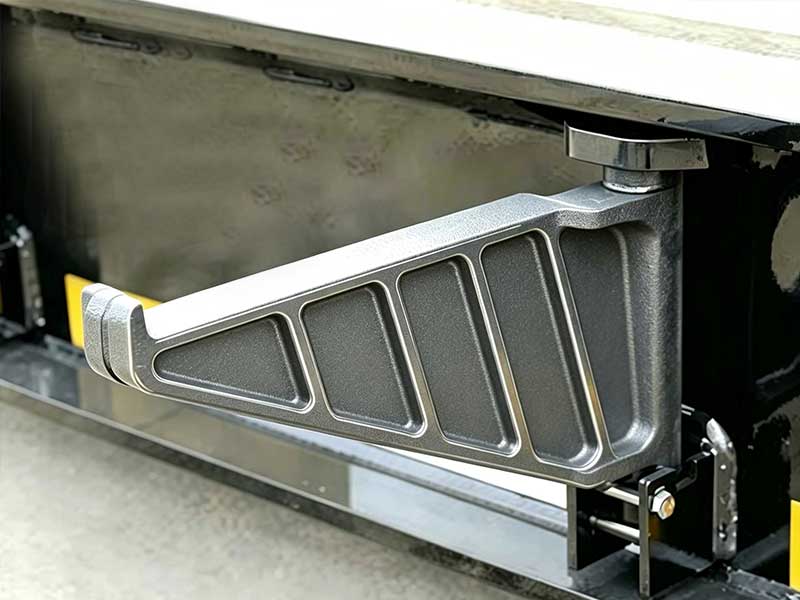
2. Forging Process & Manufacturing Technology
Forging is the core process that distinguishes high-performance steel outriggers from ordinary cast parts. It optimizes metal grain flow, eliminates internal pores and cracks, and greatly improves structural stability. The mainstream industrial forging types and standardized manufacturing procedures are as follows.
2.1 Three Core Forging Technologies
Closed-Die Forging: The most common process for standard outriggers. Steel blanks are formed via precise molds with high dimensional accuracy, uniform thickness and stable consistency, suitable for mass production of telescopic and swing outriggers.
Open-Die Forging: Adopts free forging for customized and heavy-duty outriggers. It optimizes internal grain structure, enhances overall toughness, and meets ultra-high load requirements for large engineering equipment.
Press Forging: Formed by continuous mechanical pressure with uniform deformation and low internal stress, widely used for medium-sized standard outriggers to ensure high assembly accuracy.
2.2 Standard Manufacturing Process Flow
Raw Material Preparation: Adopt high-quality carbon steel or alloy steel, complete composition inspection and fixed-length cutting to ensure raw material qualification.
Constant Temperature Heating: Heat steel billets in a professional furnace with strictly controlled temperature to ensure uniform ductility for smooth forging forming.
Precision Forging Forming: Complete upsetting, shaping and final forging to refine metal grains and eliminate internal defects.
Heat Treatment: Conduct quenching and tempering to balance hardness and toughness, release forging stress, and improve fatigue and impact resistance.
Precision Machining: Complete turning, milling, drilling and deburring to meet assembly tolerance standards.
Surface Anti-Corrosion Treatment: Adopt galvanizing or spraying treatment to improve outdoor environmental adaptability and extend service life.
Quality Inspection: Finish dimensional detection, load test and flaw detection to ensure compliance with industrial safety standards before delivery.
3. How to Choose Between Swing-Out and Removable Forged Steel Outrigger Mechanisms
Swing-out and removable outriggers are two mainstream side support structures for trailers, truck cranes and mobile work platforms. Swing-out means the leg rotates outward via hinges while staying mounted on the frame; removable means the entire outrigger can be fully detached for storage or replacement. The selection depends on working space, load demand, frequency of use, weight limit and maintenance needs.
Comparison Table: Swing-Out VS Removable Outrigger Mechanism
| Evaluation Item | Swing-Out Mechanism | Removable Mechanism |
| Structure Principle | Hinge + locking pin, integrated with vehicle frame, swing open/closed | Separate connecting base, complete disassembly of the whole outrigger leg |
| Operation Speed | Fast, only swing and lock; no disassembly steps | Slow, requires bolt disassembly/assembly each use |
| Occupied Frame Space | Permanently occupies side frame installation position | Free up frame space after removal for other accessories |
| Maximum Load Capacity | Higher; integral welded hinge base, good force transmission | Medium; split connection reduces overall structural rigidity |
| Weight Burden | Extra weight permanently on vehicle chassis | Can remove legs to cut empty vehicle weight during transit |
| Daily Operation Scenarios | Frequent deployment, regular outdoor construction | Occasional use, long-distance highway transport |
| Maintenance Difficulty | Simple; only lubricate hinge and lock pins | Complicated; need to store separate legs, easy loss of parts |
| Cost & Manufacturing | Lower cost, fewer spare parts | Higher cost, matching storage brackets required |
4. Key Selection Criteria
1. Choose Swing-Out Mechanism If You Meet These Conditions
The equipment needs to deploy supports multiple times every day (crane trucks, aerial lifts). Quick swing locking greatly improves working efficiency.
Heavy load is required (10–50 tons). The integrated hinge structure bears pressure more evenly without loose connection risks.
There is enough reserved space on both sides of the trailer chassis, and no demand for extra side installation space.
Minimal daily maintenance is expected; no need to carry and store independent support legs.
2. Choose Removable Mechanism If You Meet These Conditions
Long-distance highway transportation is frequent, and vehicle weight limits are strict. Removing outriggers effectively reduces curb weight to avoid overload fines.
The trailer frame needs to install other auxiliary tools, tanks or equipment, requiring full release of side space.
Outriggers are only used occasionally (short-term temporary construction, seasonal operation). Legs can be stored in warehouses when idle.
Single small-to-medium load demand (2–12 tons), and the operator has enough time to assemble/disassemble before work.
3. Supplementary Tips for Forged Steel Outrigger Matching
For swing-out types: Select thick forged hinge brackets and integrated forged legs to avoid hinge fracture under heavy load.
For removable types: Use high-strength forged connecting lugs and anti-loss lock bolts to prevent loosening during load bearing.
Corrosive wet working environments: Prioritize hot-dip galvanized surface treatment for both mechanisms to extend service life.
RELATED NEWS
- How to choose the right lawn mower blades? 2026-09-23
- How to Choose Right Industrial Steel Self-Dumping Forklift Hopper? 2026-09-21
- Disc Plow vs Disc Harrow for Primary & Secondary Tillage 2026-09-18
- What Factors Affect Plough Share Service Life? 2026-09-15
- 2026 Bucket Teeth Selection Guide for Soil Rock and Mining 2026-09-11
CATEGORIES
LATEST NEWS
CONTACT US
Contact: Susanna Sun
Phone: +86 13706842897
E-mail: sue-sunwin@vip.163.com ; sophie091983@gmail.com
Whatsapp:+86 13706842897
Add: 1588 Jiangnan Road Ningbo High-tech Industry zone