Blog
Matching Tractor Horsepower to Disc Harrow Size: Manufacturing, Depth Setup & Maintenance Guide
Many farm operators and equipment dealers struggle with three core questions: how to pair tractor horsepower with disc harrow working width, how premium disc harrow parts are manufactured, and how to set tillage depth and avoid costly maintenance failures.
This guide combines field data, material specifications and maintenance best practices to help purchasers select, operate and maintain disc harrows for long-term performance.
1. Matching Tractor Horsepower to Disc Harrow Size
The first rule of sizing is simple: power requirement rises with working width, disc weight, disc diameter and soil conditions.
Light sandy soils demand less drawbar power, while heavy clay, compacted ground and heavy tandem disc harrows need substantially more horsepower.
Industry benchmark data shows a general range of 25–45 HP per metre of working width, with heavier units pushing toward the upper end of that scale.
| Disc Harrow Type | Working Width | Recommended Tractor HP | Typical Weight | Best Application |
|---|---|---|---|---|
| Mounted Light Disc Harrow | 1.2–2.0 m | 25–45 HP | 190–460 kg | Small farms, post-harvest residue chopping, light seedbed finishing |
| Mounted Medium Disc Harrow | 2.0–3.0 m | 45–85 HP | 460–650 kg | Mixed loam, primary stubble incorporation, mid-sized row crop fields |
| Tandem Heavy Trailed Disc Harrow | 3.0–4.0 m | 95–135 HP | 1470–3040 kg | Large commercial farms, hard clay, high residue corn and wheat ground |
When purchasing replacement gangs or complete disc harrows for resale, remind your customers that under-powering the tractor leads to wheel slip, premature wear on disc blades and cast hubs, and uneven tillage. Over-powering wastes fuel and can bend axles or damage QT450-10 cast housings if operators run at excessive speed. Serrated boron steel discs create higher draft load than smooth discs, so add 10–15% to the horsepower requirement when ordering notched disc sets for heavy residue work.
2. How Is a Disc Harrow Manufactured?
A quality disc harrow is built from a mix of precision casting, hot forming, CNC machining and controlled heat treatment, not just welded frame assembly. At Lihuacasting, we produce cast components and supply finished disc assemblies for OEM and aftermarket buyers, with full traceability for material grades and non-destructive testing such as MT (magnetic particle testing) on critical castings.
| Component | Standard Material Grade | Key Production Process | Surface Treatment |
|---|---|---|---|
| Disc Blade | 30MnB5 Boron Steel / 65Mn | Blank cutting, concave forming, quenching & tempering | Electrophoretic coating or black anti-rust paint; target HRC 40–48 |
| Bearing Hub / Spool | QT450-10 Ductile Iron | Sand casting, stress relief annealing, CNC boring, MT inspection | Primer + powder coating |
| Gang Axle | 42CrMo Alloy Steel | Forging, rough machining, quenching and tempering | Polishing and anti-corrosion oil |
The production workflow starts with pattern making and casting for ductile iron hubs. After casting, parts go through heat treatment to optimise toughness and reduce brittleness, then CNC machining to hold tight tolerance for bearing seats.
Disc blades are stamped from boron steel coil, formed into concave shape, heat-treated and sharpened. Final assembly installs sealed bearings, scrapers and disc gangs, followed by full load testing before shipment. Poor heat treatment is the top cause of early disc cracking and hub fatigue, which is why our casting plant maintains programmable furnaces with ±5°C temperature control for all Wear Parts and cast components.
3. How Deep Should You Set Your Disc Harrow?
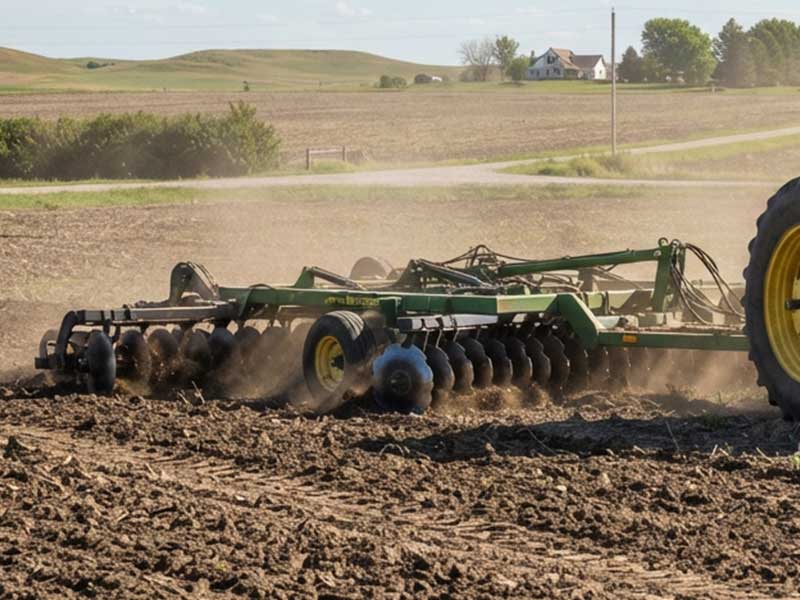
Disc harrow depth is not a fixed number; it depends on soil texture, disc diameter, farming objective and the weight of the implement. A widely accepted field guideline: maximum effective working depth is roughly 25% of the disc diameter, to avoid overloading gangs and losing uniform penetration. Most standard 560–610 mm farm discs operate between 2.5–15 cm (1–6 inches).
| Soil Condition | Recommended Working Depth | Primary Goal | Suggested Operating Speed |
|---|---|---|---|
| Sandy, loose soil | 10–15 cm (4–6 in) | Deep residue mixing, breaking compacted layers | 6–8 mph |
| Loam / Moderate residue | 5–10 cm (2–4 in) | Seedbed preparation, clod pulverisation | 4–6 mph |
| Heavy clay / Wet sticky soil | 2.5–5 cm (1–2 in) | Surface crust breaking, weed control | 3–4 mph |
Depth is adjusted via tractor hydraulic hitch or mechanical depth wheels. If discs run too deep in clay, they will plug with soil, pull unevenly and wear the edges of boron steel discs rapidly. Too shallow, and stubble remains on the surface, hurting germination.
For consistent results, operators should complete a test pass, dig soil cross-sections and adjust disc angle between 10°–25° alongside depth settings; larger angles deliver better penetration on hard ground.
4. 5 Common Disc Harrow Maintenance Mistakes
Even premium cast hubs and boron steel discs fail early when routine maintenance is ignored. Our field data from aftermarket replacement part orders shows that over 62% of premature disc harrow breakdowns stem from five preventable errors, not material defects.
1. Skipping scheduled greasing of bearing assemblies
Bearing hubs rely on consistent lubrication. Single-lip seals typically only last 100–150 hours in abrasive soil; triple-lip sealed units extend service life to 500+ hours, but still require periodic greasing to flush out fine dirt and moisture. Neglect causes seal failure, pitting and heat damage to QT450-10 cast housings.
2. Running with dull or unevenly worn discs
Dull discs slide instead of cutting, increasing draft load and stress on axles and frame. Replace discs in matched sets rather than one at a time, and choose OEM-grade 30MnB5 boron steel to extend working life.
3. Ignoring loose bolts and misaligned gangs
Vibration loosens gang bolts and scraper mounts. Weekly inspection and torque checks prevent axle bending, uneven wear and cracking at cast mounting points. Misaligned gangs create side load that quickly damages bearings.
4. Leaving the disc harrow dirty and stored wet
Soil and crop residue trap moisture and accelerate corrosion on 42CrMo axles and uncoated cast parts. Clean, dry and coat bare metal with anti-rust fluid before off-season storage.
5. Overloading depth or speed beyond implement rating
Pushing depth and speed to finish faster creates shock loads when discs hit rocks. This leads to chipped disc edges, cracked cast hubs and bent axles, raising replacement part costs for farmers and equipment dealers.
If you need custom casting drawings, bulk pricing for disc harrow wear parts or material test reports for boron steel and QT450-10 castings, reach out to our engineering team for OEM support.
RELATED NEWS
- Resin Coated Sand Casting: Advantages, Limitations & Selection Guide for Agricul 2026-11-23
- Does a Disc Harrow Improve Seedbed Preparation? Corn Stalk Management & Buying G 2026-11-20
- Plowshare Export Market Analysis: How Agricultural Spare Parts Wholesalers Selec 2026-11-19
- Disc Harrow Troubleshooting: Uneven Soil, Bearing Selection & Cost Reduction for 2026-11-17
- Plough Point Replacement Complete Guide for Farmers & Equipment Operators 2026-11-13
CATEGORIES
LATEST NEWS
CONTACT US
Contact: Susanna Sun
Phone: +86 13706842897
E-mail: sue-sunwin@vip.163.com ; sophie091983@gmail.com
Whatsapp:+86 13706842897
Add: 1588 Jiangnan Road Ningbo High-tech Industry zone