Blog
Resin Coated Sand Casting: Advantages, Limitations & Selection Guide for Agricultural Machinery Castings
As a professional agricultural casting supplier, we frequently receive enquiries from global OEM buyers about whether resin coated sand casting (shell molding) is the right manufacturing route for tractor, harvester, tillage and hydraulic components.
Resin coated sand casting coats high-purity silica sand with thermosetting phenolic resin, curing agent and functional additives; the coated sand hardens under heating to form rigid shells or cores, which delivers exceptional dimensional stability and surface finish for precision farm machinery parts.
For agricultural foundry projects that demand complex internal oil channels, thin-wall sections and consistent batch quality, this shell molding process has become a preferred option, though it also comes with clear cost, gas evolution and reclamation trade-offs that every procurement engineer should evaluate before finalizing casting specifications.
Industry data shows that resin coated sand casting can reduce secondary machining allowance by 20–30% and cut post-casting cleaning labour by roughly 15% compared to conventional green sand casting, while the raw material cost of coated sand runs 2.5–4 times higher than standard silica sand, creating a classic quality-cost balance for agricultural casting buyers.
1. Process Performance Benchmark — Resin Coated Sand vs Furan Resin Sand vs Green Sand Casting
| Evaluation Item | Resin Coated Sand (Shell Molding) | Furan Resin Sand | Green Sand |
|---|---|---|---|
| Dimensional Accuracy | High (CT7–CT9) | Medium-high (CT9–CT11) | General (CT10–CT12) |
| Surface Roughness | Ra 3.2–6.3 μm | Ra 6.3–12.5 μm | Ra 12.5–25 μm |
| Core / Mold Strength | High (room & elevated temperature) | Medium-high | Low |
| Complex Cavity Adaptability | Excellent (thin-wall, long internal passages) | Good | Limited |
| Mass Production Efficiency | High (automated core blowing) | Medium-high | High |
| Raw Material Cost | Higher | Medium | Low |
| Gas Evolution Risk | Noticeable | Moderate | Low |
| Used Sand Reclamation Difficulty | High | Medium-high | Easy |
| Environmental Pressure | High (VOC emission control required) | High | Low |
2. Core Advantages of Resin Coated Sand Casting for Agricultural Castings
1. Superior dimensional stability and tight tolerance control
Cured resin coated sand cores deform minimally during pouring and solidification. For QT450-10 / QT500-7 ductile iron hydraulic valve bodies, harvester knife guards and tractor gearbox covers, consistent dimensions lower machining stock and reduce scrap caused by dimensional drift. It supports thin-wall structures down to 2.5–3.5 mm, which is critical for lightweight, high-performance agricultural hydraulic and transmission castings.
2. Premium surface quality and reduced cleaning work
Fine graded coated sand minimizes mechanical burn-on and sand adhesion. The smooth as-cast surface lowers grinding, shot blasting and polishing workload, which is especially valuable for sealing surfaces and mating faces on pump housings and hydraulic manifolds used in farm equipment.
3. High core strength for intricate agricultural internal geometries
Coated sand cores resist breakage and sand shedding during blowing, handling and mold assembly. This makes the process ideal for long, narrow oil galleries, cooling passages and stacked internal cores common in tractor hydraulic castings, reducing the need for multi-piece core assembly and potential alignment errors.
4. High repeatability for automated batch production
Thermal curing inside heated core boxes completes quickly, fitting automated core shooting lines. Batch-to-batch consistency suits serial OEM orders for planter housings, tillage component brackets and harvester auxiliary parts, where buyers require stable quality across thousands of castings.
5. Design freedom for integrated complex agricultural components
Many modern farm machinery castings combine multiple flow paths and mounting features. Resin coated sand molding consolidates separate cores into fewer assemblies, simplifying casting design and lowering cumulative tolerance stack-up.
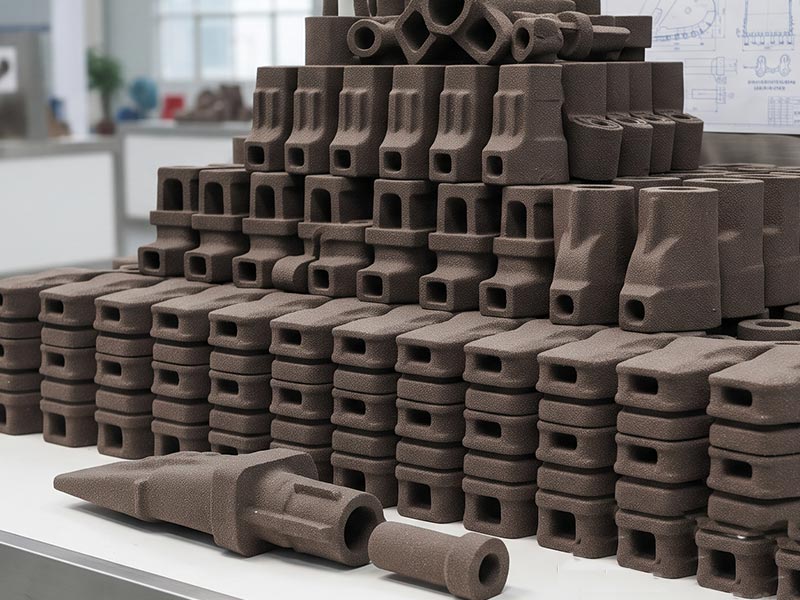
3. Limitations of Resin Coated Sand Casting to Consider
1. Higher base sand material cost
The phenolic resin coating and additives push up per-ton sand cost significantly. For large, simple agricultural counterweights or plain brackets with loose tolerance requirements, the premium material cost is hard to justify.
2. Higher gas evolution and strict venting design
When molten iron contacts the hot shell, resin pyrolysis releases gas. Poor venting quickly triggers pinholes, blowholes and veining defects, so gating, riser and vent layout must be engineered carefully for every agricultural core package.
3. Limited collapsibility and hot tearing risk
Fully cured resin shells maintain high rigidity at elevated temperatures. For ductile iron castings such as QT500-7 harvester housings with high solidification shrinkage, restricted contraction can increase hot tear and micro-shrinkage risk. Our foundry team adds collapsibility agents and optimizes core structure to mitigate this issue for agricultural ductile iron orders.
4. Demanding environmental compliance
Curing and pouring generate organic VOC emissions. A qualified agricultural casting supplier must equip exhaust collection, filtration and abatement systems, which adds fixed operating overhead and compliance requirements for European and North American agricultural OEM buyers.
5. Complex used sand reclamation
Resin residue on reclaimed sand alters grain properties, LOI and strength. Thermal or mechanical reclamation lines are mandatory, and reclaimed sand ratio must be tightly controlled to avoid recurring surface and gas defects.
6. Narrow process window
Core box temperature, curing time, resin addition rate and raw sand moisture are highly sensitive. Under-curing causes soft, fragile cores; over-curing creates brittle shells prone to cracking during pouring. Strict SPC monitoring is required for stable agricultural casting output.
4. Common Defects, Root Causes & Corrective Actions for Resin Coated Sand Agricultural Castings
| Defect | Root Causes | Optimisation Measures |
|---|---|---|
| Gas holes / pinholes | Excessive resin gas release, blocked vents, damp coating | Adopt low-nitrogen coated sand, add targeted vent channels, fully dry refractory coatings |
| Burn-on / sand penetration | Over-high pouring temperature, weak coating, coarse sand | Adjust pouring temperature, apply high-quality graphite coating, optimise sand grain grading |
| Core cracking | Over-cured brittle shell, sharp core geometry | Reduce cure time / core box temperature, add core radii and support ribs |
| Core deformation | Uneven core box temperature, inconsistent cooling | Balance heating circuit of core boxes, standardise core ejection and cooling cycle |
| Hot tearing / micro-shrinkage | Poor core collapsibility, rigid constraint on shrinkage | Add collapsibility additives, redesign core relief sections, adjust feeding system |
| Veining | High silica sand thermal expansion, resin brittleness | Blend reclaimed sand, use low-expansion sand or veining inhibitors |
5. Best-Fit Agricultural Machinery Castings for Resin Coated Sand Casting
| Recommended Agricultural Parts | Typical Material | Key Requirements Justifying Shell Molding |
|---|---|---|
| Hydraulic valve bodies & pump housings | QT450-10, QT500-7 | Complex internal oil channels, tight sealing surface tolerance, low leakage risk |
| Harvester gearbox covers & differential housings | QT450-10, HT250 | Consistent dimensional control, smooth mating faces, high batch repeatability |
| Tractor hydraulic manifold castings | QT500-7 | Multiple intersecting flow passages, thin-wall galleries, minimal machining allowance |
| Precision tillage implement brackets & connection housings | QT450-10 | Complex core geometry, high core handling strength, low scrap rate |
| Seed metering housing & planter castings | HT200 / QT400-18 | Smooth surface, stable dimensions for precision seed delivery |
Final Sourcing Recommendation for Agricultural OEM Buyers
Resin coated sand casting is not a universal solution for all farm machinery castings, but it delivers clear ROI when your agricultural part requires complex internal cores, tight tolerances, smooth as-cast surfaces and consistent batch quality. While the upfront sand cost and environmental investment are higher, savings from reduced machining, fewer rejections and simplified assembly often offset the premium for high-value hydraulic and transmission castings.
For simple, heavy, cost-sensitive agricultural parts such as counterweights and plain support brackets, green sand casting remains the more economical option. For medium-complexity ductile iron housings with moderate tolerance demands, furan resin sand may strike a better balance between price and performance.
At our foundry, we run resin coated sand shell molding lines alongside furan and green sand capacity, so we can quote the most suitable casting route based on your drawing, material specification (QT450-10, QT500-7, HT200, HT250), annual volume and tolerance target. We support full OEM service: pattern development, casting, heat treatment, NDT inspection, CNC machining and surface finishing for tractor, harvester, plow and tillage components.
If you have agricultural casting drawings ready for quotation, send us your specs and we will provide a process recommendation, tolerance statement and lead time proposal.
RELATED NEWS
- Does a Disc Harrow Improve Seedbed Preparation? Corn Stalk Management & Buying G 2026-11-20
- Plowshare Export Market Analysis: How Agricultural Spare Parts Wholesalers Selec 2026-11-19
- Disc Harrow Troubleshooting: Uneven Soil, Bearing Selection & Cost Reduction for 2026-11-17
- Plough Point Replacement Complete Guide for Farmers & Equipment Operators 2026-11-13
- Why Does Plough Point Hardness Matter? 2026-11-12
CATEGORIES
LATEST NEWS
CONTACT US
Contact: Susanna Sun
Phone: +86 13706842897
E-mail: sue-sunwin@vip.163.com ; sophie091983@gmail.com
Whatsapp:+86 13706842897
Add: 1588 Jiangnan Road Ningbo High-tech Industry zone