Blog
Does a Disc Harrow Improve Seedbed Preparation? Corn Stalk Management & Buying Guide
Does a disc harrow improve seedbed preparation? For most grain and row-crop operations, the answer is yes, when paired with the correct disc blade design, working depth and residue management workflow. This article breaks down seedbed performance, corn stalk management, notched versus smooth disc blades, and 7 essential checks buyers should complete before sourcing a disc harrow or replacement disc parts.
A properly set disc harrow creates a uniform, friable seedbed by breaking clods, leveling the soil surface and mixing residue into the top profile. USDA conservation tillage data notes that ideal seedbed conditions require consistent soil tilth with partial residue retention; excessive surface trash can block seed-to-soil contact and delay emergence, while over-incorporation raises erosion risk.
A disc harrow sits between light finishing cultivators and heavy moldboard plows, making it flexible for both conventional tillage and reduced-till systems. The final result depends heavily on blade selection, gang angle, travel speed and material quality of the disc harrow components.
1. Disc Harrowing for Corn Stalk Management
Corn residue is one of the most challenging materials for post-harvest tillage. Thick corn stalks, cobs and root masses resist cutting, wrap around disc gangs and plug the implement, which slows field progress and creates uneven seedbeds. Research shows that disc harrowing at 6–10 km/h with correctly sized blades can cut corn residue into smaller fragments and accelerate decomposition, while retaining enough surface cover to protect against water and wind erosion.
Table 1: Disc Harrow Corn Residue Performance Benchmarks
| Operation Mode | Residue Burial Rate | Typical Surface Residue Remaining | Best Fit |
|---|---|---|---|
| Light disc harrow pass (shallow 63.5 mm) | 28–35% | 55–65% | Conservation tillage, no-till transition |
| Standard disc harrow pass (80–100 mm) | 42–50% | 35–45% | Conventional corn-soybean rotation |
| Heavy disc harrow pass (127 mm deep) | 52–58% | 25–32% | Heavy stalk load, clay soils, full seedbed reset |
Deep disc harrowing increases residue mixing by roughly 5.1% compared to shallow settings, but also raises draft force, fuel consumption and wear on disc blades and hubs. For buyers sourcing replacement disc harrow parts for high-residue corn ground, boron steel blades with induction heat treatment outlast high-carbon steel in rocky, abrasive fields.
Lihuacasting produces matched disc assemblies, cast bearing hubs and scraper brackets for OEM replacement, built to handle continuous corn stalk cutting without premature cracking or bending.
2. Notched vs. Smooth Disc Blades
The choice between notched and smooth disc blades is the single biggest variable in disc harrow performance.
Notched blades have cutaway edges that bite into hard soil and tough stalk residue; smooth plain blades slice cleanly with less soil disturbance and leave a finer final surface.
Neither is universally better, and many farmers run a mixed setup: notched discs on front gangs for aggressive cutting, smooth discs on rear gangs for finishing the seedbed.
Table 2: Notched vs Smooth Disc Blade Technical Comparison
| Parameter | Notched Disc Blade | Smooth Disc Blade |
|---|---|---|
| Primary Strength | Penetration, stalk cutting, reduced slip in hard ground | Uniform clod breakdown, smooth finish, less soil throw |
| Average Draft Force | ~579 N (tested 460 mm disc) | ~620 N |
| Best Working Speed | 7–10 km/h | 6–9 km/h |
| Common Material | Boron steel 30MnB5, heat-treated 48–52 HRC | Boron steel or high carbon steel, 38–46 HRC |
| Typical Use Case | Heavy corn stalks, compacted soil, stubble breaking | Final seedbed finishing, vegetable beds, light residue |
Notched discs deliver lower draft force in controlled soil-bin tests, which reduces tractor load and fuel use in high-residue conditions. Smooth blades are preferred when growers need a level seedbed for small-seeded crops, where rough ridges or uneven soil can hurt planting depth consistency. For distributors stocking disc harrow Wear Parts, we recommend carrying both blade styles, plus cast spacers and hub assemblies that fit common disc diameters from 16” to 28”.
Material selection directly impacts service life. Boron steel is the dominant grade for export-grade disc blades, while QT500-7 ductile iron cast hubs offer excellent impact toughness for heavy-duty disc harrow gangs. 42CrMo alloy steel is widely used for axles and spindle sleeves, where bending fatigue is a top failure mode. All TrueCast casting parts go through magnetic particle testing (MT) to detect hidden casting defects before shipment.
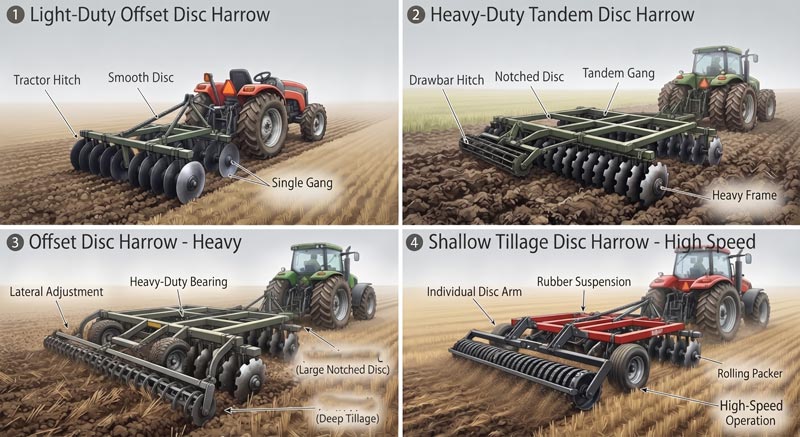
3. 7 Things to Check Before Buying a Disc Harrow
Whether you are purchasing a complete disc harrow for your farm or sourcing wholesale disc harrow components for resale, these seven checks avoid costly downtime and premature wear.
Table 3: Disc Harrow Buying & Pre-Purchase Checklist
| Check Item | What to Verify | Acceptable Standard |
|---|---|---|
| 1. Tractor HP Match | Working width, disc weight and gang resistance | 20–35 HP for light offset units; 60–100 HP for heavy tandem disc harrows |
| 2. Disc Blade Material & Heat Treatment | Grade, hardness, edge thickness | Boron steel ≥48 HRC for heavy residue; MT inspection for cast hubs |
| 3. Gang Angle Adjustment | Tool-free adjustment range, locking mechanism | 10°–22° adjustable for residue cutting vs finishing |
| 4. Hub & Bearing Construction | Cast hub material, seal design | QT450-10 / QT500-7 cast hubs, double lip seals for wet soil |
| 5. Disc Spacing & Diameter | Clearance between discs to prevent plugging | 225–250 mm spacing for corn stalk work |
| 6. Frame Strength & Weld Quality | Main frame material, tensile rating | Heavy rectangular tube, no visible cold shuts or cracked welds |
| 7. Spare Parts Availability | Blade, hub, scraper and axle stock from supplier | OEM compatible wear parts with short lead times |
Tractor HP compatibility: An underpowered tractor cannot pull a heavy disc harrow at consistent speed, which creates poor seedbed uniformity and overloads disc gangs.
Disc blade material and heat treatment: Avoid low-cost non-heat-treated blades; they dull quickly and bend in rocky ground. Confirm hardness certificates for boron steel discs.
Gang angle adjustability: Steeper angles cut more residue but create rougher tilth; shallow angles produce a finer seedbed with less mixing.
Cast hub and bearing quality: Many budget disc harrows fail early at the hub. QT500-7 ductile iron hubs resist shock far better than ordinary cast iron.
Disc spacing: Too narrow spacing leads to plugging with corn stalks; too wide spacing leaves uncut residue strips.
Frame integrity: Frame flex causes uneven disc depth and accelerated wear on axles and cast hubs.
Spare parts supply chain: For distributors, reliable access to OEM replacement disc blades, cast hubs and scrapers is critical to support after-sales service.
Final Takeaways
A disc harrow absolutely improves seedbed preparation when configured correctly, especially for corn stalk residue management. Notched discs handle tough stubble and compacted soil, while smooth discs deliver a clean, level finish. The biggest long-term cost factor is not the initial machine price, but the quality of wear parts: disc blades, cast hubs, axle sleeves and scrapers.
At Lihuacasting, we specialize in OEM casting for disc harrows, plowshares, hydraulic breaker wear parts and sickle sections. We supply QT450-10, QT500-7 ductile iron castings, 42CrMo machined components and boron steel disc blades for global agricultural equipment brands and distributors. If you need custom disc harrow cast parts or bulk replacement disc blades, send your drawing and quantity requirement for a quotation.
RELATED NEWS
- Plowshare Export Market Analysis: How Agricultural Spare Parts Wholesalers Selec 2026-11-19
- Disc Harrow Troubleshooting: Uneven Soil, Bearing Selection & Cost Reduction for 2026-11-17
- Plough Point Replacement Complete Guide for Farmers & Equipment Operators 2026-11-13
- Why Does Plough Point Hardness Matter? 2026-11-12
- How to Choose the Right Sickle Sections for Combine Mower and Swather Headers? 2026-11-05
CATEGORIES
LATEST NEWS
CONTACT US
Contact: Susanna Sun
Phone: +86 13706842897
E-mail: sue-sunwin@vip.163.com ; sophie091983@gmail.com
Whatsapp:+86 13706842897
Add: 1588 Jiangnan Road Ningbo High-tech Industry zone