Blog
Why Precision CNC Axle Flanges Matter for Heavy-Duty Trailers?
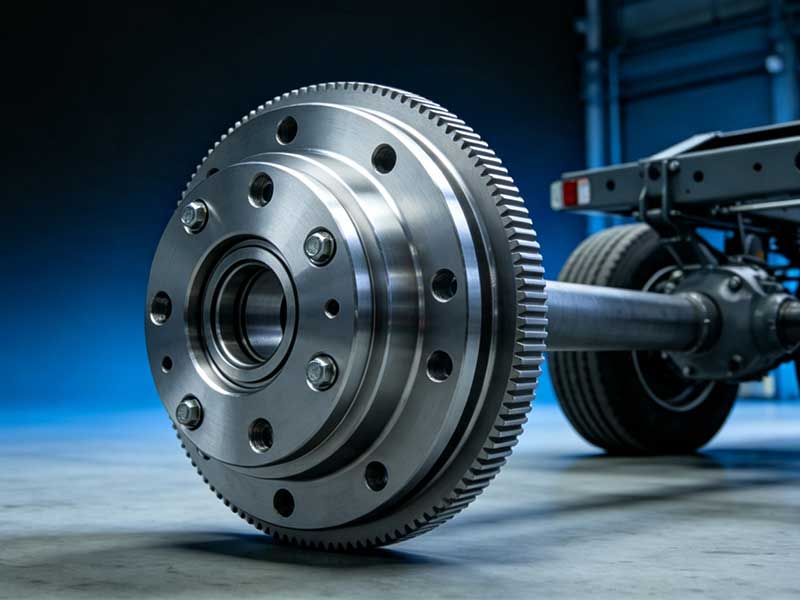
CNC axle flanges are the unseen heroes of commercial transportation. When dealing with heavy-duty fleets, the axle flange serves as the critical mounting interface that connects the axle tube to the brake assembly and wheel hub. For procurement managers, commercial buyers, and B2B wholesalers, sourcing these components is not merely a matter of finding the lowest price—it is about ensuring fleet safety, preventing catastrophic on-road failures, and minimizing long-term maintenance costs.
From an assembly perspective, the structural integrity of heavy Trailer Parts relies entirely on strict dimensional tolerances. If an axle flange lacks the necessary flatness or hole position accuracy, the entire wheel and braking geometry becomes compromised.
1. The Assembly Perspective: Why Tolerances Dictate Performance
During the assembly of a heavy-duty trailer axle, the brake backing plate or caliper bracket is bolted directly to the axle flange. If the flange is manufactured using basic casting methods without secondary precision CNC machining, two critical geometric flaws commonly emerge:
Poor Surface Flatness: The mounting surface is slightly warped or uneven.
Inaccurate Hole Positioning: The bolt holes deviate from the true center or pitch circle diameter (PCD).
When a mechanic torques down the bolts on an imperfect flange, the mating components are forced into a bind. This induces severe mechanical stress and misalignment before the trailer even hits the road.
Consequence 1: Catastrophic Braking Failures
Brake systems operate under extreme thermal and mechanical loads. If an axle flange has poor flatness, the brake drum or rotor will not sit perfectly parallel to the axle center.
Uneven Brake Engagement: A misaligned flange causes the brake shoes or pads to engage the drum or rotor at an angle. This leads to localized friction, premature pad wear, and severe brake drag.
Thermal Cracking and Overheating: Because the braking force is not distributed evenly, specific spots on the brake components absorb excessive heat. This thermal shock can lead to drum cracking or catastrophic loss of braking power (brake fade) on steep descents.
Industry Authority Data: According to the Federal Motor Carrier Safety Administration (FMCSA), brake-related issues are a leading causal factor in commercial motor vehicle crashes, accounting for approximately 29% of all heavy truck accidents.
Furthermore, the Commercial Vehicle Safety Alliance (CVSA) consistently ranks brake system defects as the number one Out-of-Service (OOS) violation during international roadchecks. Substandard, misaligned axle components are a direct contributor to these dangerous compliance failures.
Consequence 2: Severe Wheel Wobble and Uneven Tire Wear
A flange surface that is out of parallel by just 0.1mm can translate to significant lateral runout at the edge of a heavy-duty commercial tire.
Dynamic Imbalance: As the wheel rotates at highway speeds, the misalignment creates a wobble. This continuous lateral scrubbing grinds the tire tread against the asphalt, leading to rapid, irregular tire wear (such as cupping or shoulder wear).
Bearing Failure: The vibration generated by an un-trued wheel assembly sends shockwaves directly into the wheel bearings and suspension components, drastically reducing their lifespan and leading to costly roadside breakdowns.
2. Comparing Manufacturing Standards
To illustrate the critical difference between raw cast parts and precision-machined components, consider the following technical comparison:
Table 1: Dimensional Tolerance Comparison in Axle Flanges
| Parameter | Standard Raw Casting (Unmachined) | Precision CNC Machined Flange | Impact on Trailer Assembly |
| Surface Flatness | ± 0.5 mm to ± 1.5 mm | ± 0.02 mm to ± 0.05 mm | CNC ensures 100% flush mounting, preventing brake bind and thermal cracking. |
| Hole Positional Accuracy | ± 0.5 mm | ± 0.01 mm | Precise hole alignment prevents bolt shearing and uneven load distribution. |
| Surface Finish (Ra) | 12.5 to 25 μm | 1.6 to 3.2 μm | Smoother finish guarantees optimal mating with brake backing plates. |
| Perpendicularity | High variation risk | Strictly controlled (< 0.05 mm) | Ensures the wheel hub rotates perfectly parallel to the axle centerline. |
3. The Financial Impact on Fleets and Wholesalers
For B2B buyers and wholesalers, supplying high-quality parts directly protects your brand reputation. Sourcing cheaper, inaccurate flanges ultimately costs end-user fleets significantly more in operational downtime.
Table 2: Cost Repercussions of Substandard Axle Flanges vs. Precision Parts
| Cost Factor | Substandard Axle Flange | Precision CNC Axle Flange |
| Tire Replacement | Frequent (due to severe scrubbing/cupping wear) | Maximized tire lifespan |
| Brake Maintenance | High (premature pad wear, cracked drums) | Standard maintenance cycle |
| Fleet Downtime | High risk of CVSA out-of-service violations | Reliable, continuous operation |
| Assembly Efficiency | Poor (mechanics struggle with misaligned bolts) | Seamless, drop-in assembly |
4. Partner with a Premier China Casting Manufacturer
To eliminate assembly issues and guarantee road safety, working with a highly capable supply chain partner is essential. As a leading China Casting Manufacturer and precision casting supplier, we understand the rigorous demands of commercial transportation and heavy machinery.
We specialize in customizing various types of castings and CNC machining services based on exact customer blueprints and requirements. While our deep manufacturing expertise spans agricultural machinery parts and engineering/construction machinery parts, our production of heavy-duty trailer axle flanges represents the pinnacle of our quality control.
RELATED NEWS
- How to Overcome Tool Wear Challenges When Machining High-Hardness Iron Castings? 2026-10-23
- Low-Temperature Charpy Impact Testing for Off-Road Trailer Castings 2026-10-20
- Common Casting Defects in Trailer Towing Rings and How to Prevent Them 2026-10-15
- Ductile Iron vs. Carbon Steel Engineering Guide for Heavy-Duty Agricultural Trai 2026-10-13
- Heavy Duty Disc Harrow: How to Choose the Right Model? 2026-10-09
CATEGORIES
LATEST NEWS
CONTACT US
Contact: Susanna Sun
Phone: +86 13706842897
E-mail: sue-sunwin@vip.163.com ; sophie091983@gmail.com
Whatsapp:+86 13706842897
Add: 1588 Jiangnan Road Ningbo High-tech Industry zone