Blog
Agricultural Trailer Chassis vs. Highway Trailer Chassis
Agricultural trailer chassis systems operate in drastically different conditions compared to their on-road counterparts. For trailer accessories manufacturers and suppliers, understanding the engineering nuances between off-road agricultural applications and high-speed highway operations is critical. The design, material selection, and manufacturing processes of undercarriage components—specifically equalizers and leaf spring brackets—must be strictly differentiated to ensure safety, longevity, and performance.
1. Divergent Operating Environments: Mud vs. Asphalt
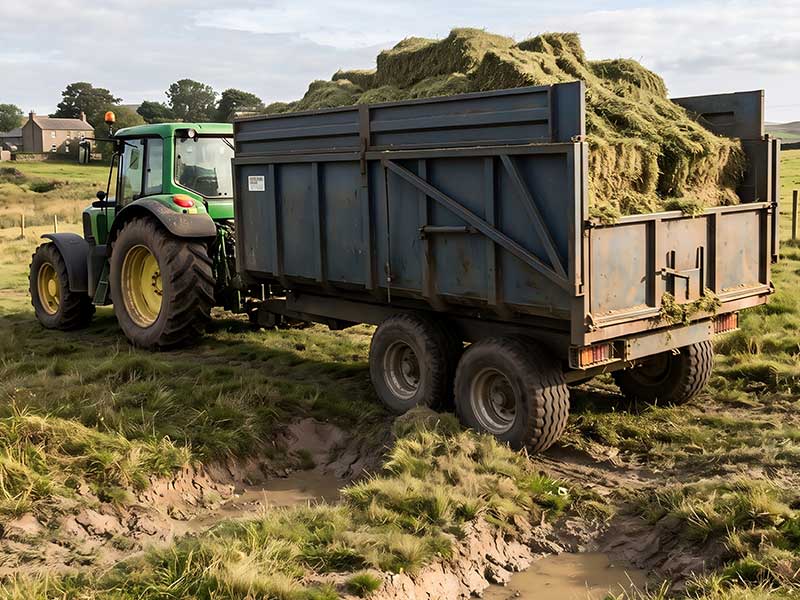
The fundamental differences in chassis casting design stem from the operational environments. Agricultural trailers operate at low speeds in muddy, uneven, and high-torque environments. They frequently cross furrows and ditches, subjecting the chassis to extreme torsional twisting. Conversely, a Highway Trailer Chassis operates at high speeds on relatively smooth asphalt but is subjected to continuous high-frequency vibrations and aerodynamic stresses over millions of miles.
| Parameter | Agricultural Trailer Chassis | Highway Trailer Chassis |
| Average Operating Speed | 10 - 40 km/h (Low Speed) | 80 - 120 km/h (High Speed) |
| Primary Stress Factor | High-amplitude torsional twisting & impact | High-frequency continuous micro-vibrations |
| Terrain / Surface | Mud, loose soil, uneven off-road fields | Smooth asphalt or concrete highways |
| Load Distribution | Highly dynamic, asymmetrical loading | Static, balanced payload distribution |
| Environmental Exposure | Corrosive fertilizers, deep mud, heavy moisture | Road salt, extreme temperature fluctuations |
Table 1: Operational Dynamics & Environmental Challenges
2. Differentiated Design in Core Chassis Castings
As an experienced supplier providing an integrated chassis casting solution, we engineer equalizers and leaf spring brackets with distinct structural philosophies tailored to these environments.
2.1. Equalizers (Rocker Arms)
Agricultural Applications: In agricultural settings, the equalizer must accommodate massive wheel articulation to keep tires grounded on uneven terrain. The casting design emphasizes thick cross-sections and uses high-ductility materials. This prevents catastrophic brittle failure when the trailer drops into a deep rut, generating sudden, massive torque spikes.
Highway Applications: Highway equalizers focus on weight reduction and fatigue resistance. High-speed travel generates constant, rapid oscillations. Castings here feature optimized web thicknesses and internal ribbing to dampen high-frequency vibrations while maintaining a lightweight profile to maximize the vehicle's legal payload capacity.
2.2. Leaf Spring Brackets (Hangers)
Agricultural Applications: Mud accumulation is a severe issue. Agricultural brackets are designed with a wider stance and self-shedding geometries to prevent mud packing, which can freeze or harden and restrict spring movement. The wear pads are cast thicker to withstand abrasive grit.
Highway Applications: Highway brackets demand strict dimensional tolerances. A slight misalignment can lead to severe tire wear at 100 km/h. Therefore, the casting process focuses on precision machining allowances and aerodynamic profiles to minimize drag and wind noise.
3. Material Selection & Technical Specifications for Castings
According to the standards published by ASTM International and heavy-duty vehicle fatigue testing protocols, the material science behind these components is strictly segregated. Highway trailers are engineered to withstand over 10^7 high-frequency fatigue cycles during their lifespan, while agricultural equipment is tested for high-stress, low-cycle impacts (often exceeding 45,000 Nm of torsional force).
| Technical Metric | Agricultural Casting Specs (e.g., Equalizers) | Highway Casting Specs (e.g., Brackets) |
| Standard Material Grade | ASTM A536 Ductile Iron (Grade 65-45-12) | ASTM A536 (80-55-06) or ASTM A148 Steel |
| Tensile Strength (Min) | 448 MPa (65,000 psi) | 552 MPa (80,000 psi) |
| Elongation Capacity | High (12%) - Prioritizes bending over breaking | Moderate (6%) - Prioritizes rigidity |
| Fatigue Life Cycle Target | 250,000 cycles (High-Amplitude Impact) | 1,000,000+ cycles (Low-Amplitude Vibration) |
| Casting Focus | Impact toughness & abrasion resistance | Yield strength & dimensional stability |
4. Your Partner for Custom Chassis Casting
Whether you are building heavy-duty slurry tankers or long-haul freight trailers, selecting the right components is non-negotiable. As a premier manufacturer, we specialize in delivering a comprehensive custom chassis casting portfolio. Our state-of-the-art foundry ensures that every equalizer, hanger, and structural bracket meets the exact metallurgical and geometric requirements of its intended environment.
By partnering with lihuacasting, OEMs and aftermarket distributors gain access to a reliable, data-driven chassis casting solution that reduces warranty claims, enhances vehicle safety, and extends the operational lifespan of the trailer—no matter where the road (or field) takes it.
RELATED NEWS
- How to Overcome Tool Wear Challenges When Machining High-Hardness Iron Castings? 2026-10-23
- Low-Temperature Charpy Impact Testing for Off-Road Trailer Castings 2026-10-20
- Common Casting Defects in Trailer Towing Rings and How to Prevent Them 2026-10-15
- Ductile Iron vs. Carbon Steel Engineering Guide for Heavy-Duty Agricultural Trai 2026-10-13
- Heavy Duty Disc Harrow: How to Choose the Right Model? 2026-10-09
CATEGORIES
LATEST NEWS
CONTACT US
Contact: Susanna Sun
Phone: +86 13706842897
E-mail: sue-sunwin@vip.163.com ; sophie091983@gmail.com
Whatsapp:+86 13706842897
Add: 1588 Jiangnan Road Ningbo High-tech Industry zone