Blog
Trailer Suspension Excellence: CNC Machining for Perfect Bearing Fit Tolerances
Trailer Suspension systems are the backbone of secure and stable heavy-duty transport, bearing immense dynamic loads under harsh operating conditions. The longevity and safety of these systems rely heavily on the dimensional accuracy of their rotating components.
Specifically, achieving micrometer-level (0.01mm) tolerance control during the CNC turning and milling of suspension castings is absolutely critical. Poor dimensional accuracy leads to improper bearing fits, which in turn causes excessive friction, rapid heat generation, and abnormal wear.
As a dedicated manufacturer of premium ductile iron, cast steel, and wear-resistant components, we understand that metallurgical strength is only half the battle. True reliability is achieved in the CNC machining center.
1. The Challenge of Bearing Fit Tolerances in Heavy Duty Suspensions
When a heavy-duty trailer is in motion, the suspension system's axles, hubs, and bearings must work in perfect unison. According to authoritative industry data published by the SKF Group, approximately 16% of all premature bearing failures are directly caused by poor fitting and improper mounting tolerances. Furthermore, engineering studies in automotive dynamics highlight that a tolerance deviation of just 0.015mm in a high-load interference fit can cause operating temperatures to spike by over 20°C, drastically degrading lubricating grease and leading to catastrophic thermal failure.
If a bearing housing is machined too large, the bearing will spin within the housing (fretting wear). If the shaft is machined too large, the interference fit becomes too tight, eliminating the internal clearance of the bearing and causing overheating and immediate galling.
Table 1: Standardized ISO Tolerance Classes for Trailer Suspension Bearing Fits
To prevent abnormal wear and overheating, strict adherence to international tolerance standards is required during production. Below are the standard CNC machining targets for high-load trailer suspensions:
| Component Area | Fit Type | ISO Tolerance Class | Allowable Deviation (Micrometers/µm) | Purpose in Suspension System |
| Axle Shaft (Inner Ring) | Tight Interference | k6 / m6 | +2 to +18 µm | Prevents inner ring rotation on the shaft under heavy shock loads. |
| Wheel Hub (Outer Ring) | Transition/Clearance | H7 / J7 | -12 to +15 µm | Allows for micro-expansion due to heat; prevents housing deformation. |
| Spindle Threads | Precision Threading | 6g | Varies by pitch | Secures the locking nut perfectly to maintain correct bearing pre-load. |
| Seal Journals | Transition | h9 | 0 to -43 µm | Ensures absolute sealing to prevent moisture and abrasive dust ingress. |
2. Advanced CNC Machining: Turning and Milling Strategies
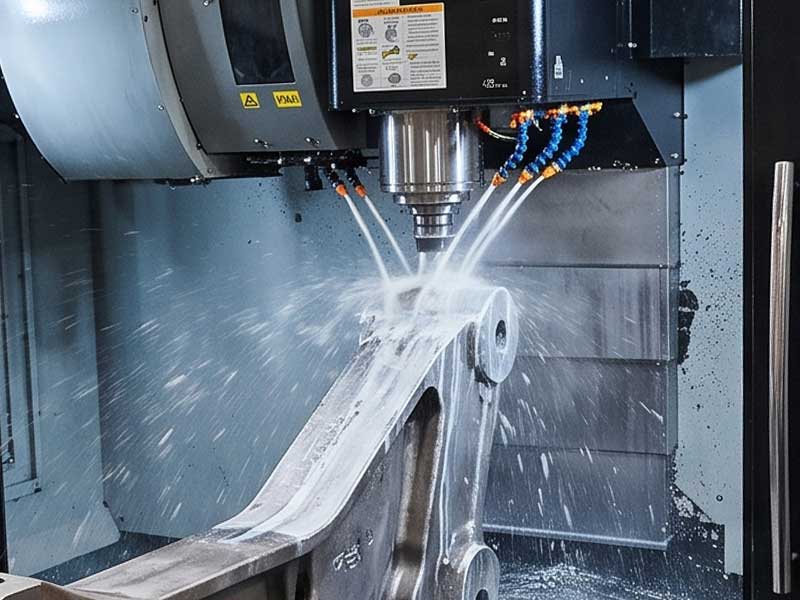
Achieving these 10-micron precision targets on heavy industrial castings requires state-of-the-art CNC Machining processes.
2.1. Precision CNC Turning for Concentricity:
The axles and spindles must have perfect concentricity. Any runout (eccentricity) translates into vibration at highway speeds. Using advanced CNC lathes with rigid tooling prevents chatter and tool deflection when cutting tough ductile iron or cast steel. We utilize multi-axis turning centers to ensure that the bearing journals, seal diameters, and threaded ends are machined in a single setup, guaranteeing absolute alignment.
2.2. 5-Axis CNC Milling for Complex Geometries:
For the suspension hangers, equalizers, and spring seats, CNC milling ensures the mounting holes and pivot points are perfectly parallel. If the equalizer pin holes are milled out of alignment by even a fraction of a degree, it forces the suspension to bind, transferring unnatural lateral forces into the bearings.
Table 2: Machining Defects and Their Consequences on Trailer Bearings
Failure to control CNC machining parameters directly impacts the end-user. Here is how specific machining defects translate into operational failures:
| Machining Defect | Root Cause in CNC Process | Consequence on Bearing Performance |
| Poor Surface Finish (Ra > 1.6) | Incorrect feed rate or worn tool inserts. | Accelerated wear of the bearing journal; microscopic peaks break off, loosening the fit. |
| Tapered Journal (Out of Cylindricity) | Tool deflection or tailstock misalignment. | Uneven load distribution across the bearing rollers; localized overheating and edge loading. |
| Excessive Runout (Eccentricity) | Machining parts in multiple setups rather than a single operation. | Severe wheel vibration; accelerated fatigue failure of both the bearing and the suspension leaf springs. |
| Oversized Housing Bore | Tool wear or improper thermal compensation during machining. | Outer ring spins in the hub (fretting); generates metal shavings that contaminate the grease. |
3. Trusted Partner in Heavy Machinery and Precision Castings
Selecting the right Trailer Suspension supplier is one of the most critical supply chain decisions a distributor can make. You need a partner who understands the complete lifecycle of heavy components—from the initial pouring of molten steel to the final micro-cut of the CNC tool.
Lihuatcasting manufacturing facilities integrate both advanced foundry operations and world-class precision machining. We specialize in producing flawless, wear-resistant castings optimized for the highest stress environments. Whether our target clients are wholesale distributors of heavy trailer axles or global buyers and wholesalers of tiller plough blades, we apply the same rigorous quality control and metallurgical expertise across all agricultural and heavy transport sectors.
RELATED NEWS
- How to Overcome Tool Wear Challenges When Machining High-Hardness Iron Castings? 2026-10-23
- Low-Temperature Charpy Impact Testing for Off-Road Trailer Castings 2026-10-20
- Common Casting Defects in Trailer Towing Rings and How to Prevent Them 2026-10-15
- Ductile Iron vs. Carbon Steel Engineering Guide for Heavy-Duty Agricultural Trai 2026-10-13
- Heavy Duty Disc Harrow: How to Choose the Right Model? 2026-10-09
CATEGORIES
LATEST NEWS
CONTACT US
Contact: Susanna Sun
Phone: +86 13706842897
E-mail: sue-sunwin@vip.163.com ; sophie091983@gmail.com
Whatsapp:+86 13706842897
Add: 1588 Jiangnan Road Ningbo High-tech Industry zone