Blog
Why Investment Casting is the Ultimate Choice for Excavator Bucket Teeth
In the demanding fields of construction, mining, and agricultural machinery, equipment downtime translates directly into massive financial losses. When an excavator or wheel loader is forced to stop, premature wear or catastrophic breakage of Ground Engaging Tools (G.E.T.), particularly bucket teeth, is often the primary culprit.
While the chemical composition of the steel is undoubtedly important, the manufacturing process is what truly determines a component's field performance. Today, we will explore why investment casting (also known as lost-wax casting) has become the gold standard for producing premium bucket teeth and heavy-duty Wear Parts.
1. What is Investment Casting?
Investment casting is a precision manufacturing process that dates back thousands of years but has been modernized for today’s high-tech industrial applications.
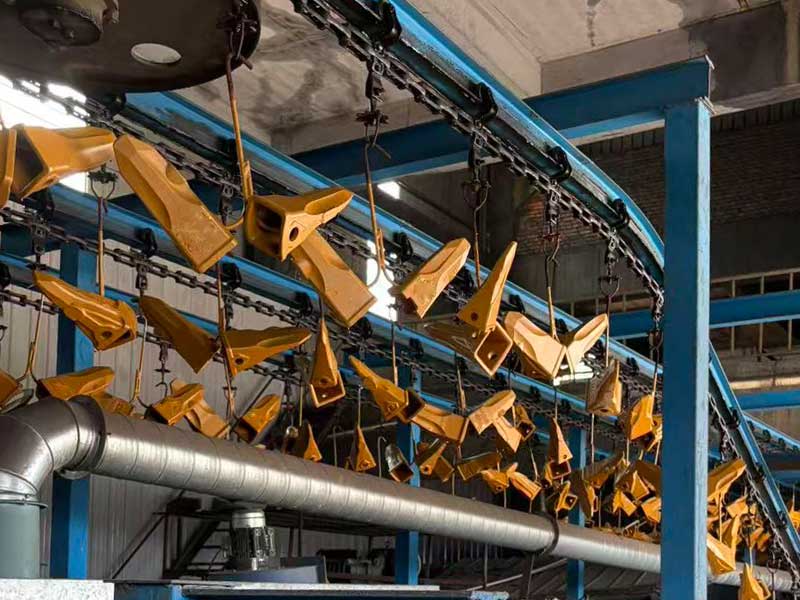
The process begins by injecting wax into an aluminum die to create an exact replica (a wax pattern) of the final bucket tooth. Multiple wax patterns are assembled onto a central sprue to form a "tree." This tree is repeatedly dipped into a ceramic slurry and coated with refractory sand to build a hard, durable shell. Once the ceramic shell cures, the wax is melted out (hence "lost-wax"), leaving a hollow cavity perfectly shaped for the final product. Molten high-strength alloy steel is then poured into this cavity.
2. 4 Reasons Why Bucket Teeth Must Be Investment Cast
For wear parts that endure severe impact and high abrasion, traditional sand casting simply cannot compete with the lost-wax process. Here are the core advantages:
2.1. Superior Dimensional Accuracy for Flawless Fitment
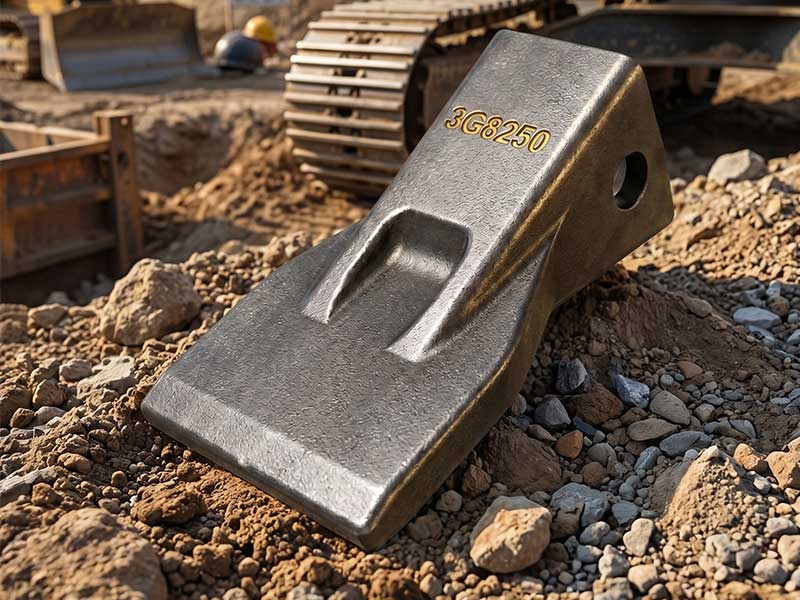
The most critical area of any bucket tooth is the mating surface where it connects to the adapter. If the tolerance is too loose, the tooth will rattle during operation. This micro-movement transfers massive stress to the retaining pin, inevitably leading to pin shear and tooth loss. Investment casting delivers incredibly tight tolerances, ensuring a snug, perfect fit between the tooth and the adapter, thereby maximizing the lifespan of the entire assembly.
2.2. Excellent Surface Finish
A rough surface creates unnecessary friction. The smooth surface finish achieved through the ceramic shell of investment casting significantly reduces the initial drag when the bucket penetrates soil, gravel, or rock. This smoother penetration not only improves digging efficiency but also helps in reducing the overall fuel consumption of the heavy machinery.
2.3. Dense Internal Structure & High Impact Resistance
Sand-cast parts are notorious for internal defects such as porosity (air pockets) and sand inclusions, which act as weak points under high stress. Investment casting, however, produces a much cleaner, denser internal metallurgical structure. When combined with rigorous heat treatment (quenching and tempering), the result is a bucket tooth that boasts a hardened, wear-resistant exterior while maintaining a tough, impact-absorbing core.
2. 4. Complex Geometry and Self-Sharpening Designs
Modern bucket teeth are highly engineered. They often feature complex internal weight-saving pockets, heavy-duty reinforcing ribs, and advanced self-sharpening profiles that maintain penetration efficiency as they wear. These intricate geometries are virtually impossible to forge and extremely difficult to achieve with sand casting, but they are easily formed through investment casting.
3. Investment Casting vs. Sand Casting: A Quick Comparison
| Feature | Investment Casting (Lost-Wax) | Sand Casting |
| Dimensional Tolerance | Excellent (Tight) | Poor (Loose) |
| Surface Finish | Very Smooth (Ra 3.2 - 6.3) | Rough (Ra 12.5 - 25) |
| Internal Porosity | Minimal to None | High Risk |
| Overall Wear Life | Significantly Longer | Shorter |
4. Beyond the Cast: The Crucial Role of CNC Secondary Machining
While investment casting provides an exceptional near-net shape, creating a truly premium industrial component requires going one step further.
For critical wear parts and heavy-duty suspension components where assembly tolerances are uncompromising, in-house CNC secondary machining is our true differentiator.
At Lihuacasting, we do not rely on casting precision alone. We utilize advanced CNC machining centers to perform precision milling, boring, and tapping on critical mounting surfaces, pin holes, and adapter mating zones. By marrying the structural integrity of investment casting with the micrometer-level precision of CNC machining, we eliminate assembly deviations entirely. This integrated manufacturing approach guarantees that every part you receive will install flawlessly and perform reliably under the harshest working conditions.
5. Upgrade Your G.E.T. Performance Today
High-quality bucket teeth are an investment in your machinery's productivity. By combining premium alloy steel, the lost-wax casting process, and precision CNC secondary machining, Lihuacasting manufactures wear parts that keep your equipment running longer and stronger.
Are you experiencing frequent bucket teeth breakages or premature wear?
Please contact our engineering team immediately to obtain a quote, technical drawings, and the full product catalog for our precision-manufactured Ground Engaging Tools (G.E.T.).
RELATED NEWS
- 2026 Bucket Teeth Selection Guide for Soil Rock and Mining 2026-09-11
- OEM vs Aftermarket Bucket Teeth: Which Delivers Better Value for Your Fleet? 2026-09-10
- Agricultural Ground‑Engaging Tools: Aftermarket & Sourcing 2026-09-08
- Mining Truck Dump Body:Trends, Material Technology & Procurement Guide for 2026‑ 2026-09-03
- How to Reduce Loader Blade Fleet Operating Costs? 2026-09-01
CATEGORIES
LATEST NEWS
CONTACT US
Contact: Susanna Sun
Phone: +86 13706842897
E-mail: sue-sunwin@vip.163.com ; sophie091983@gmail.com
Whatsapp:+86 13706842897
Add: 1588 Jiangnan Road Ningbo High-tech Industry zone