Blog
Mining Truck Dump Body:Trends, Material Technology & Procurement Guide for 2026‑2033
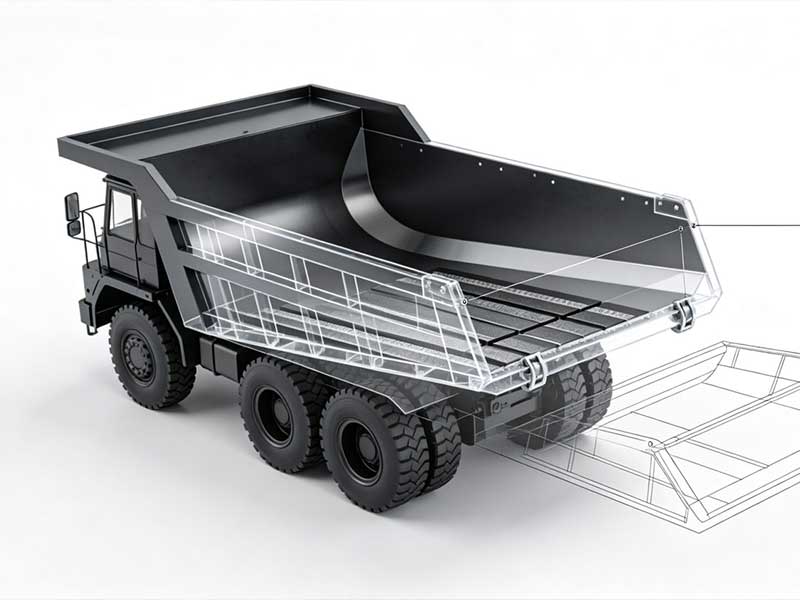
As the core load‑bearing component for heavy‑haul surface mining operations, the mining truck dump body is undergoing profound technical shifts toward lightweight construction, superior wear resistance and full compatibility with electric mining chassis.
Driven by mine electrification, larger haul truck tonnage and rising global mineral demand, the global mining truck dump body market is entering a steady growth cycle.
1. Global Mining Truck & Dump Body Market Overview
Global mining truck market revenue is projected to surpass USD 33 billion by 2033, delivering a compound annual growth rate (CAGR) of 5.9%. Heavy‑duty haul units within the 200‑400‑ton class currently capture more than 38% of total market share, as mine operators pursue larger single‑trip payloads to shrink fleet size and cut labor expenditure.
Among all truck configurations, rigid mining dump trucks account for approximately 50.7% of total industry revenue, making the mining truck dump body a fiercely competitive segment for OEMs and aftermarket component manufacturers.
| Table: Global Mining Truck Market Key Benchmark Statistics | Value |
| Total projected market size (2033) | USD 33 Billion |
| Overall market CAGR (2026‑2033) | 5.9% |
| 200‑400‑ton heavy truck market share | >38% |
| Rigid dump truck revenue share | 50.7% |
| Battery‑electric mining truck CAGR forecast | 9.88% |
| Diesel‑powered dump body market share (2025) | 68.73% |
Data source: Technavio, Grand View Research, ResearchAndMarkets industry reports
Diesel‑powered dump bodies still dominate current installed bases at 68.73% (2025). Nevertheless, battery‑electric mining truck segments exhibit far faster expansion at 9.88% CAGR.
Autonomous haulage has transitioned from field trials toward standard specification for large‑scale mines. Rio Tinto operational data from Pilbara sites demonstrates autonomous mining trucks deliver round‑the‑clock operation, lifting ton‑kilometer output while lowering maintenance spend, with return‑on‑investment cycles compressed below two years for high‑production open‑pit mines.
Capital expenditure for ultra‑large mining haul trucks ranges from USD 3‑6 million per unit. Factoring in fuel, tyre replacement and scheduled service over a 10‑year service life, lifetime total expenditure can reach USD 15‑20 million per truck. This heavy capital exposure pushes procurement teams to prioritize long‑term operating metrics over short‑term purchase price.
2. Three Defining Technical Trends for Modern Mining Truck Dump Body
2.1. Lightweight Trade‑offs for Electric Mining Truck Chassis
Battery packs and electric drive hardware add substantial dead weight to trolley‑assisted and fully electric mining trucks. Without optimized mining truck dump body design, usable payload will shrink directly, erasing the economic gains of electrification. The old design philosophy of “thicker plate equals stronger body” has become obsolete.
Modern dump body engineering relies heavily on FEA finite‑element topology optimization. Engineers map stress distribution under full‑load impact and tipping discharge conditions, removing redundant structural mass while reinforcing high‑stress zones such as weld seams and stress concentration points.
High‑strength steel with yield strength ≥1000 MPa paired with low‑beam or beam‑less flexible floor construction can achieve 15‑20% dump body weight reduction. Flexible floor architecture absorbs impact energy from falling large‑size ore through controlled elastic deformation, mitigating fatigue cracking at weld joints under cold‑climate and high‑shock mine conditions.
2.2 Custom Dump Body Geometry for Improved Material Flow & Reduced Carry‑back
Material physical properties — ore abrasiveness, moisture content and stickiness — dictate optimal dump body geometry. Persistent material carry‑back reduces real payload per cycle and shifts load centre, hurting fleet throughput.
U‑shaped / parabolic floor profiles eliminate sharp corner gaps. For sticky laterite nickel ore and high‑moisture overburden, streamlined material flow raises discharge cleanliness above 98%. Optimised rear floor raise angles of 5°‑8° combined with extended duck‑bill baffles prevent material spillage on uphill hauls and accelerate material slide‑off during early tipping stages.
| Table 2: Custom Mining Dump Body Geometry vs Typical Mine Material Profile | Material Type | Recommended Dump Body Configuration |
| High‑abrasion hard rock (iron ore, granite) | Dual‑V / heavy‑duty flat floor with dense bottom cross beams | Resist heavy rock impact, minimise floor gouging wear |
| Sticky soft rock / wet overburden (laterite nickel ore) | Beam‑less U‑shaped / parabolic flexible floor | Carry‑back reduction, discharge rate >98% |
| Low‑density light material (raw coal) | High‑volume widened lightweight dump body | Maximise volumetric utilisation without over‑engineering wear plates |
| Electric mine site all‑scenario | FEA‑topology‑optimised stepped‑thickness floor | Cut dump body dead weight, preserve nominal payload |
2.3. Advanced Wear‑Resistant Alloys, Heat Treatment & Precision CNC Machining
Service life of high‑friction zones including mid‑rear floor sections and lower side panels directly governs mine site equipment uptime. Two pillars determine real‑world component performance: alloy metallurgy plus heat treatment, and precision machining tolerances for replacement Wear Parts.
Chromium‑molybdenum micro‑alloying combined with boron steel quenching & tempering (Q&T) heat treatment delivers surface hardness ranging HBW 500‑600 while retaining sufficient core impact toughness to avoid brittle fracture under sub‑zero mine environments. Even high‑hardness wear liners and side cutter blades require tight manufacturing control.
CNC milling and boring processes manage counter‑sink depth tolerance and hole co‑axiality. Fully recessed bolt heads prevent shear damage from sliding ore and enable drop‑in field replacement of wear components.
| Table 3: Key Material & Process Benchmarks for Mining Truck Dump Body Wear Components | Parameter | Performance Specification |
| Cr‑Mo micro‑alloyed plate hardness | HBW 500‑600 | High surface wear resistance without extra plate thickness |
| Base material yield strength (lightweight variant) | ≥1000 MPa | Achieve 15‑20% dump body mass reduction |
| CNC counter‑sink hole position tolerance | Precision‑machined recessed bolt profile | Bolt head shear avoidance, plug‑and‑play part swap |
| Floor structure style for sticky ore | Beam‑less parabolic flexible floor | Material carry‑back minimised, higher cycle efficiency |
3. Practical Mining Truck Dump Body Selection Framework for B2B Buyers
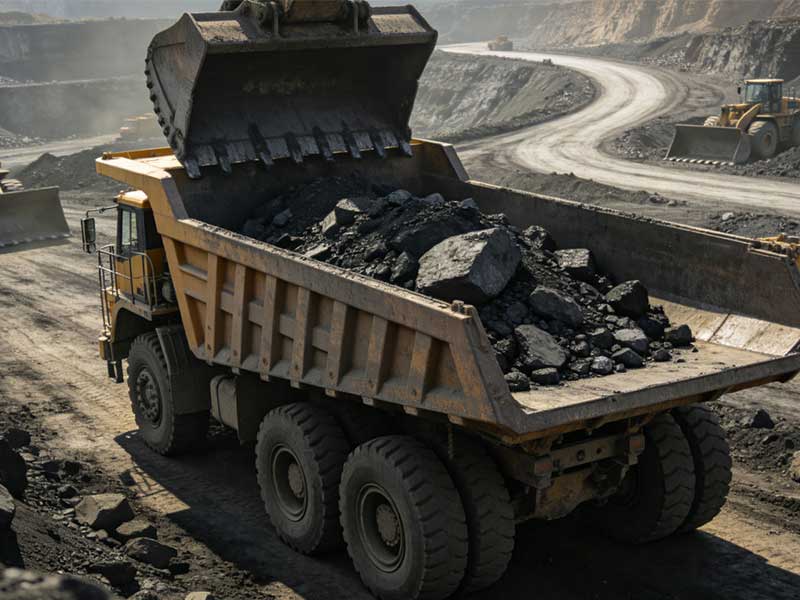
Procurement teams evaluating custom mining dump body or replacement wear assemblies should match hardware to actual mine‑site conditions instead of chasing single‑spec marketing metrics. Four critical evaluation dimensions cover structural fatigue resistance, wear service interval, dead‑to‑payload ratio and spare‑part interchangeability.
1. Structural reliability & anti‑fatigue performance: Under extreme cold and heavy impact, weld zones and stress hotspots suffer fatigue cracking. Reputable suppliers deliver FEA stress‑modelling reports as objective proof of structural optimisation.
2. Wear performance and maintenance cycle: Rapid abrasion on floor and side cutters triggers unplanned downtime and lost mine output. Verify documented outcomes from Cr‑Mo micro‑alloying and specialised quenching‑tempering heat treatment cycles.
3. Dead weight vs usable payload: Excess dump body weight raises power draw for diesel or electric trucks and cuts effective ore carrying capacity. High‑yield‑strength steel construction balances mechanical performance and lightweight targets.
4. Component consistency & assembly accuracy: Misaligned mounting holes create fit‑failure issues during on‑site wear‑part replacement. Confirm CNC‑controlled dimensional accuracy guarantees plug‑and‑play spare‑part installation.
4. Additional procurement considerations for global mining operators
Total cost of ownership extends far beyond initial invoice value. Operational power consumption, tyre degradation frequency, maintenance downtime intervals and residual value — especially for electric truck hardware — require full lifecycle calculation. Regulatory compliance such as Tier‑4 / Stage‑V emission standards also drives fleet renewal across European and North‑American mining territories.
When short‑listing manufacturing partners, China‑based mining component suppliers offer approximately 18% cost advantage versus Western OEMs, paired with strong customisation capability. Valid supplier qualification checks include access to CAD and FEA simulation capability, robotic welding workflows, ultrasonic non‑destructive weld testing and verified on‑time delivery track records.
Outlook
Mining truck dump body development continues centering on maximised payload output and minimised total cost of ownership. Electrification, autonomous haulage and modular quick‑change wear‑part architectures will shape new‑generation dump body specifications. For mine operators and procurement specialists, the optimal solution is not the universally strongest dump body, but one engineered and manufactured to match your exact ore characteristics, climate and truck chassis constraints.
Lihuacasting provides custom‑engineered mining truck dump body components, high‑performance wear liners and structural optimisation support for global mining fleet clients.
RELATED NEWS
- How to Overcome Tool Wear Challenges When Machining High-Hardness Iron Castings? 2026-10-23
- Low-Temperature Charpy Impact Testing for Off-Road Trailer Castings 2026-10-20
- Common Casting Defects in Trailer Towing Rings and How to Prevent Them 2026-10-15
- Ductile Iron vs. Carbon Steel Engineering Guide for Heavy-Duty Agricultural Trai 2026-10-13
- Heavy Duty Disc Harrow: How to Choose the Right Model? 2026-10-09
CATEGORIES
LATEST NEWS
CONTACT US
Contact: Susanna Sun
Phone: +86 13706842897
E-mail: sue-sunwin@vip.163.com ; sophie091983@gmail.com
Whatsapp:+86 13706842897
Add: 1588 Jiangnan Road Ningbo High-tech Industry zone