Blog
How to Reduce Loader Blade Fleet Operating Costs?
The global loader blades aftermarket reached USD 542.4 million in 2025, projected to hit USD 746.8 million by 2032 at a 4.68 % CAGR, driven by high replacement demand from construction, quarrying and mining operations.
For fleet managers, equipment rental firms and bulk buyers, premature wear of loader blades remain one of the largest pain points: frequent replacements trigger unplanned downtime, raise parts expenditure and drag down overall project profitability.
Traditional loader cutting edges made of ordinary structural steel deliver limited service life under heavy‑abrasion working scenarios such as rock loading, coal handling and sand‑gravel excavation.
Recent industry discussions and 2026 engineering research focus on three proven technical pathways: advanced material selection, simulation‑driven structural redesign and high‑performance surface hardening treatment, to boost abrasion resistance without sacrificing impact toughness of blades for loader.
1. Material Upgrade: High‑Strength Wear‑Resistant Steel Replaces Conventional Structural Steel
Material grade determines the baseline wear performance of blades for loader. Conventional Q550D structural steel (HBW 170‑220) suffers fast material loss under continuous particle abrasion, resulting in short service cycles and frequent part turnover. Global manufacturers are progressively migrating to dedicated wear‑resistant steel grades, including domestic NM400 / NM500 and international benchmark Hardox 400, for producing high‑end loader cutting edgesSSAB.
Table 1: Mechanical property comparison of typical steel grades for blades for loader
| Steel Grade | Hardness | Typical Tensile Strength | Relative Wear‑Life Multiplier | Suitable Working Condition |
| Q550D | HBW 170‑220 | 670‑830 MPa | 1.0× | Light‑load earth‑moving, low‑abrasion soil |
| NM400 / Hardox 400 | HBW 370‑430 | ≥1200 MPa | 2.0‑2.5× | General construction, sand‑gravel site |
| NM500 / Hardox 500 Tuf | HBW 470‑530 | ≥1500 MPa | 3.0‑4.0× | Quarry, mining, high‑impact rock loading |
As shown in Table 1, NM500 and Hardox 500 Tuf deliver up to four‑times longer service life than conventional structural steel for blades for loader under identical operating parametersSSAB. Some OEM‑customized blades for loader achieve hardness above HRC 55 via precise quenching‑and‑tempering heat treatment, targeting ultra‑heavy‑duty rock‑handling jobs.
Although high‑grade wear‑resistant steel raises initial procurement cost, total‑cost‑of‑ownership drops significantly: fewer change‑outs reduce machine stand‑still hours and cut labour expense for part replacement. Many bulk purchasers now shift mindset from “low unit price purchase” toward “lifecycle cost control” when sourcing loader bucket cutting edges.
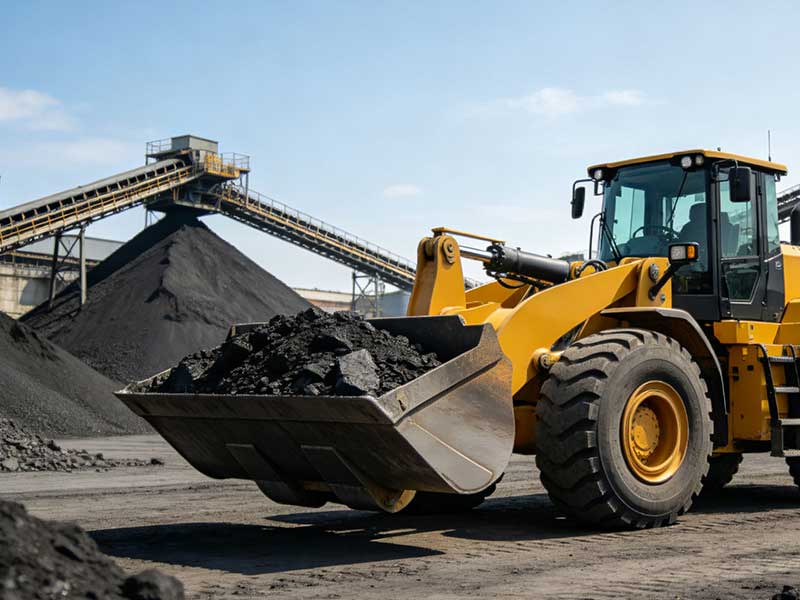
2. Structure Optimization Guided by Discrete‑Element Simulation
Even premium steel cannot achieve full potential if the loader blade geometry does not match real‑world wear patterns. Recent engineering research adopts the Discrete Element Method (DEM) to simulate particle‑blade contact, pinpointing that the main cutting edge region bears over 70 % of total abrasive impact for loader blades.
Table 2: Wear performance data — original vs DEM‑optimized blade structure (2026 academic test data)
| Item | Original Blades for Loader | DEM‑Optimized Structural Design | Improvement Rate |
| Main‑edge cumulative wear loss | Baseline 100 % | 29.2 % | Wear reduction 70.8 % |
| Local maximum stress value | 426 MPa | 311 MPa | Stress drop 27.0 % |
| Estimated service cycle | 1 000 working‑hours | 1 680 working‑hours | Life extension 68 % |
Simulation results demonstrate that targeted structural tuning redistributes contact stress across loader blades: thickened local cross‑section at high‑wear zones, transitional fillet modification and material‑flow‑friendly profile jointly mitigate concentrated abrasion and stress cracking risk.
Optimized structural design brings extra practical value for aftermarket customers: it can be combined with bolt‑on replaceable wear segments. Instead of swapping the complete blades for loader after edge wear, site crews only replace local wear blocks, further lowering parts consumption. This composite‑structure solution becomes increasingly popular for mining and quarry fleets.
Weld quality also plays a non‑negligible role in overall reliability of blades for loader. Finite‑element analysis highlights that welding joints are high‑risk locations for fatigue crack initiation under cyclic heavy impact. Qualified OEM manufacturing must strictly control welding procedure parameters to guarantee joint toughness for loader cutting edges operating in coal mine and rock‑quarry environments
3. Surface Hardening Technology: Laser Cladding & Hard‑Facing Overlay
Material substrate provides overall strength and impact resistance; surface hardening adds an “armour layer” for the most vulnerable edge sections of loader blades. Two mainstream technical routes dominate current discussions: traditional alloy hard‑facing overlay and advanced laser cladding with surface texture design.
Table 3: Surface‑treatment technical comparison for high‑wear zones of blades for loader (2026 test dataset)
| Surface‑Treatment Technology | Surface Hardness | Relative Wear Rate | Alloy‑Material Consumption | Core Advantage |
| Conventional hard‑facing overlay | HRC 58‑62 | 100 % baseline | 100 % baseline | Mature process, low equipment threshold |
| Laser cladding + surface texture | HRC 60‑64 | 20 % (‑80 % wear loss) | 33 % (‑67 % powder consumption) | Material‑saving, low thermal distortion, precise local strengthening |
Novel laser‑cladding textured treatment only deposits high‑hardness alloy onto the high‑abrasion edge strip of blades for loader, preserving good impact toughness of the steel substrate while drastically lowering surface wear rate. Compared with full‑surface hard‑facing, it cuts expensive alloy powder consumption by 67 %, balancing wear‑resistance upgrade and manufacturing cost.
For fleet operators, surface‑reinforced blades for loader are ideal for mixed‑condition worksites: the substrate absorbs heavy shock loads; the cladding layer resists abrasive particle scraping. This hybrid scheme avoids the common failure mode: ultra‑hard yet brittle components that chip under impact loading.
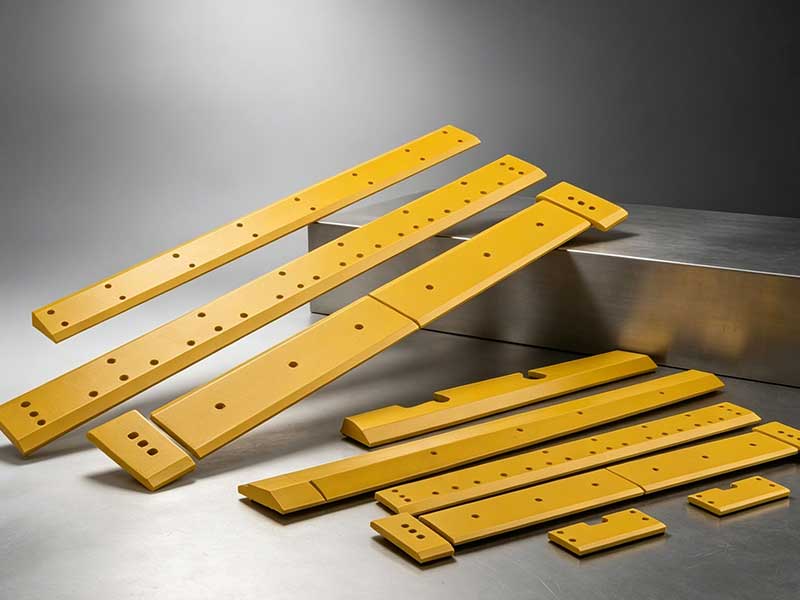
4. Practical Sourcing Guidance for Loader Blades: Shift from Single‑Product Purchase to Customized Solution
Market demand evolves: global buyers no longer only compare unit price of blades for loader, but seek application‑oriented GET component solutions. Three core procurement principles for reference:
1. Match material grade to actual working conditions
For light‑duty soil‑handling jobs, NM400 grade blades for loader deliver balanced performance‑cost output.
For quarry rock‑loading and coal‑mining sites, specify NM500 or equivalent grade plus local hard‑facing / laser‑cladding reinforcement on cutting edges.
2. Adopt composite‑structure “combined‑strategy” design
Select high‑strength wear‑resistant steel for the main cutting section of blades for loader, adopt structural steel for non‑stress back frame, and install bolt‑on replaceable wear blocks on the most abraded edge zone. This configuration achieves optimal balance between service‑life improvement and procurement investment.
3. Verify manufacturing process capability of OEM suppliers
Confirm heat‑treatment control, welding qualification and surface‑treatment capacity. As a qualified OEM manufacturers, Lihuacasting provides full traceability for raw‑material certificates and hardness test reports for blades for loader, avoiding inconsistent quality from generic aftermarket parts. Contact Us for more infomation
Total operational cost, rather than unit purchase price, determines real economic benefit. Higher‑spec blades for loader may cost more upfront; however, extended service cycles reduce downtime loss and cut overall fleet maintenance expenditure over the equipment lifecycle.
Fleet managers, rental‑company decision‑makers and international bulk buyers should evaluate parts according to real‑site abrasive‑impact conditions, and cooperate with capable OEM manufacturers to obtain customised loader cutting‑edge solutions, maximising return‑on‑investment for heavy‑equipment fleets.
RELATED NEWS
- How to Overcome Tool Wear Challenges When Machining High-Hardness Iron Castings? 2026-10-23
- Low-Temperature Charpy Impact Testing for Off-Road Trailer Castings 2026-10-20
- Common Casting Defects in Trailer Towing Rings and How to Prevent Them 2026-10-15
- Ductile Iron vs. Carbon Steel Engineering Guide for Heavy-Duty Agricultural Trai 2026-10-13
- Heavy Duty Disc Harrow: How to Choose the Right Model? 2026-10-09
CATEGORIES
LATEST NEWS
CONTACT US
Contact: Susanna Sun
Phone: +86 13706842897
E-mail: sue-sunwin@vip.163.com ; sophie091983@gmail.com
Whatsapp:+86 13706842897
Add: 1588 Jiangnan Road Ningbo High-tech Industry zone