News
Bucket Tooth Tips Sourcing Guide for Material and Tolerance Control
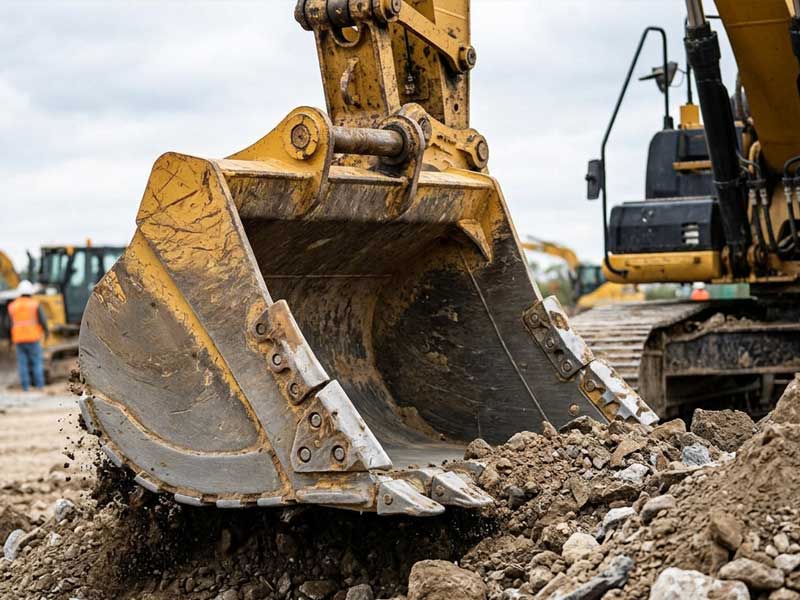
Sourcing bucket tooth tips is a system‑level decision combining working‑condition matching, metallurgy knowledge, heat‑treatment performance and full‑life‑cycle cost accounting. Poorly selected or poorly manufactured bucket tooth tips trigger premature breakage, accelerated adapter wear, frequent downtime and inflated operational expenses for mines, quarries and large construction contractors.
The global ground engaging tools (GET) market keeps steady expansion. The worldwide bucket teeth & tips market reached USD 2.14 billion in 2025 and is projected to hit USD 3.19 billion by 2032, delivering a 5.9% CAGR. The heavy‑duty equipment segment alone accounts for USD 1.65 billion market value in 2025, forecasted to grow to USD 2.285 billion by 2032 at 4.7% CAGR.
Aftermarket replacement demand dominates over OEM original equipment sales, as bucket tooth tips belong to high‑consumption wear components. Procurement mindsets are shifting: sophisticated B‑end buyers are moving away from chasing the lowest unit price and prioritizing cost per hour (CPH) and total life‑cycle cost (LCC).
1. Material Science for Bucket Tooth Tips: Balance Hardness vs Impact Toughness
Bucket tooth tips mainly fail via two modes: abrasive wear and impact fracture. Higher hardness improves wear resistance yet reduces impact toughness; overly‑soft grades deliver good impact performance but wear out rapidly. Proper material selection must match actual site working media and impact load intensity.
Table 1: Main Material Grades for Bucket Tooth Tips & Performance Benchmark
| Material Grade Category | Key Alloy Elements | Typical Hardness Range | Core Performance Characteristics | Best‑Fit Working Conditions |
| Low‑alloy cast wear‑resistant steel | C, Mn, Cr, Mo, V | HRC 40‑50 | Balanced toughness & wear resistance; cost‑effective; grain refinement via Mo/V micro‑alloying | General earthwork, sand‑gravel, medium‑abrasion sites |
| High‑manganese steel ZGMn13 | Mn 11‑14%, C | HRC 20‑25 (work‑hardened to HRC 50+) | Work‑hardening under heavy impact; core remains ductile | Hard rock mines, heavy continuous impact scenarios |
| Forged alloy steel | Cr, Mo, Ni | HRC 45‑52 | Dense metallographic structure; superior impact resistance; service life ~2× standard cast parts | Severe rock, quarry, sites sensitive to equipment downtime |
| Boron‑alloyed wear steel | Cr, Mo, trace B | HRC 48‑53 | Excellent hardenability; uniform surface‑to‑core hardness; high anti‑shock capacity | Heavy‑duty mining, high‑impact rock excavation |
Low‑alloy cast steel remains the mainstream for mass‑produced bucket tooth tips. Adding molybdenum and vanadium forms dispersed carbide phases and refines grain structure, lifting overall strength and abrasion resistance.
High‑manganese steel ZGMn13 only delivers premium wear performance under continuous heavy impact; its service life drops sharply under low‑impact digging.
Boron micro‑alloying greatly improves through‑hardening capacity, avoiding soft core issues common in conventional cast bucket tooth tips.
Hardness classification reference for bucket tooth tips: low hardness ≤HRC40, medium hardness HRC40‑50, high hardness ≥HRC50. Higher HRC value does not always equal better field performance. Hard grades risk brittle fracture under heavy shock loads.
2. Manufacturing Process: Investment Casting vs Forging + Heat‑Treatment Criticality
Manufacturing process directly decides internal metallurgical quality of bucket tooth tips. Even identical alloy composition can produce completely different service results due to process variance. Heat‑treatment (quenching & tempering) acts as the core procedure determining final mechanical properties. Improper temperature control leads to brittle tooth tips prone to cracking or soft components that wear quickly.
Table 2: Process Comparison: Investment Casting VS Forged Bucket Tooth Tips
| Process Route | Major Advantages | Inherent Drawbacks | Typical Extra Machining Requirement | Suitable Application |
| Investment Casting (Silica‑sol / Water‑glass) | Complex inner cavity geometry achievable; mass‑production efficiency; competitive unit cost | Potential porosity, shrinkage cavity, coarse grain; inner cavity cannot be post‑machined economically | Minor finishing; inner cavity depends entirely on casting precision | Mass‑volume general‑purpose & heavy‑duty bucket tooth tips |
| Forging | Compact metal flow lines; minimal internal defects; outstanding impact toughness | Complex inner cavity hard to form; high tooling & production cost | CNC machining for fitting surfaces & pin holes | Extreme‑condition mining, high‑impact quarry GET parts |
Investment‑cast bucket tooth tips rely entirely on wax‑pattern shrinkage compensation and shell‑mold surface quality for inner cavity accuracy. Inner blind cavity of bucket tooth tips is practically impossible to finish‑machine afterwards. Any sand sticking or metal nodule inside the cavity creates false fit clearance and triggers early‑failure risk.
Forged bucket tooth tips own dense microstructure, yet forging cannot readily produce complex tapered inner profiles matching adapters. Most forged bucket tooth tips require follow‑up CNC milling and boring to meet assembly dimensional requirements. Advanced quenching‑and‑partition (QP) heat‑treatment can optimize cast bucket tooth tips’ microstructure by introducing retained austenite within martensite matrix, further improving toughness without sacrificing wear performance.
3. Tolerance Control: Why Bucket Tooth Tips Break Prematurely (Casting + CNC Machining)
A large share of early bucket tooth tip fractures originate not from defective alloy material, but from excessive fit clearance between bucket tooth tips and adapters. Excessive clearance generates lever‑effect stress concentration during digging cycles. FEA simulation consistently shows high‑stress red zones concentrated around pin holes and tooth root walls when fit clearance goes out of tolerance range.
Perfect rigid engagement requires synergized precision investment casting (for bucket tooth inner cavity) and CNC machining (for adapter nose and pin holes).
3.1. Investment casting controls bucket tooth tip inner‑cavity precision
Wax‑pattern mould must implement accurate dimensional compensation for steel solidification shrinkage. Shell‑mold inner surface finish must be strictly managed to prevent sand adhesion and surface protrusions. Even 1‑2 mm local protrusion stops bucket tooth tips from seating fully onto adapters, creating dangerous false fit. Since inner cavity cannot be CNC reworked, casting accuracy defines baseline assembly performance.
3.2. CNC milling controls adapter nose matching profile
Adapter nose receives CNC finish‑milling on tapered contact faces. Target contact ratio between adapter nose and bucket tooth inner cavity should reach ≥80% across upper and lower bearing surfaces. Design controlled end‑gap clearance at nose tip; hard bottom‑to‑bottom contact must be avoided, which would separate tapered contact faces and cause tooth splitting under load.
3.3. CNC boring secures pin‑hole coaxiality & counter‑bore dimension
Pin holes represent critical stress‑concentration zones. One‑setup horizontal‑machining‑center boring guarantees pin‑hole coaxiality across through‑holes. Offset coaxiality leads to pin seizure, pin shearing or pin‑hole wall cracking. For side‑lock pin structures, counter‑bore depth tolerance needs tight monitoring: shallow counter‑bore causes retainer dropping out; over‑deep counter‑bore weakens locking force. Tool‑wear compensation routines are essential for batch production of hard alloy workpieces to prevent aperture drift as cutting tools degrade.
Table 3: Key Dimensional Tolerance Reference for Bucket Tooth Tips & Adapter Assembly
| Control Item | Tolerance Target | Failure Risk if out‑of‑spec | Inspection Suggestion |
| Bucket tooth inner cavity (casting) | ±0.8 mm critical profile | False seating, lever‑effect fracture | Visual + sample assembly fit test |
| Adapter nose taper contact rate | ≥80% bearing contact | Local point loading, accelerated wear | Blue‑ink contact‑pattern sampling |
| Pin‑hole coaxiality | ≤0.15 mm | Pin shear, hole wall cracking | CMM coordinate measuring sampling |
| Counter‑bore depth for retainer pin | ±0.3 mm | Lock pin loosening / insufficient locking | CNC program + periodic probe check |
4. Working‑Condition‑Driven Bucket Tooth Tips Selection Framework
Bucket tooth tips cannot be selected purely by hardness value. Digging medium, impact load magnitude and penetration requirements determine optimal geometry profile and material solution.
- Light‑to‑moderate working conditions: general soil, silt, low‑abrasion sand.
Select general‑purpose profile bucket tooth tips. Low‑alloy cast steel delivers balanced cost‑performance. Prioritize total procurement cost for large‑volume replacement cycles.
- High‑abrasion working conditions: sand‑aggregate pit, high‑silica soil, fragmented rock.
Specify heavy‑duty bucket tooth tips. Choose high‑alloy cast steel or forged alloy steel with target hardness ≥HRC 50. Focus on wear life extension to cut replacement frequency.
- High‑impact plus high‑abrasion working conditions: hard rock mine, frozen ground, blasted rock.
Adopt penetration‑style or double‑spike bucket tooth tips with optimized tip geometry for low digging resistance. For sustained heavy shock environments, high‑manganese steel or premium forged bucket tooth tips are preferred options.
Besides bucket tooth tips itself, evaluate whole GET system including adapter and pin retainer assemblies. Traditional horizontal pins deliver robust performance for heavy‑load scenarios. Hammer‑free quick‑change retainer systems improve field‑service efficiency and operator safety and become a valuable cost‑reduction option for large‑scale job sites.
RELATED NEWS
CATEGORIES
LATEST NEWS
CONTACT US
Contact: Susanna Sun
Phone: +86 13706842897
E-mail: sue-sunwin@vip.163.com ; sophie091983@gmail.com
Whatsapp:+86 13706842897
Add: 1588 Jiangnan Road Ningbo High-tech Industry zone