Blog
How to Choose the Right Type of Excavator Bucket Teeth?
Excavator bucket teeth are mainly divided into three core categories: dirt teeth for soft soil and sand conditions, rock teeth for hard rock and mining operations, and cone/flat teeth for coal, frozen soil and other special working conditions.
Different types of bucket teeth adopt targeted shape and material designs to adapt to specific construction scenarios, effectively reducing excavation resistance and greatly extending service life. In addition, special tiger teeth are widely used for fine and high-penetration excavation work. The detailed introduction of common bucket tooth types, performances and applications is as follows.
1. Classification, Characteristics and Application of Bucket Teeth
The following table systematically summarizes the appearance features, applicable working conditions and core advantages of all mainstream excavator bucket teeth, providing an intuitive reference for model selection:
| Tooth Type | Appearance Characteristics | Applicable Working Conditions | Core Advantages |
| Standard Dirt Teeth | Wide cutting edge with a gentle tooth tip. It has moderate penetrating power and large material holding capacity. | Suitable for excavating ordinary soil, clay, sand, loose surface soil and all kinds of soft and loose working conditions. | High excavation efficiency, anti-sticking performance without soil accumulation, and ultra-wide universality for general construction scenarios. |
Rock Teeth | Sharp front end, thick and solid overall structure, equipped with reinforced ribs for enhanced structural strength. | Designed for high-load and heavy-duty operations, including hard rock, sub-hard rock, weathered rock excavation, as well as iron ore quarry and stone yard mining. | Extremely strong penetrating power and impact resistance, capable of crushing hard materials stably and resisting severe impact wear. |
| Cone / Flat Teeth | Conical or flat strip front end, which can always maintain a sharp working surface during wear and abrasion. | Ideal for coal mining (improves coal block rate), frozen soil, weathered sand and other materials with special medium hardness. | No blunt failure caused by long-term wear, effectively reduces excavation resistance and saves fuel consumption during operation. |
| Tiger / Flared Teeth | Extra slender and sharp tooth tip, or with flared wing blades on both sides for concentrated stress. | Applied for high-penetration excavation of dense soil and hard frozen soil, as well as fine operations such as root removal and hard dry sediment cleaning. | Superior penetrating performance, capable of accurately cutting into hard and loose stratum that is difficult to excavate, suitable for special fine construction work. |
2. Bucket Tooth Selection & Maintenance Tips
2.1 Manufacturing Process
There are two mainstream manufacturing processes for bucket teeth: casting and forging.
Forged bucket teeth feature high material density, excellent toughness and strong anti-twist capacity. Their service life is generally twice that of cast bucket teeth, making them the optimal choice for harsh working conditions with frequent strong impact.
Cast bucket teeth have cost-effective prices and stable basic performance, suitable for conventional general construction scenarios with low impact load.
2.2 Installation Mode
Two common installation methods are adopted for excavator bucket teeth:
Vertical Installation: Vertical assembly structure, easy and fast to disassemble and replace, mainly matched with small and medium-sized excavators for daily general excavation work.
Horizontal Installation: Horizontal assembly structure with more reasonable force-bearing design, which can bear heavy load and strong impact. It is widely equipped on medium and large heavy-duty excavators for mining and high-intensity construction.
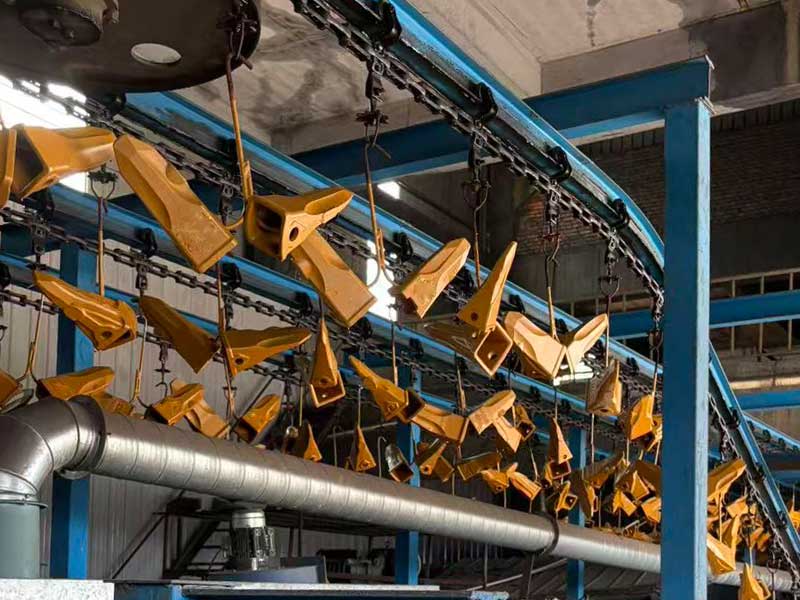
3. Professional Matching Service
Lihuacasting delivers highly targeted, customized bucket tooth matching solutions for global purchasers by adopting a four-dimensional precise matching standard, covering construction working conditions, excavator tonnage, manufacturing technology and installation mode. This standardized and classified recommendation avoids generic selection errors and fully fits diverse engineering and mining demands.
3.1 Precise Matching by Construction Working Conditions (Core Tooth Type Selection)
We select exclusive bucket tooth types according to different stratum hardness and operation scenarios to ensure optimal working performance:
Standard dirt teeth are specially configured for soft working conditions including ordinary soil, clay and loose sand, focusing on high excavation efficiency and anti-blocking performance.
Rock teeth with reinforced structure are matched with medium and high-hard working conditions such as weathered rock, sub-hard rock, granite and open-pit mine quarrying, delivering strong impact resistance and crushing capacity.
Cone and flat teeth are exclusively used for coal mining, frozen soil and weathered sand construction, maintaining long-term sharpness to improve coal block rate and reduce fuel consumption.
Tiger teeth are applied to special fine operations, including dense hard soil excavation, tree root removal and hard dry sediment cleaning, providing ultra-high penetration for difficult stratum.
3.2 Precise Matching by Excavator Tonnage (Model & Specification Adaptation)
The bucket tooth model and installation structure are strictly bound with excavator tonnage to ensure stable stress and compatibility:
Small excavators (1–6 tons) are matched with vertically installed standard dirt teeth and light-duty rock teeth, featuring easy disassembly and adaptation for light daily excavation.
Medium excavators (7–20 tons) adopt dual-purpose vertical and horizontal installation teeth, which can be flexibly switched according to actual working conditions to balance efficiency and durability.
Large heavy-duty excavators (above 20 tons) are equipped with thickened reinforced rock teeth with horizontal installation, which bear heavy continuous impact and adapt to high-intensity mining operations.
3.3 Precise Matching by Working Load (Manufacturing Technology Selection)
We allocate different production processes based on operation intensity and impact frequency:
Cost-effective cast bucket teeth are recommended for conventional low-impact soil and loose earthwork projects, meeting daily construction demands with lower procurement cost.
Forged bucket teeth with high density, high toughness and anti-twist performance are exclusively recommended for high-frequency impact scenarios such as hard rock mining and granite excavation. Their service life is twice that of cast teeth, effectively reducing replacement frequency and construction downtime loss.
3.4 Professional Avoidance & Supporting Customized Service
While formulating matching schemes, we eliminate common selection errors in advance, such as fuel waste caused by installing heavy rock teeth on soft soil working conditions and tooth fracture risks caused by using light dirt teeth on hard rock.
Meanwhile, we provide supporting services including wear resistance grade selection, estimated service life evaluation and matching accessory models, helping global purchasers maximize construction efficiency, control comprehensive cost and realize long-term stable operation of equipment.
4. About Lihuacasting
Lihuacasting is a Chinese supplier of bucket teeth with over 30 years of professional casting experience. We offer a comprehensive range of durable, cost-effective Wear Parts for construction machinery, designed to perform perfectly under the diverse operating conditions found in global markets. By providing both customized and standard bucket tooth solutions for excavators, we help customers worldwide reduce equipment maintenance costs, extend component service life, and ensure stable, efficient operations.
RELATED NEWS
- Common Casting Defects in Trailer Towing Rings and How to Prevent Them 2026-10-15
- Ductile Iron vs. Carbon Steel Engineering Guide for Heavy-Duty Agricultural Trai 2026-10-13
- Heavy Duty Disc Harrow: How to Choose the Right Model? 2026-10-09
- How to choose the right lawn mower blades? 2026-09-23
- How to Choose Right Industrial Steel Self-Dumping Forklift Hopper? 2026-09-21
CATEGORIES
LATEST NEWS
CONTACT US
Contact: Susanna Sun
Phone: +86 13706842897
E-mail: sue-sunwin@vip.163.com ; sophie091983@gmail.com
Whatsapp:+86 13706842897
Add: 1588 Jiangnan Road Ningbo High-tech Industry zone