Blog
Ductile Iron vs. Carbon Steel Engineering Guide for Heavy-Duty Agricultural Trailer Parts
Ductile iron vs. carbon steel is one of the most consequential material decisions an agricultural trailer OEM can make. The choice dictates structural integrity in the field, machining cost on the shop floor, weldability at assembly, and ultimately the warranty claims that land back on your desk.
Both metals are proven workhorses in heavy-duty equipment—but they are not interchangeable, and specifying the wrong one for a suspension bracket, hitch component or chassis plate can cost far more than the material itself.
The global iron and steel casting market was valued at roughly US$54.8 billion for ductile iron alone in 2025, with ductile iron holding about 30% of total iron-and-steel casting value against around 22% for steel castings (PW Consulting, 2026). Meanwhile the farm trailers market reached approximately US$33.15 billion in 2025 and is projected to grow at a 6.2% CAGR toward US$53.6 billion by 2033 (Verified Market Research). Every one of those trailers carries cast and fabricated parts whose material selection is now a competitive and compliance issue.
1. Mechanical Properties and Load-Bearing Character
The first and most basic distinction is how each material carries load.
Carbon steel—whether structural grades such as Q355/Q355B, or medium-carbon grades like 45# (≈AISI 1045 / EN C45) after hardening and tempering—offers a higher tensile ceiling. A normalized-and-tempered 1045 forging routinely delivers 600–700 MPa tensile strength and 355–420 MPa yield, which is why steel remains the default for components under pure tensile or shear loads.
Ductile iron (e.g. QT450-10, QT500-7, QT600-3) compensates with an unusual combination: high compressive strength **plus** genuine ductility made possible by spheroidal graphite nodules. QT450-10 provides a minimum **450 MPa tensile, 310 MPa yield and ≥10% elongation**. That elongation is the property that lets a cast suspension bracket survive overloading instead of fracturing abruptly.
Damping and fatigue absorption are where ductile iron is unmatched. The graphite nodules act as micro-scale shock absorbers, dissipating high-frequency vibration from rough field roads and reducing transmitted fatigue to the chassis. Carbon steel is stiffer and higher in elastic modulus, but it damps vibration slowly—under sustained heavy shock it can resonate and develop fatigue micro-cracks at weld toes and stress risers.
Table 1. Mechanical Property Comparison — QT450-10 (Ductile Iron) vs. 45#/1045 (Carbon Steel)
| Property | Ductile Iron QT450-10 | Carbon Steel 45# (AISI 1045, hardened & tempered) |
|---|---|---|
| Microstructure | Ferritic + pearlitic matrix with spheroidal graphite | Medium-carbon steel, normalized or quenched & tempered |
| Tensile strength (Rm) | ≥ 450 MPa | 600–700 MPa (H&T) |
| Yield strength (Rp0.2) | ≥ 310 MPa | 355–420 MPa (H&T) |
| Elongation | ≥ 10% | 12–20% typical, lower at high hardness |
| Damping / vibration absorption | Excellent | Moderate to low |
| Hardness (typical) | 160–210 HB | 170–230 HB (H&T) |
| Best load mode | Compression, combined bending + vibration | Tension, shear, impact |
Data reference: ASTM A536 Grade 65-45-12 minimums (448 MPa tensile / 310 MPa yield / 12% elongation) align closely with GB QT450-10; 1045 properties per AISI/EN 10083 C45 typical hardened-and-tempered values.
2. Castability vs. Fabricability: Shaping the Part
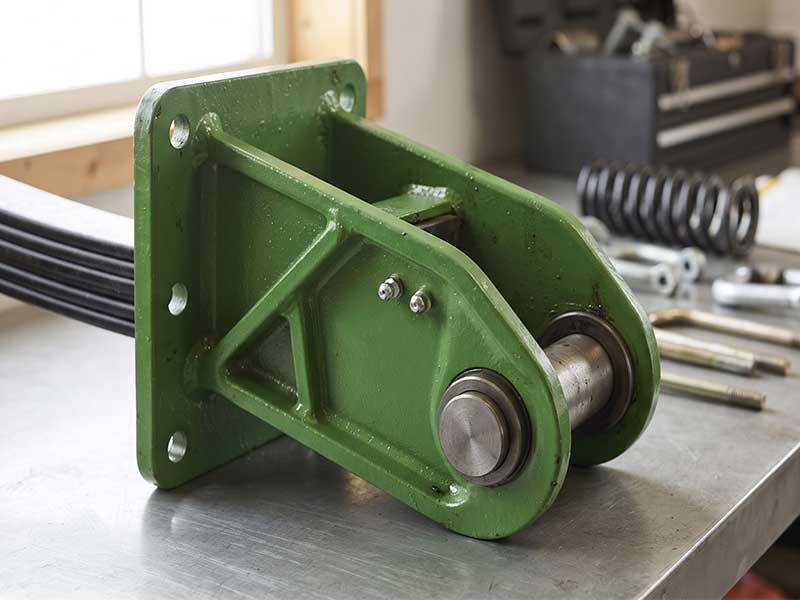
Ductile iron is the material for complex geometry. Its excellent flowability lets you cast an integral suspension hanger, equalizer arm, or torque arm seat with reinforcing ribs, hollow sections and precision boss locations in a single pour—eliminating dozens of machining and welding operations. For high-volume, complex parts, the amortized tooling cost drives per-piece cost dramatically down, and near-net-shape casting slashes CNC time.
Carbon steel shapes itself through fabrication. Plate laser-cutting, folding, welding and machining build brackets from flat stock; die forging produces stronger but pricier near-net parts. For simple geometry or low-volume custom builds, steel requires no expensive molds and offers far lower front-end investment.
The catch: a complex one-piece bracket that must be monolithic is enormously expensive to machine from solid steel or to die-forge. That is precisely where ductile iron wins the total-cost argument.
3. Weldability — The Critical Gate
For heavy-duty trailers, weldability is rarely optional, because most brackets, hangers and chassis members are welded to the main frame or subframe. This single factor disqualifies or confirms a material more than any other.
- Carbon steel welds cleanly. Q235/Q355 structureal steels are engineered for welding; attachments can be fillet-welded directly into the main beam and treated as one structure.
- Ductile iron is difficult to weld. High carbon equivalent plus nodularizing elements make direct welding crack-prone. If a cast part must be welded onto the frame, you typically need preheating, nickel-based filler and post-weld heat treatment—slow, specialized and expensive.
Practical rule: if the part is welded into the chassis, use steel. If it is a stand-alone cast component bolted or pinned in place, ductile iron is the strong, economical choice.
4. Wear Resistance and Impact Toughness
Wear: the graphite in ductile iron provides a mild self-lubricating effect under sliding contact, giving cast components—pin sleeves, axle seats, pivot bosses—excellent wear performance in dry friction zones.
Impact: hardened-and-tempered carbon steel delivers superior toughness and absorbed impact energy, making it the right answer for components that take sudden shock from heavy loads, potholes and hard braking.
5. Cost and Economics
| Scenario | Winning material | Why |
|---|---|---|
| Complex geometry, high volume | Ductile iron | Tooling amortizes; near-net-shape cuts machining |
| Simple shape / low-volume custom | Carbon steel (fabricated) | No mold cost; fast turnaround |
| Part welded to main frame | Carbon steel | Direct structural welding |
| Cast-in-place wear/compression part | Ductile iron | Ribs + damping + wear in one casting |
Raw carbon steel stock is usually cheaper per tonne than premium ductile iron castings. But once machining hours, scrap rate and assembly labor are included, total cost often reverses—a fact too many buyers learn after the first production run.
6. Part-by-Part Selection Guide
Table 2. Recommended Material by Agricultural Trailer Component
| Component | First-choice material | Primary reason |
|---|---|---|
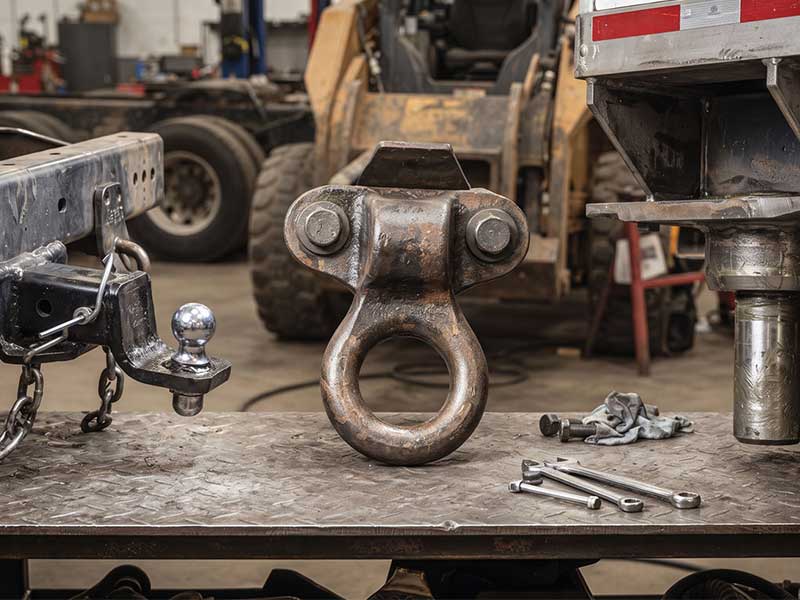
| Tow hitch / towing eye / kingpin | Forged carbon or alloy steel | High tensile + absolute fracture safety |
| Axle end, wheel hub flange, steering boss | Ductile iron (QT500-7/QT600-3) | Complex geometry, compression, wear |
| Suspension hanger / equalizer / torque arm seat | Ductile iron (QT450-10) | Complex ribs, damping, wear |
| Chassis main beam / side panels / coupling plate | Structural carbon steel (Q355) | Weldability into main structure |
| Wear sleeves / pivot bushes | Ductile iron | Self-lubricating graphite under friction |
7. Deep Dive: Suspension Brackets — QT450-10 vs 45# Steel
The suspension bracket is the best real-world case study because it demands everything at once: fatigue resistance from road shock, side torque, and often a complex profile.
Table 3. Suspension Bracket Comparison — Ductile Iron QT450-10 vs 45# Steel
| Dimension | Ductile iron QT450-10 | Carbon steel 45# (1045) |
|---|---|---|
| Standard mapping | ASTM A536 65-45-12 / ISO 1083 EN-GJS-450-10 | AISI 1045 / EN 10083 C45 / JIS S45C |
| Tensile | ≥ 450 MPa | 600–700 MPa (H&T) |
| Elongation | ≥ 10% | Depends on heat treatment |
| Vibration damping | Excellent | Moderate |
| Complex integral ribs / hollows | Cast in one piece | Requires machining or fabrication |
| Weldability to frame | Poor (cracking risk) | Excellent |
| Best use | Stand-alone cast hanger, bolted/pinned | Welded structural bracket |
Choose QT450-10 when the bracket is a stand-alone casting—equalizer arm seat, torque arm seat, integral suspension hanger with multiple ribs—dominated by compression and high-frequency vibration. Choose 45#/1045 when the bracket is a welded structural assembly that must be integrated into the main beam.
Summary
There is no universal "better" metal—only the right metal for the load path, the geometry and the joining method. Ductile iron vs carbon steel for heavy-duty agricultural Trailer Parts resolves cleanly once you ask three questions: Is it welded into the frame? Is it complex and high-volume? Does it live in compression and vibration? Answer those, and the choice—and your downstream cost—stops being a gamble.
At Lihuacasting, we manufacture heavy-duty ductile iron and steel trailer components—suspension hangers, equalizer arms, axle flanges, Wear Parts and custom castings—under QT450-10 / QT500-7 / QT600-3 and 1045-equivalent grades. We combine resin-sand and lost-foam casting with in-house CNC machining, provide 3.1 material certificates and NDT on request, and ship with full traceability to farms and OEMs across Europe, North America and the Middle East. If you are specifying a new suspension bracket or upgrading an existing line, send us your 2D/3D drawings (STEP/IGES/PDF) for a material recommendation and DFM review at no cost.
Need help selecting cast vs. steel components? Contact Lihuacasting with your drawings for a free engineering review and quote.
RELATED NEWS
- Heavy Duty Disc Harrow: How to Choose the Right Model? 2026-10-09
- How to choose the right lawn mower blades? 2026-09-23
- How to Choose Right Industrial Steel Self-Dumping Forklift Hopper? 2026-09-21
- Disc Plow vs Disc Harrow for Primary & Secondary Tillage 2026-09-18
- What Factors Affect Plough Share Service Life? 2026-09-15
CATEGORIES
LATEST NEWS
CONTACT US
Contact: Susanna Sun
Phone: +86 13706842897
E-mail: sue-sunwin@vip.163.com ; sophie091983@gmail.com
Whatsapp:+86 13706842897
Add: 1588 Jiangnan Road Ningbo High-tech Industry zone