News
Why Choose Investment Cast Bucket Teeth Over Traditional Sand-Cast Bucket Teeth?
Choosing investment-cast bucket teeth may appear, on the surface, to be simply a choice of a more sophisticated manufacturing process; however, in essence, it represents a choice for superior safety, extended service life, higher operational efficiency, and lower overall operating costs. For overseas buyers and distributors of construction machinery who prioritize both quality and efficiency, investment-cast bucket teeth have long been regarded as an indispensable standard component.
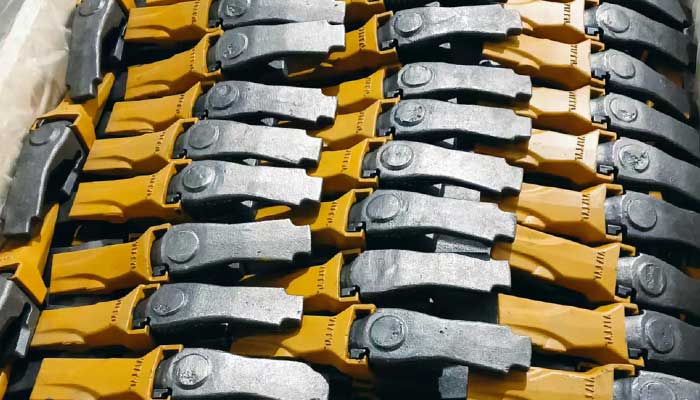
In the practical application of heavy machinery—such as excavators and loaders—bucket teeth are critical Wear Parts subjected to high loads and extreme abrasion, engaging in direct, head-on impact with rock, soil, and sediment.
Although traditional sand casting can indeed produce bucket teeth—often at a lower cost—most manufacturers of high-end, wear-resistant construction machinery today firmly opt for investment casting (also known as precision casting). The following are several key reasons why, in the specific context of bucket teeth, investment casting decisively outperforms sand casting:
1. Superior Fit Precision: Secure Locking Prevents Tooth Loss and Adapter Failure
Bucket teeth do not function in isolation; they must be mounted securely onto a tooth adapter via a locking pin.
Disadvantages of Sand Casting:
Sand casting is characterized by wide dimensional tolerances. If the internal cavity (mounting hole) of the bucket tooth is cast too large, the tooth will wobble during operation. Under the immense impact forces generated by excavators—ranging from several tons to tens of tons—this minute wobble is amplified exponentially. This makes it extremely likely for the locking pin to dislodge (resulting in tooth loss) or, worse, to exert leverage that fractures the adapter itself. Conversely, if the internal cavity is cast too small, workers on-site will find it impossible to drive the tooth into place during installation.
Advantages of Investment Casting:
Investment casting offers exceptionally high dimensional accuracy (with tolerances typically falling within ±0.2 ~0.5 \mm). This ensures that every bucket tooth leaving the factory achieves a perfect fit and secure lock with its corresponding adapter. The resulting uniform load distribution not only saves time and effort during installation but also significantly extends the service life of the adapter, thereby eliminating accidents caused by loose-fitting teeth.
2. Denser Material Structure: No Internal Porosity; Impact-Resistant and Non-Fracturing
When excavating hard rock, bucket teeth are subjected to extremely high instantaneous impact forces.
Disadvantages of Sand Casting:
Sand casting utilizes molding sand, which possesses relatively limited permeability. During the pouring of molten metal, it is highly prone to forming internal pores, sand inclusions, or areas of structural looseness within the casting. These internal defects are invisible to the naked eye; however, during high-intensity operations, they act as critical "stress concentration points." Consequently, the bucket teeth often snap directly in the middle the moment they strike a hard object.
Advantages of Investment Casting:
Investment casting employs ceramic shells that have undergone high-temperature firing. These shells not only contain zero moisture but also possess excellent gas-venting capabilities. Furthermore, the cooling and solidification processes in investment casting are more easily controlled. This results in a highly compact internal metallographic structure for the bucket teeth, virtually free of pores and impurities. Their impact toughness is significantly enhanced, ensuring that—even under the most arduous working conditions—the bucket teeth will "wear down, but never break."
3. More Scientific Structural Design: Maintains Sharpness for Higher Excavation Efficiency
The design of bucket teeth places great emphasis on aerodynamic geometry; a superior bucket tooth should possess "self-sharpening" properties—meaning it retains a relatively sharp edge even as it undergoes abrasive wear.
Disadvantages of Sand Casting:
Constrained by the mold-release process, sand casting struggles to produce extremely thin and sharp cutting edges; likewise, the transitions in wall thickness cannot be executed with great precision. The resulting bucket teeth often appear bulky and blunt, generating high excavation resistance and subsequently increasing the excavator's fuel consumption.
Advantages of Investment Casting:
Investment casting effortlessly facilitates the creation of complex geometric shapes and razor-sharp cutting edges—even allowing for the incorporation of design features such as reinforcing ribs and grooves on the bucket tooth surface. Bucket teeth produced via this method exhibit minimal cutting resistance and deliver sharper, more aggressive excavation performance, thereby significantly boosting the overall operational efficiency of the machine and reducing fuel costs.
4. Superior Surface Finish: Reduced Friction and Smoother Soil Discharge
Bucket teeth produced via sand casting typically possess a rough surface—resembling sandpaper—which causes soil to adhere easily to both the teeth and the adapters when excavating cohesive soils (such as red soil or clay). This leads to a phenomenon known as "bucket clogging," thereby reducing operational efficiency.
In contrast, bucket teeth produced via investment casting feature a smooth surface finish (approaching the texture of a CNC-machined part). With a low coefficient of friction and superior self-cleaning properties, these teeth allow soil and rock to slide past effortlessly, ensuring highly efficient operations.
5. The Ultimate Economic Comparison: Higher Overall Cost-Effectiveness
Many buyers are initially enticed by the extremely low "unit price" of sand-cast bucket teeth; however, in actual field use, they quickly discover the reality:
| Comparison Criteria | Sand-Cast Bucket Teeth | Investment-Cast Bucket Teeth (High-End Standard) |
| Unit Purchase Price | Lower | Slightly Higher |
| Service Life | Short (Prone to breakage; poor wear resistance) | Long (Highly wear-resistant; uninterrupted performance) |
| Risk of Unexpected Downtime | High (If a tooth breaks, the excavator must halt operations for replacement) | Extremely Low (Wears predictably; replacements can be scheduled) |
| Collateral Damage/Losses | Prone to wobbling; highly likely to damage the expensive adapter | Precise, tight fit; effectively protects the adapter |
| Overall Cost-Effectiveness | Frequent replacements + lost labor costs = High overall cost. | Higher upfront cost, but lower operating cost = Low overall cost. |
6. Typical Application Scenarios for Investment Casting and Sand Casting
Components Suitable for Investment Casting:
Precision industrial parts required to withstand complex stresses or high temperatures—such as excavator bucket teeth, grapples, and rigging hardware used in heavy machinery.
Suspension system castings and trailer coupling devices (e.g., specially shaped pintle hooks) for the automotive and commercial vehicle sectors.
Turbine blades and impellers for the aerospace industry, as well as components for medical devices, valves, and piping systems.
Components Suitable for Sand Casting:
Large housings for heavy machinery, machine tool bases, and large flywheels.
Automotive engine blocks, cylinder heads, and crankshafts.
Rough castings for valves and piping, counterweights, and similar items where structural strength is the primary requirement and strict surface finish precision is not critical.
The choice of casting process depends primarily on the complexity of the casting, its size and weight, surface finish requirements, and annual production volume. If a part features a complex structure, presents challenges for subsequent machining, and demands a high-quality surface finish, investment casting is an excellent choice. Conversely, for large, heavy parts with relatively simple structures—or when the priority is achieving the lowest possible unit cost—traditional sand casting remains an indispensable foundational process.
As a distinguished leader in this manufacturing sector, Lihua Casting was established in 1994. With over 30 years of extensive experience, Lihua Casting stands as a premier OEM casting service provider, dedicated to the custom R&D and manufacturing of high-quality precision castings and mechanical components. Whether the requirement involves precision investment castings with exacting dimensional tolerances or heavy machinery components engineered for maximum structural strength, Lihua Casting leverages its deep industry expertise to deliver comprehensive, high-standard, and customized casting solutions to clients worldwide.
RELATED NEWS
CATEGORIES
LATEST NEWS
CONTACT US
Contact: Susanna Sun
Phone: +86 13706842897
E-mail: sue-sunwin@vip.163.com ; sophie091983@gmail.com
Whatsapp:+86 13706842897
Add: 1588 Jiangnan Road Ningbo High-tech Industry zone