Blog
Rock / Heavy Duty Teeth vs. Standard Skid Steer Bucket Teeth
Rock / Heavy Duty Teeth vs. Standard Skid Steer Bucket Teeth: Performance, Structure and Industrial Application Guide
In the construction, mining, and demolition industry, skid steer bucket teeth are core wearable components that directly determine operational efficiency, equipment fuel consumption, and maintenance costs. As professional bucket teeth supplier, the most frequent customer selection dilemma lies in choosing between Rock / Heavy Duty Teeth (Rock Bucket Teeth) and conventional standard teeth, tiger teeth.
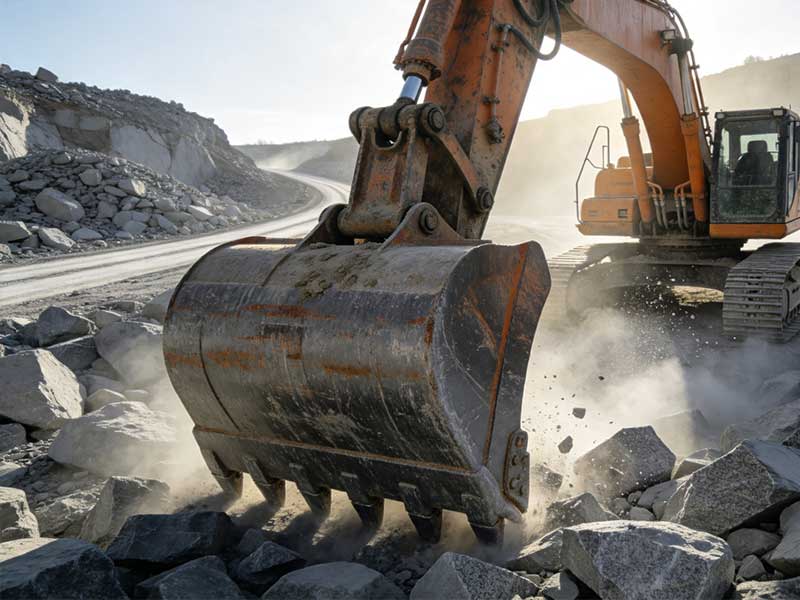
The essential difference among all bucket tooth types is the trade-off between impact resistance & wear resistance and material penetration capability. Rock bucket teeth abandon extreme sharpness and prioritize structural robustness and service life, making them the optimal choice for harsh high-intensity working conditions.
This article systematically compares mainstream bucket tooth types and common fixing systems with industry verified data to provide reliable selection references for engineering practitioners and purchasers.
1. Core Performance & Structural Comparison of Mainstream Skid Steer Bucket Teeth
Different bucket tooth designs are tailored for specific working scenarios. Standard teeth, tiger teeth, and rock/heavy duty teeth cover light earthwork, compact soil operation, and heavy rock breaking respectively.
Combined with 2026 industry wear data and operational hour statistics, the differentiated advantages are summarized as follows:
| Comparison Dimension | Rock / Heavy Duty Teeth (Rock Bucket Teeth) | Tiger / Single-Point Teeth | Standard Earthwork Teeth |
| Head Structure & Design | Wide, thick and blunt head with reinforced back ribs; maximum wear mass and structural rigidity; optimized material distribution for anti-impact performance | Slender and ultra-sharp conical structure; concentrated material on the tip for extreme penetration | Moderate flat chisel-shaped head; balanced structure for universal earthwork scenarios |
| Core Performance Advantage | Industry-leading impact resistance; 63.5% lower wear rate than standard teeth; no brittle fracture under heavy rock prying and breaking loads | Excellent penetration for compacted clay and frozen soil; effectively reduces digging resistance in dense soil layers | Strong versatility; balances penetration and basic wear resistance for daily light-duty operations |
| Key Deficiency | Large contact area leads to high digging resistance; 10-15% higher fuel consumption in pure soil working conditions | Poor impact resistance; tip and root prone to fracture when hitting hard rocks; rapid wear in abrasive working conditions | Limited load-bearing capacity; easy wear and deformation in rock and high-abrasion scenarios |
| Average Service Life (Industry Data) | 180-1000 working hours; 1.5-3 times longer than standard teeth; stable performance after 300 hours of continuous operation | 80-120 working hours; sharp tip fails rapidly in abrasive environments | 120-150 working hours; mainstream replacement cycle for general engineering |
| Typical Application Scenarios | Quarrying, concrete demolition, asphalt milling, hard rock handling, high-abrasion ore transportation | Frozen soil excavation, compacted foundation soil breaking, high-density soil layer operation | Loose soil, gravel, daily construction waste cleaning, general earthwork projects |
2. Operational Cost & Economic Benefit Data Comparison
Engineering cost data shows that bucket tooth replacement and equipment energy consumption account for 8-12% of the total daily operation cost of skid steer loaders. Selecting matching rock bucket teeth can significantly reduce comprehensive operating costs.
The following table quantifies the economic differences of different tooth types in typical working conditions:
| Economic Index | Rock / Heavy Duty Teeth | Tiger Teeth | Standard Teeth |
| Hourly Operating Cost | Reduced by 62.5% in rock working conditions; low replacement frequency cuts downtime loss | High replacement cost in rock scenarios; 20% increase in comprehensive loss due to tooth fracture | Moderate single cost but frequent replacement; high cumulative maintenance cost |
| Equipment Operation Efficiency | Stable efficiency in heavy loads; no shutdown caused by tooth breakage; cycle time increased by only 3-5% | High efficiency in soil operation; cycle time reduced by 10% but invalid in rock scenarios | Universal stable efficiency; cycle time increased by 15-20% in heavy abrasive conditions |
| Annual Maintenance Downtime | Reduce by 40-50%; single replacement interval up to 40 working days | Increase by 35%; frequent replacement leads to long equipment downtime | Moderate downtime; replacement required every 15 working days in heavy-duty scenarios |
| Applicable Working Condition Profit Rate | Best for rock/mining scenarios; comprehensive profit increased by 28% annually | Best for soil/frozen soil scenarios; low profit in rock working conditions | Stable basic profit; no advantage in extreme working conditions |
3. Comparison of Three Mainstream Bucket Tooth Fixing Systems
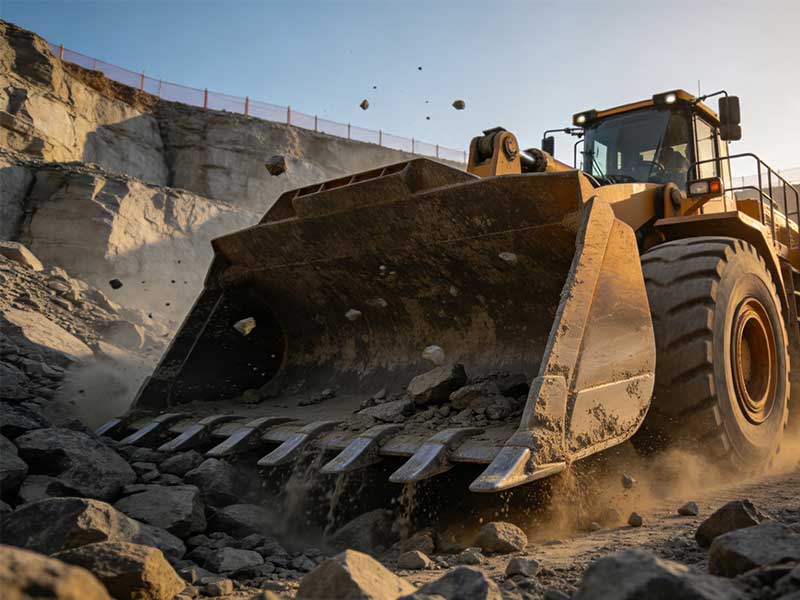
The fixing system determines the stability, maintenance efficiency and service life of skid steer bucket teeth. At present, side-pin, top-pin and weld-on systems dominate the market. Professional bucket teeth supplier will match different fixing structures according to customer working conditions to avoid tooth loss and pin damage failures:
| Fixing System Type | Structural Features | Core Advantages | Deficiencies & Applicable Scenarios |
| Side-Pin (Horizontal Pin) System | Classic industry standard structure (CAT J series mainstream); pin penetrates horizontally with rubber retainer locking; pin avoids direct material friction | Ultra-high stability; almost no tooth loss under heavy prying load; pin wear rate lower than 12% after 500 hours of operation; strong impact resistance | Limited replacement operation space; sediment and gravel easily block pin holes and increase disassembly difficulty; suitable for heavy rock duty and long-term continuous operation |
| Top-Pin (Vertical Pin) System | Vertical pin installation from the top; mainstream in ESCO style products; fully exposed top pin structure | Tool-free convenient replacement; no space limitation for narrow bucket arrangement; replacement efficiency improved by 30% compared with side-pin | Pin top is directly worn by materials; easy deformation in high-abrasion scenarios; slightly poor lateral force resistance; suitable for compact skid steer buckets and frequent maintenance scenarios |
| Weld-On System | Divided into weld-on adapter (matching pin teeth) and direct weld-on teeth; rigid welding connection with bucket blade | Zero tooth loss risk; ultra-high overall rigidity; flat bottom surface suitable for flat ground cleaning; weld-on adapter supports fast tooth replacement | Direct weld-on teeth have extremely high maintenance costs, requiring cutting and re-welding after wear; weld-on adapter repair process is complex after fracture; suitable for special flat operation scenarios and low-frequency wear working conditions |
4. Professional Selection Guide & Industry Trend Analysis
According to the 2026 global ground engaging tools market data, the annual growth rate of high-manganese steel rock / heavy duty teeth reaches 25%, which is far higher than that of standard bucket teeth. More engineering teams and bucket teeth supplier focus on high-strength wear-resistant products to reduce comprehensive operating costs.
For practical selection:
Choose rock bucket teeth if the core work involves rock prying, concrete breaking and high-abrasion material handling;
Choose tiger teeth for frozen soil and compacted soil excavation;
Select standard skid steer bucket teeth for conventional light earthwork.
In terms of fixing systems,
Side-pin systems are prioritized for heavy-duty rock working conditions,
while top-pin systems are more suitable for daily flexible maintenance,
And weld-on systems are reserved for special operation scenarios.
Excellent bucket teeth supplier will optimize tooth body material ratio and structural design according to customer working conditions, improving the overall wear resistance and impact resistance of skid steer bucket teeth, helping engineering users reduce replacement frequency, lower downtime loss, and maximize long-term economic benefits.
RELATED NEWS
- Low-Temperature Charpy Impact Testing for Off-Road Trailer Castings 2026-10-20
- Common Casting Defects in Trailer Towing Rings and How to Prevent Them 2026-10-15
- Ductile Iron vs. Carbon Steel Engineering Guide for Heavy-Duty Agricultural Trai 2026-10-13
- Heavy Duty Disc Harrow: How to Choose the Right Model? 2026-10-09
- How to choose the right lawn mower blades? 2026-09-23
CATEGORIES
LATEST NEWS
CONTACT US
Contact: Susanna Sun
Phone: +86 13706842897
E-mail: sue-sunwin@vip.163.com ; sophie091983@gmail.com
Whatsapp:+86 13706842897
Add: 1588 Jiangnan Road Ningbo High-tech Industry zone