Blog
How to Select Proper Bolt‑on Reversible Cutting Edges for Excavator & Heavy Machinery Parts
Bolt‑on Reversible Cutting Edges are critical GET Wear Parts fitted to buckets of excavators, loaders, bulldozers and motor graders. Selecting incorrect specifications will cause bolt loosening, early fracture, short service life or even bucket lip damage.
For B2B distributors, fleet managers and procurement specialists sourcing excavator parts and heavy machinery parts, selection cannot rely only on price; you need to evaluate working conditions, material‑heat‑treatment, dimensional matching, CNC machining quality and supplier capability comprehensively.
Market Reference
Global GET aftermarket research shows reversible bolt‑on cutting edges have grown 14.2% year‑over‑year, as end‑users push to cut welding labour cost and machine downtime. Over 61% of large fleet buyers prefer boron‑steel reversible edges instead of low‑cost high‑carbon‑steel alternatives for high‑abrasion rock & quarry jobsites. Working with a professional Excavator Parts Supplier helps buyers avoid quality risks from generic aftermarket parts.
Step 1: Match Material & Heat‑Treatment to Actual Working Conditions
Material grade and quenching‑and‑tempering quality determine wear resistance and anti‑shock performance of bolt‑on reversible cutting edges. Never blindly pursue maximum hardness; balance hardness and core toughness according to site material and impact load.
| Material Option | Hardness Range | Core Properties | Recommended Working Scenarios |
| High‑Carbon Steel | HRC 34‑42 | Low cost, moderate wear resistance, limited impact toughness | Light‑duty earth‑moving, loam soil, low‑impact landscaping projects |
| Boron Steel (Quenched & Tempered) | HRC 44‑52 | High hardenability, balanced surface hardness and inner toughness, resist cracking under heavy shock | Quarry, rock excavation, gravel digging, high‑abrasion heavy‑duty construction sites |
Procurement tip: Request MTR (Material Test Report) from your Excavator Parts Supplier. Qualified boron‑steel bolt‑on reversible cutting edges must achieve uniform hardness across the whole plate, not only surface spot hardening.
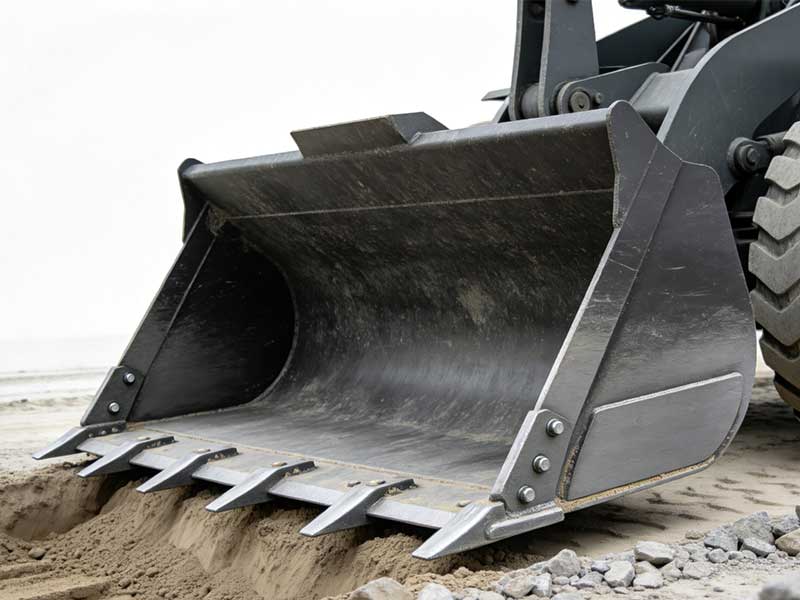
Step 2: Verify Dimensional & Installation Compatibility
Even premium‑material cutting edges will fail early if dimensions do not match bucket lip. Four key dimensions must be double‑checked before ordering:
1. Overall dimension: Length, thickness, height. Thickness directly affects impact‑bearing capacity; heavy‑duty buckets require thicker blanks.
2. Bolt hole pattern: Hole quantity, hole centre spacing, hole diameter. Tolerance drift will make plow bolts subject to shear force during vibration, leading to loose assembly or bolt breakage.
3. Counterbore / Countersink quality:
- Counterbore depth adopts positive tolerance (+0.10 mm /‑0.00 mm), ensuring plow bolt heads fully sink below plate surface without protruding.
- Require good coaxiality between base hole and counterbore; offset holes will jam square neck of plow bolts.
4. Double‑bevel symmetry: Both‑side bevel geometry must be symmetric. Asymmetric bevel cannot deliver expected performance after 180° flipping.
| Compatibility Inspection Items | Acceptable Standard | Risk If Not Met |
| Hole‑spacing tolerance | ≤ ±1.5 mm | Bolt shear, cutting edge shifting |
| Counterbore coaxiality | ≤0.8 mm | Plow bolt square neck cannot seat properly |
| Counterbore depth tolerance | +0.10 mm /‑0.00 mm | Bolt head protrudes → abrasion & shear failure |
| Double‑bevel symmetry | Bevel angle & size consistent on top & bottom | Poor digging performance after flipping |
For OEM replacement: provide OEM part number to Excavator Parts Supplier. For custom production: supply drawing or physical sample with caliper measured dimension data.
Step 3: Evaluate Manufacturing Process Quality
Bolt‑on reversible cutting edges performance depends on combined casting / forging blank quality and CNC finishing:
1. Blank quality: Blanks shall reserve proper machining allowance (1.5‑3 mm for hole features). Do not accept parts with directly‑cast finished counterbores, which easily generate stress‑concentration micro‑cracks at step corners. Fillet radius shall be added at counterbore step transition.
2. CNC machining: Piloted counterbore cutters shall be applied to guarantee coaxiality. Tool‑wear compensation is essential for mass‑production to avoid insufficient counter‑sink depth.
3. Heat‑treatment: Full quenching plus tempering instead of only surface hardening. Partial hardening causes uneven wear and brittle fracture under heavy impact.
Step 4: Total‑Cost‑of‑Ownership Analysis & Supplier Screening
Many buyers only compare unit price, ignoring downtime cost and replacement frequency. When selecting an Excavator Parts Supplier for bolt‑on reversible cutting edges and other heavy machinery parts, focus on these points:
1. Material certification & hardness test reports.
2. In‑house CNC workshop capability for counterbore & hole‑pattern machining.
3. OEM & custom drawing processing support.
4. Sample testing support before bulk order.
5. After‑sales support for fit‑up problem solving.
Boron‑steel bolt‑on reversible cutting edges carry higher upfront cost, yet double service life and less downtime often bring lower total operating cost for high‑utilization fleets. For light‑duty low‑abrasion jobs, high‑carbon‑steel version is the cost‑effective alternative.
Common Mistakes To Avoid
1. Over‑pursuing ultra‑high hardness without toughness consideration: Excessively high hardness will lead to edge chipping under rock impact.
2. Ignoring counterbore depth and coaxiality: Perfect material cannot compensate bad machining; protruding bolt heads will be quickly worn off.
3. Buying asymmetric‑bevel reversible edges: After flipping, cutting performance drops sharply.
4. Using mismatched plow bolts: Must adopt matched high‑strength plow bolts; ordinary bolts will shear under heavy vibration.
Lihuacasting supplies OEM & custom bolt‑on reversible cutting edges compatible with mainstream excavator, loader and bulldozer bucket models. We provide full material test reports, precise CNC counterbore machining and sample validation for global wholesalers, rental firms and maintenance contractors. Contact us for drawing review and quotation.
RELATED NEWS
- How to Overcome Tool Wear Challenges When Machining High-Hardness Iron Castings? 2026-10-23
- Low-Temperature Charpy Impact Testing for Off-Road Trailer Castings 2026-10-20
- Common Casting Defects in Trailer Towing Rings and How to Prevent Them 2026-10-15
- Ductile Iron vs. Carbon Steel Engineering Guide for Heavy-Duty Agricultural Trai 2026-10-13
- Heavy Duty Disc Harrow: How to Choose the Right Model? 2026-10-09
CATEGORIES
LATEST NEWS
CONTACT US
Contact: Susanna Sun
Phone: +86 13706842897
E-mail: sue-sunwin@vip.163.com ; sophie091983@gmail.com
Whatsapp:+86 13706842897
Add: 1588 Jiangnan Road Ningbo High-tech Industry zone