Blog
Casting Materials Guide for Heavy‑Duty & Agricultural Machinery Parts
Introduction
The global ground‑engaging tools (GET) market reached USD 5.8 billion in 2024, projected to expand at a 6.0% CAGR through 2033, driven by construction, mining and agricultural equipment aftermarket demand. Bucket teeth alone capture over 35% of total GET replacement volume, as Wear Parts require frequent site‑side replacement across North American and European job‑sites.
For B2B importers, distributors and wholesale buyers, many sourcing failures stem not from part dimension errors, but from incorrect casting materials matching operating failure modes. Too‑hard bucket teeth crack under rock impact; overly‑soft adapters deform under cyclic load; mis‑specified ductile iron raises total‑cost‑of‑ownership (TCO) despite low unit price.
This article delivers actionable technical guidance for your RFQ process: how to select casting materials according to real‑world failure modes, compare key casting alloys, specify bucket teeth‑adapter performance thresholds, and write enforceable technical requirements for overseas foundry suppliers.
Core Principle: Select casting materials based on the dominant component failure mode.
Prefer cast steel when impact loading and structural strength dominate service conditions.
Prefer ductile iron for vibration dampening, compression‑wear scenarios and cost‑sensitive projects.
1. Main Casting Materials for Heavy‑Duty & Agricultural Equipment
Four major casting material families dominate heavy machinery and agricultural equipment castings: ductile iron, cast steel, gray iron and non‑ferrous castings. Table 1 summarizes core mechanical performance, reference standards and typical component applications.
Table 1: Key Casting Materials Comparison for Construction & Agricultural Machinery
| Material Category | Representative Grade | Key Mechanical Features | Applicable International Standard | Typical Parts |
| Ductile Iron (Nodular Iron) | QT450‑10 (65‑45‑12), QT600‑3 | High tensile strength, good elongation, balanced toughness‑cost | ISO 1083, ASTM A536 | Plow components, differential housing, crankshafts, brackets, transmission housings |
| Carbon & Low‑Alloy Cast Steel | ZGMn13 (High‑Manganese Steel), low‑alloy quenched‑tempered cast steel | Ultra‑high impact toughness, good weldability, work‑hardening capacity for Mn‑steel | ISO 3755, ASTM A148, ASTM A128 | Bucket teeth, adapters, frame structures, crusher jaws, track shoes |
| Gray Cast Iron | HT200‑HT300 | Excellent vibration damping, high compression strength, low ductility | ISO 1561, ASTM A48 | Machine bases, pump housings, gearbox casings (gradually replaced by ductile iron) |
| Non‑Ferrous Castings (Cu / Al Alloy) | Bronze casting, cast aluminum alloy | Anti‑friction property or lightweight & thermal conductivity | ISO casting alloy series | Bushes, worm gears, engine pistons, lightweight housing parts |
1.1 Ductile Iron – Workhorse for Agricultural Equipment Castings
Spherical graphite inside ductile iron minimizes matrix disruption, delivering far better plasticity and impact performance compared to gray cast iron.
QT450‑10 / ASTM 65‑45‑12: Tensile strength ≥ 450 MPa, elongation ≥ 10 %. Ideal for plow legs, brackets subjected to bending and moderate shock loads.
QT600‑3 / ASTM 80‑55‑06: Tensile strength ≥ 600 MPa, elongation ≥ 3 %. Suited for crankshafts, connecting rods under heavy cyclic loading.
Procurement Note: Ductile iron delivers outstanding cost‑performance. Where service requirements permit, substituting cast steel with qualified ductile iron can cut component procurement cost significantly without sacrificing core service life.
1.2 Cast Steel – High‑Impact Structural Backbone
Cast steel contains less than 2.11 % carbon, offering top‑tier impact toughness among common casting alloys plus favorable weld repair capability for large assemblies.
Carbon cast steel: Heavy static‑load structures such as mill housings and base frames.
Low‑alloy cast steel: Minor Mn‑Cr‑Mo additions; optimized via quenching‑and‑tempering for critical load‑bearing components.
High‑manganese steel ZGMn13: Unique work‑hardening behaviour. Soft initial austenitic surface rapidly hardens under heavy impact abrasion, while interior retains high toughness. Classic for bucket teeth, crusher jaw plates and track shoes.
Critical specification: Water‑quenching (water‑toughening) heat‑treatment is mandatory. As‑cast high‑manganese steel remains brittle and will fracture prematurely.
Procurement Note: Cast steel involves more complex gating, pouring and welding workflows, driving higher unit cost. Specify cast steel only when cast‑iron grades cannot meet impact‑toughness targets.
1.3 Gray Cast Iron – Economical Vibration‑Damping Material
Flake graphite grants excellent vibration‑damping capacity (5‑10 × steel), good sliding‑wear resistance, yet low tensile strength and near‑zero ductility. Mainly deployed for static compression‑loaded housings and machine bases. In modern agricultural and heavy‑duty machinery, many traditional gray‑iron components are upgraded to ductile iron for improved reliability.
1.4 Non‑Ferrous Castings – Special‑Condition Supplement
Copper‑base casting alloys: Anti‑friction, corrosion‑resistant for bushings, wear sleeves and worm wheels.
Aluminum casting alloys: Low density and high thermal conductivity for engine pistons and lightweight casings.
2. B2B Buyer’s Four‑Step Casting‑Material Sourcing Strategy
Smart wholesale procurement focuses on total‑cost‑of‑ownership (TCO), not unit price alone. Follow these four steps in your RFQ workflow for casting parts including bucket teeth and agricultural equipment castings.
Step 1: Define Dominant Failure Modes
Clarify how components actually fail on‑site before reviewing quotations:
Impact fracture / heavy static load: Prioritize cast steel (high‑manganese steel for impact‑abrasion combined conditions).
Abrasive wear (sand, rock scratching): High‑chromium white cast iron or high‑manganese steel. High‑chromium offers superior wear resistance yet low toughness; manganese steel balances toughness plus work‑hardening performance.
Vibration damping & complex housing parts: Gray iron or ductile iron.
Step 2: Lock‑In International Standards in RFQ Documents
Avoid quoting only OEM part‑numbers. Write explicit material‑standard requirements inside request‑for‑quotation sheets and demand mechanical‑test reports (tensile, hardness, Charpy impact energy):
Ductile iron: ISO 1083 / ASTM A536, example grade “65‑45‑12”.
General cast steel: ISO 3755 / ASTM A148.
High‑manganese wear steel: Mandatory ASTM A128 specification.
Reference GB/T 43415‑2023 Heavy‑Duty Machinery‑Casting Design Requirements for systematic material‑selection guidance for Chinese‑origin foundry suppliers.
Step 3: Audit Heat‑Treatment & Non‑Destructive‑Testing (NDT) – Hidden Cost Driver
Identical casting material grades can deliver multiple‑fold service‑life gaps controlled purely by heat‑treatment parameters.
Require suppliers to submit heat‑treatment time‑temperature curves.
Require NDT documentation: Ultrasonic Testing (UT) for internal shrinkage / porosity defects; Magnetic‑Particle Inspection (MPI) for surface crack detection.
For ZGMn13 manganese steel bucket teeth: Insist on metallurgical reports confirming fully austenitic microstructure after water‑toughening. Without correct microstructure, work‑hardening wear performance vanishes.
Step 4: Optimize Technical Communication Channels
General B2B platforms work for initial vendor screening. For complex casting components such as custom bucket teeth and agricultural equipment castings, leverage manufacturing‑specialized platforms for CAD drawing review, design‑for‑manufacturability feedback and material‑grade consultation to reduce downstream re‑work risk.
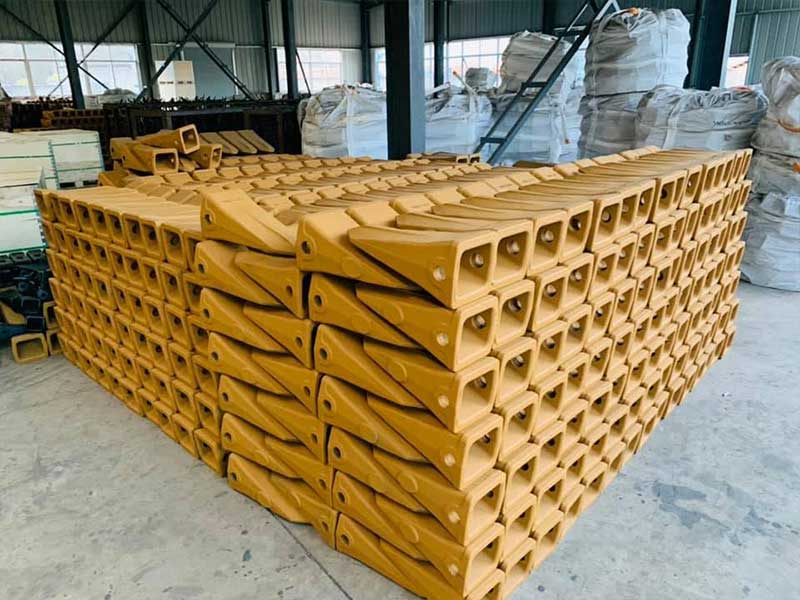
3. Bucket Teeth & Adapter Material Selection: Hardness vs Toughness Trade‑Off
Bucket teeth and adapters (tooth holders) serve completely different mechanical functions, even assembled as one GET unit. Many wholesale buyers make the mistake of applying identical casting‑material specifications for both parts.
Bucket tooth: Direct contact with rock, soil and sand. Subjected to abrasive wear plus repeated impact shock. Core conflict: higher hardness improves wear resistance but elevates brittle‑fracture risk.
Adapter / Tooth holder: Welded onto excavator bucket body; transfers impact force. Main failure modes are pin‑hole deformation and fracture; direct abrasive wear is secondary. Must maintain excellent weldability.
Table 2: Bucket Tooth Performance Reference for Different Working Conditions
| Hardness Range HRC | ASTM G65 Abrasion‑Loss Volume | Charpy Impact Energy | Recommended Application Scenarios |
| 46‑48 | Moderate material loss | ≥ 25 J | High‑impact rock excavation, demolition sites |
| 50‑52 | Low wear‑loss volume | ~ 17‑22 J | Sand, clay and moderate‑abrasion earth‑moving |
| 55 | Minimum abrasion loss | ~ 14 J | Not recommended: Excessive fracture risk, diminishing return on service‑life improvement |
3.1 Bucket Tooth: Material Options
High‑Manganese Steel (ZGMn13 / Mn13Cr2)
First‑choice for rock‑mining heavy‑impact conditions. Water‑toughened austenitic microstructure starts at ~200 HB surface hardness, work‑hardens up to HRC 50+ under repeated blows.
Require water‑toughening process certification plus metallurgical inspection reports. Mn13Cr2 and ZGMn13‑Mo further enhance yield strength and suppress casting shrinkage porosity for oversized bucket teeth.
Low‑Alloy Wear‑Resistant Cast Steel
For medium‑to‑low‑impact earth‑moving sites (clay, sand). Tiered grades (T1 / T2 / T3) are widely adopted across wholesale GET supply chains. Typical target performance: HRC 48‑52 hardness; minimum impact value ≥ 17 J. T2 intermediate grade strikes balanced TCO for general‑purpose fleets.
Sourcing Tip: Always communicate exact site conditions to your casting foundry. For rock‑mining applications, prioritize ≥ 25 J Charpy impact energy even if you compromise slightly on surface hardness. For soft‑soil projects, specify HRC 50‑52 to extend wear‑service interval.
3.2 Adapter / Tooth‑Holder: High‑Toughness & Weldability Requirements
Adapters apply low‑carbon low‑alloy cast steel (carbon content generally below 0.3 %). Typical chemistry window: C 0.28‑0.32 %, Mn 1.40‑1.70 %, Si 1.30‑1.60 %, Cr 1.45‑1.85 %, Mo 0.15‑0.25 %. Quench‑and‑temper heat‑treatment produces low‑carbon martensite matrix balancing strength, toughness and weld compatibility.
Target performance benchmark for qualified adapters:
Hardness HRC 34‑38 (intentionally lower than bucket‑tooth hardness)
Charpy impact energy ≥ 25 J, resisting shock transmitted from bucket teeth without brittle cracking.
Small‑part critical note: Retainer pin / locking clip
Locking hardware prevents bucket‑tooth dislodgement on‑site. Premium suppliers deploy 65Mn or 60Si2Mn spring steel for retainer clips, greatly outperforming low‑grade carbon steel or polyurethane alternatives. In your wholesale RFQ, explicitly ask for retainer‑clip material specification and spare‑part quantity included per set. Small components are frequent sources of premature field failure.
4. Practical Procurement Checklist for B2B Wholesale Buyers
Use this checklist when drafting RFQ documents for excavator GET and agricultural equipment castings:
Table 3: B2B Cast‑Part RFQ Action Checklist
| Item | Required Procurement Action |
| Working‑Condition Documentation | Describe job‑site environment (granite mine / clay earth‑moving / farm tillage). Request tiered material‑grade options (T1 / T2 / T3) with guaranteed hardness & impact‑energy values |
| Standard Specification Reference | List applicable ISO / ASTM standards: ASTM A128 for manganese‑steel bucket teeth; ASTM A536 for ductile‑iron agricultural castings |
| Heat‑Treatment Proof | Demand water‑toughening reports plus austenite metallurgical inspection for high‑Mn steel bucket teeth; quench‑temper curve documentation for adapters |
| NDT & Quality Records | Request UT / MPI non‑destructive‑test reports to rule out internal shrinkage and surface cracks |
| Auxiliary Wear‑Kit Parts | Confirm retainer‑pin / clip material grade and spare‑parts quantity supplied with each adapter set |
Conclusion
Casting‑materials selection for heavy‑duty and agricultural machinery parts is never about picking “the hardest material”. Successful wholesale sourcing matches alloy grades to real‑world component failure modes: cast steel for high‑impact structural loading; ductile iron for balanced cost‑performance in agricultural equipment castings.
For bucket‑tooth and adapter packages, separate material‑performance thresholds must be enforced: bucket teeth balance wear‑hardness against anti‑fracture toughness, while adapters prioritize impact‑toughness and welding compatibility. Always embed international standards, heat‑treatment and NDT requirements within RFQ documentation to control total‑cost‑of‑ownership beyond simple piece‑price comparison.
Lihuacasting delivers OEM and wholesale custom casting solutions for ground‑engaging tools and agricultural equipment castings. If you require technical support for your bucket‑teeth project or material‑grade consultation for large‑volume procurement, contact our engineering team today.
RELATED NEWS
- How to Overcome Tool Wear Challenges When Machining High-Hardness Iron Castings? 2026-10-23
- Low-Temperature Charpy Impact Testing for Off-Road Trailer Castings 2026-10-20
- Common Casting Defects in Trailer Towing Rings and How to Prevent Them 2026-10-15
- Ductile Iron vs. Carbon Steel Engineering Guide for Heavy-Duty Agricultural Trai 2026-10-13
- Heavy Duty Disc Harrow: How to Choose the Right Model? 2026-10-09
CATEGORIES
LATEST NEWS
CONTACT US
Contact: Susanna Sun
Phone: +86 13706842897
E-mail: sue-sunwin@vip.163.com ; sophie091983@gmail.com
Whatsapp:+86 13706842897
Add: 1588 Jiangnan Road Ningbo High-tech Industry zone